
Rohit Sharma’s journey from a talented young cricketer in Mumbai to one of India’s greatest modern batters is a story of determination, reinvention, extraordinary records, and championship-winning leadership. Known worldwide as the Hitman, Rohit transformed himself from an inconsistent middle-order prospect into an iconic opening batter who helped shape modern Indian cricket.
Few Indian cricketers have experienced such a remarkable career transformation. From struggling to establish a permanent place in India’s batting lineup to becoming the only player with three ODI double centuries, Rohit’s rise demonstrates how talent, opportunity, and persistence can combine to create sporting greatness.
His achievements extend far beyond individual statistics. Five IPL titles as Mumbai Indians captain, the 2024 ICC Men’s T20 World Cup triumph, and the 2025 ICC Champions Trophy victory have established his reputation as a successful leader.
But how did a young boy who learned cricket in Mumbai become one of the most recognizable figures in international cricket? What changed his career in 2013? And why does his legacy extend beyond runs and trophies?
This detailed Rohit Sharma biography explores his early life, international breakthrough, batting records, captaincy achievements, career statistics, and lasting influence on Indian cricket.
Rohit Sharma’s Early Life: From Nagpur to the Cricket Grounds of Mumbai
Rohit Gurunath Sharma was born on April 30, 1987, in Nagpur, Maharashtra. Although Nagpur was his birthplace, Mumbai played the defining role in his cricketing development.
Growing up in a family with limited financial resources, Rohit spent much of his childhood living with his grandparents and other relatives. His journey into organized cricket began through a coaching camp, where his natural ability attracted attention.
Coach Dinesh Lad recognized his potential and encouraged him to join a school offering better cricket facilities. Rohit eventually developed his skills at Swami Vivekanand International School in Mumbai.
Interestingly, Rohit initially attracted attention as an off-spin bowler. However, his coach soon recognized that his greatest potential lay in batting.
As his technique improved, Rohit began producing impressive performances in school competitions. His timing, balance, and ability to find gaps made him stand out among young Mumbai cricketers.
Mumbai’s demanding cricket environment also taught him an important lesson: talent alone was insufficient. Consistency and discipline were essential to progress.
Domestic Cricket: The First Major Step Toward International Recognition
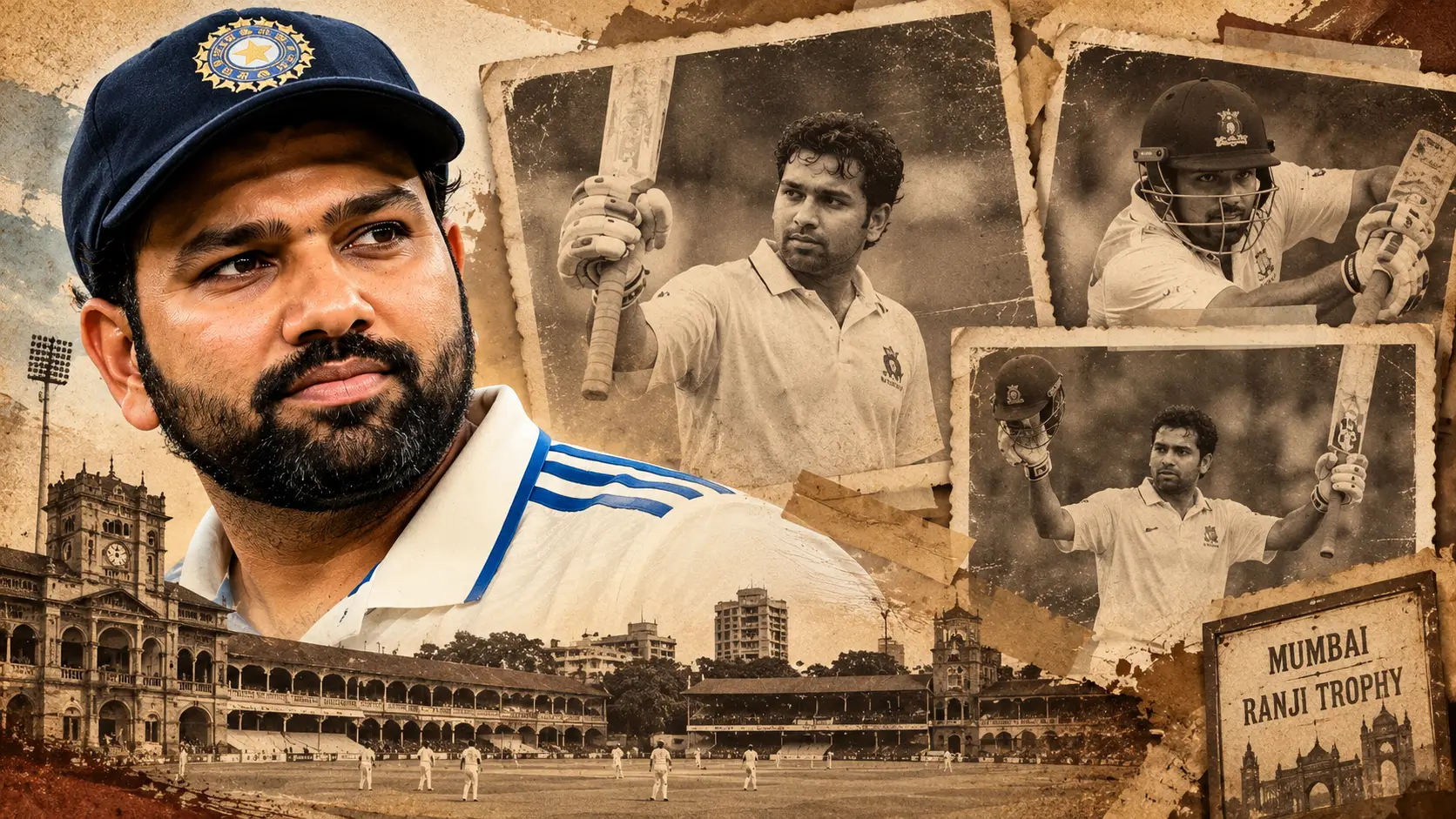
Before representing India, Rohit Sharma had to prove himself through domestic cricket.
His breakthrough arrived in 2006 when he scored an unbeaten 142 against North Zone in the Deodhar Trophy. That innings highlighted his ability to construct a substantial score while playing attacking cricket.
He subsequently represented India A and Mumbai, gaining experience against increasingly competitive opposition.
Mumbai’s domestic cricket system has historically produced technically accomplished batters, and Rohit developed within that environment.
His domestic performances attracted national selectors, who recognized his elegant strokeplay and potential to become a long-term international player.
However, earning an India cap would prove easier than immediately establishing himself as a regular member of the national team.
Rohit Sharma’s International Debut in 2007: A Promising Beginning
Rohit made his ODI debut against Ireland on June 23, 2007, at just 20 years old.
He also made his T20 international debut in September 2007 during the inaugural ICC Men’s T20 World Cup.
The tournament became an important early milestone. Rohit scored a valuable half-century against South Africa and contributed to India’s title-winning campaign under MS Dhoni.
His performances demonstrated confidence and composure against international bowling attacks. Yet his early international career remained unpredictable.
Despite possessing exceptional batting ability, Rohit struggled to convert promising starts into consistent match-winning performances.
He frequently moved between batting positions, making it difficult to establish a settled role.
His omission from India’s victorious 2011 ODI World Cup squad became one of the biggest disappointments of his career.
Rather than defining his future, that setback became part of the journey that eventually transformed him into an international superstar.
The 2013 Turning Point: How MS Dhoni Changed Rohit Sharma’s Career
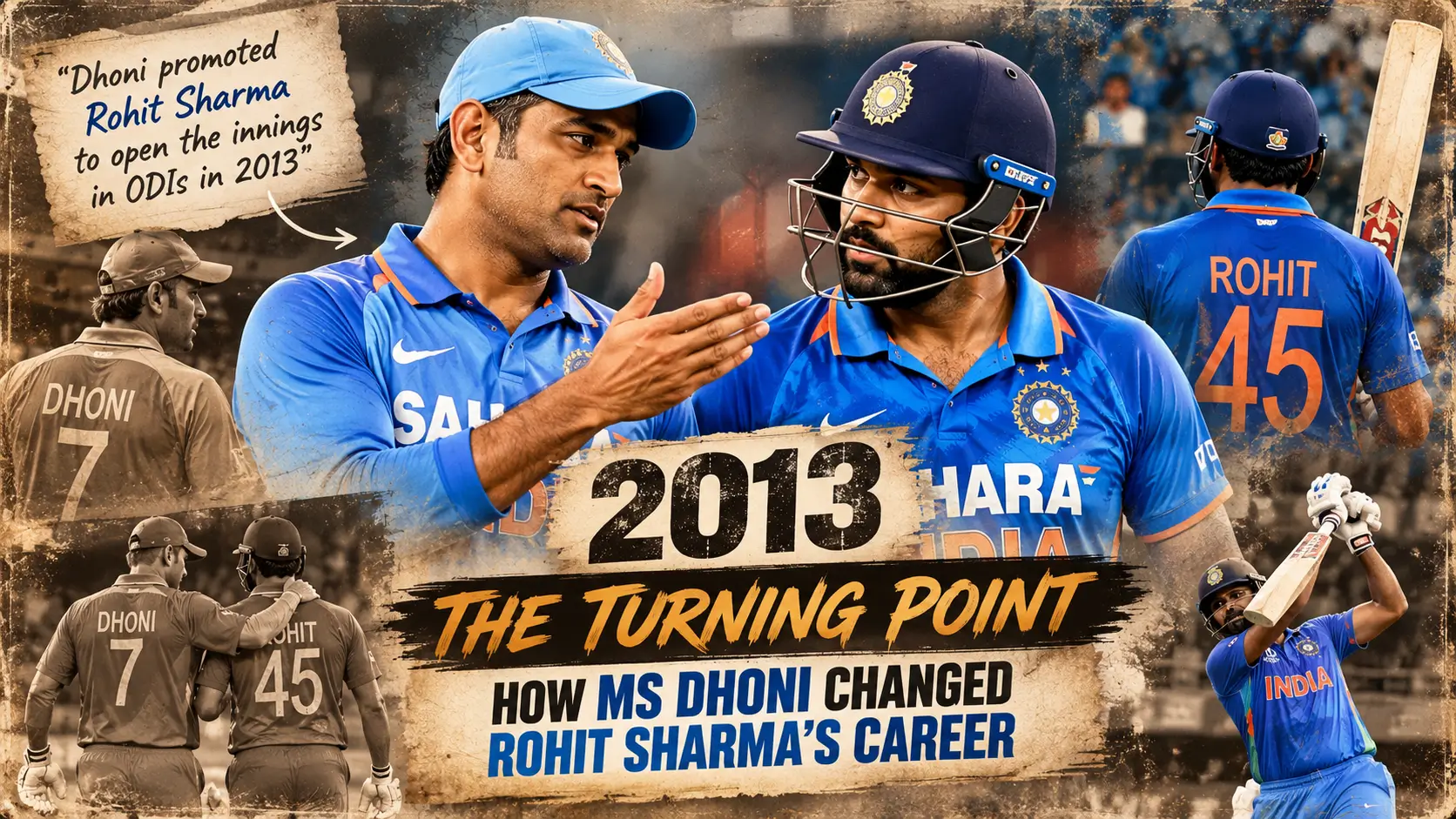
Perhaps the most important decision in Rohit Sharma’s international career came when MS Dhoni backed him as an opening batter in ODI cricket.
Until then, Rohit had largely played in the middle order, where his performances had been inconsistent. Opening the innings gave him greater time to settle, assess conditions, and construct significant scores.
The change became especially important during the 2013 ICC Champions Trophy. Rohit partnered Shikhar Dhawan at the top of India’s batting order, creating a combination that would remain influential for years.
Dhawan frequently attacked early, while Rohit could establish his rhythm before accelerating. The partnership offered India a combination of stability and aggressive run-scoring.
This memorable partnership continues to attract interest among cricket enthusiasts, including readers exploring cricket news, match analysis, and online services related to Betting ID in India. Rohit and Dhawan’s success demonstrated how strategic decisions and effective partnerships can transform a team’s batting performance.
India won the 2013 Champions Trophy, and Rohit’s transformation had begun.
Rohit Sharma Career Statistics: Test, ODI and T20I Records
Rohit’s career numbers demonstrate why he is regarded as one of the outstanding white-ball batters of his generation.
| Format | Matches | Runs | Average | 100s | Highest |
|---|---|---|---|---|---|
| Tests | 67 | 4,301 | 40.58 | 12 | 212 |
| ODIs | 290 | 12,028 | 49.09 | 35 | 264 |
| T20Is | 159 | 4,231 | 32.05 | 5 | 121* |
| Total | 516 | 20,560 | — | 52 | — |
Statistics are a reported October 2026 snapshot and should be checked against the latest ODI records before publication. International total is the sum of the format figures shown.
Bar lengths are proportional to the highest format total.
ODI cricket accounts for the largest share of Rohit’s international runs. His near-50 batting average across a lengthy ODI career reflects his ability to combine consistency with major innings.
His Test career followed a different trajectory, featuring periods of uncertainty and impressive performances after his promotion to opening the batting.
Meanwhile, his T20I numbers highlight his importance to India’s aggressive approach in the shortest international format.
Rohit Sharma’s Three ODI Double Centuries: A Record That Defines His Greatness
One of Rohit Sharma’s most extraordinary achievements is his record of scoring three double centuries in ODI cricket.
No other batter has matched that feat.
| Year | Score | Opposition | Venue |
|---|---|---|---|
| 2013 | 209 | Australia | Bengaluru |
| 2014 | 264 | Sri Lanka | Kolkata |
| 2017 | 208* | Sri Lanka | Mohali |
The Unforgettable 264 Against Sri Lanka
On November 13, 2014, at Eden Gardens, Kolkata, Rohit produced one of the most astonishing innings in cricket history.
He scored 264 from 173 deliveries, including 33 fours and nine sixes.
The innings remains the highest individual score in men’s ODI cricket.
What made the performance remarkable was the combination of patience and acceleration. Rohit initially built his innings before launching a sustained attack that overwhelmed Sri Lanka’s bowlers.
The score demonstrated his unique ability to transform a century into a truly enormous individual total.
His three double centuries are not simply records of aggressive hitting. They also reflect concentration, fitness, game awareness, and the capacity to bat for extended periods.
The 2019 Cricket World Cup: Rohit Sharma’s Greatest Batting Tournament?
The 2019 ICC Cricket World Cup in England marked another defining chapter.
Rohit scored 648 runs in nine matches, finishing as the tournament’s leading run-scorer.
Even more remarkably, he scored five centuries in a single World Cup edition, establishing a tournament record.
His centuries came against South Africa, Pakistan, England, Bangladesh, and Sri Lanka.
The 140 against Pakistan was particularly memorable because of the intensity surrounding the rivalry.
His unbeaten century against South Africa, meanwhile, demonstrated a different quality: the patience required to chase a challenging target in difficult batting conditions.
Although India lost to New Zealand in the semifinal, Rohit’s individual performances were among the tournament’s major highlights.
The five-century record reinforced his standing as one of ODI cricket’s most accomplished tournament batters.
Rohit Sharma’s Test Cricket Journey: From Uncertainty to Opening Success
Rohit’s Test career began spectacularly in November 2013 when he scored 177 against the West Indies on debut at Eden Gardens.
However, his subsequent Test performances were inconsistent, particularly outside India.
He struggled to establish himself permanently in the middle order despite showing occasional flashes of brilliance.
A major change arrived in 2019 when India promoted him to open in Test cricket.
The move produced immediate results, including twin centuries against South Africa at Visakhapatnam and a maiden Test double century of 212 at Ranchi.
Opening in Tests demanded a different approach from his white-ball role.
Rohit needed to leave deliveries outside off stump, negotiate the new ball, and manage longer periods of defensive batting.
His improvement demonstrated that even established international players can successfully reinvent their techniques.
He eventually finished his Test career with 4,301 runs and 12 centuries, retiring from the format in May 2025.
Although his Test achievements do not match the scale of his ODI records, his successful transition to opening remains an important part of his career story.
Rohit Sharma as Mumbai Indians Captain: Building an IPL Dynasty
Rohit Sharma’s IPL career has been equally significant in establishing his reputation as a successful leader.
He began his IPL journey with Deccan Chargers in 2008 and was part of their title-winning team in 2009.
Mumbai Indians signed him in 2011, beginning a long association with the franchise.
When Rohit took over the captaincy in 2013, Mumbai Indians entered a remarkable period of success.
Under his leadership, the franchise won five IPL titles.
| IPL Season | Mumbai Indians’ Achievement |
|---|---|
| 2013 | Champions |
| 2015 | Champions |
| 2017 | Champions |
| 2019 | Champions |
| 2020 | Champions |
These victories established Mumbai Indians as one of the most successful franchises in IPL history.
Rohit’s captaincy was characterized by tactical flexibility, confidence in younger players, and the ability to manage high-pressure situations.
His leadership also benefited from strong team combinations featuring players such as Jasprit Bumrah, Kieron Pollard, Lasith Malinga, and Hardik Pandya.
Importantly, his influence extended beyond personal batting performances. He helped create an environment in which several emerging players developed into established international cricketers.
Rohit Sharma’s Captaincy: From the 2023 World Cup Heartbreak to ICC Glory
Rohit Sharma’s journey as India captain featured some of the most emotional moments in modern Indian cricket.
The 2023 ODI World Cup: Dominance Without the Trophy
During the 2023 ODI World Cup, India played an aggressive and entertaining brand of cricket.
Rohit frequently attacked bowlers during the powerplay, giving India’s middle order opportunities to build on rapid starts.
India won ten consecutive matches before losing to Australia in the final in Ahmedabad.
The defeat was heartbreaking, especially after such a dominant tournament.
Nevertheless, Rohit’s approach helped establish a more attacking identity for India’s ODI batting lineup.
The 2024 T20 World Cup: Ending India’s ICC Trophy Drought
The following year, Rohit led India to victory in the 2024 ICC Men’s T20 World Cup.
India defeated South Africa in a thrilling final in Barbados, ending an 11-year wait for a senior men’s ICC title.
Rohit played an important role throughout the tournament, particularly with aggressive innings against Australia and England.
Following the victory, he announced his retirement from T20 internationals.
It was a fitting conclusion to a T20I career that had begun with India’s title-winning campaign in 2007.
The 2025 Champions Trophy: Another Defining Captaincy Achievement
In March 2025, Rohit guided India to another major ICC triumph.
India defeated New Zealand by four wickets in the Champions Trophy final in Dubai.
Rohit scored 76 from 83 deliveries and received the Player of the Match award.
His performance demonstrated the value of experience in a high-pressure final.
Winning the Champions Trophy also reinforced his standing as a captain capable of delivering results in major international tournaments.
What Makes Rohit Sharma’s Batting Style So Special?
Rohit’s batting is admired for its timing, balance, and apparently effortless strokeplay.
Unlike batters who rely primarily on physical strength, Rohit often generates power through precise positioning and exceptional bat speed.
His pull shot is especially recognizable. Even deliveries that are not particularly short can disappear over the boundary when he gets into position early.
Another defining feature is his ability to accelerate after settling at the crease.
In ODI cricket, this has allowed him to convert ordinary starts into massive centuries.
His strengths include reading length early, playing spin confidently, controlling the pace of an innings, and clearing boundaries without sacrificing balance.
However, his career has also featured challenges against high-quality seam bowling, particularly during periods when deliveries moved away from him early in an innings.
The evolution of his batting technique, especially after becoming a Test opener, reflects his willingness to adapt.
Rohit Sharma’s Legacy: Why the Hitman Will Inspire Future Generations
Rohit’s influence cannot be measured solely through centuries and championship trophies.
His journey offers several lessons for young cricketers.
First, early struggles do not necessarily determine the direction of a player’s career. Rohit needed several years to become a consistent international performer.
Second, finding the right role can transform a career. His promotion to opening in 2013 was the turning point that unlocked his full batting potential.
Third, leadership requires more than individual brilliance. His success with Mumbai Indians and India reflected team management, tactical decisions, and trust in teammates.
Finally, his career demonstrates the importance of adapting to different formats and changing expectations.
With his T20I and Test careers completed, his ODI performances remain an important part of his continuing cricket story.
His records will eventually be challenged, but the scale of his transformation from an uncertain middle-order prospect into a champion opening batter will remain memorable.
Frequently Asked Questions About Rohit Sharma
1. Where was Rohit Sharma born?
Rohit Sharma was born on April 30, 1987, in Nagpur, Maharashtra. He grew up in Mumbai, where he developed his cricketing skills.
2. Who was Rohit Sharma’s childhood cricket coach?
Dinesh Lad played a crucial role in identifying Rohit’s talent and helping him develop as a young cricketer.
3. How many ODI double centuries has Rohit Sharma scored?
Rohit Sharma has scored three ODI double centuries: 209 against Australia, 264 against Sri Lanka, and 208 not out against Sri Lanka.
4. What is Rohit Sharma’s highest ODI score?
His highest ODI score is 264 against Sri Lanka at Eden Gardens in Kolkata in 2014. It remains the highest individual score in men’s ODI cricket.
5. How many IPL titles has Rohit Sharma won as captain?
Rohit Sharma captained Mumbai Indians to five IPL titles, winning in 2013, 2015, 2017, 2019, and 2020.
6. Has Rohit Sharma retired from international cricket?
Rohit retired from T20 internationals in June 2024 and Test cricket in May 2025. As of October 2026, he continues to play ODI cricket.
7. Why is Rohit Sharma called the Hitman?
Rohit earned the nickname Hitman because of his powerful strokeplay, effortless six-hitting ability, and reputation for scoring exceptionally large innings.
Conclusion: From Mumbai’s Cricket Grounds to Indian Cricket Immortality
Rohit Sharma’s remarkable journey is one of the most inspiring stories in modern Indian cricket.
From his early days in Mumbai to the international stage, he has experienced disappointment, reinvention, record-breaking performances, and championship success.
His three ODI double centuries, five centuries at the 2019 World Cup, five IPL titles as captain, and leadership in India’s 2024 T20 World Cup and 2025 Champions Trophy victories represent an extraordinary collection of achievements.
Yet perhaps his greatest accomplishment is proving that a difficult beginning does not prevent an exceptional career.
Rohit Sharma will be remembered not just as the Hitman who dominated bowling attacks, but as a cricketer who helped redefine India’s approach to batting and leadership.
His story is a reminder that greatness is not always immediate. Sometimes, it takes years of persistence, the right opportunity, and the courage to evolve.