
PRE-MATCH PREVIEW | 26 OCTOBER 2026
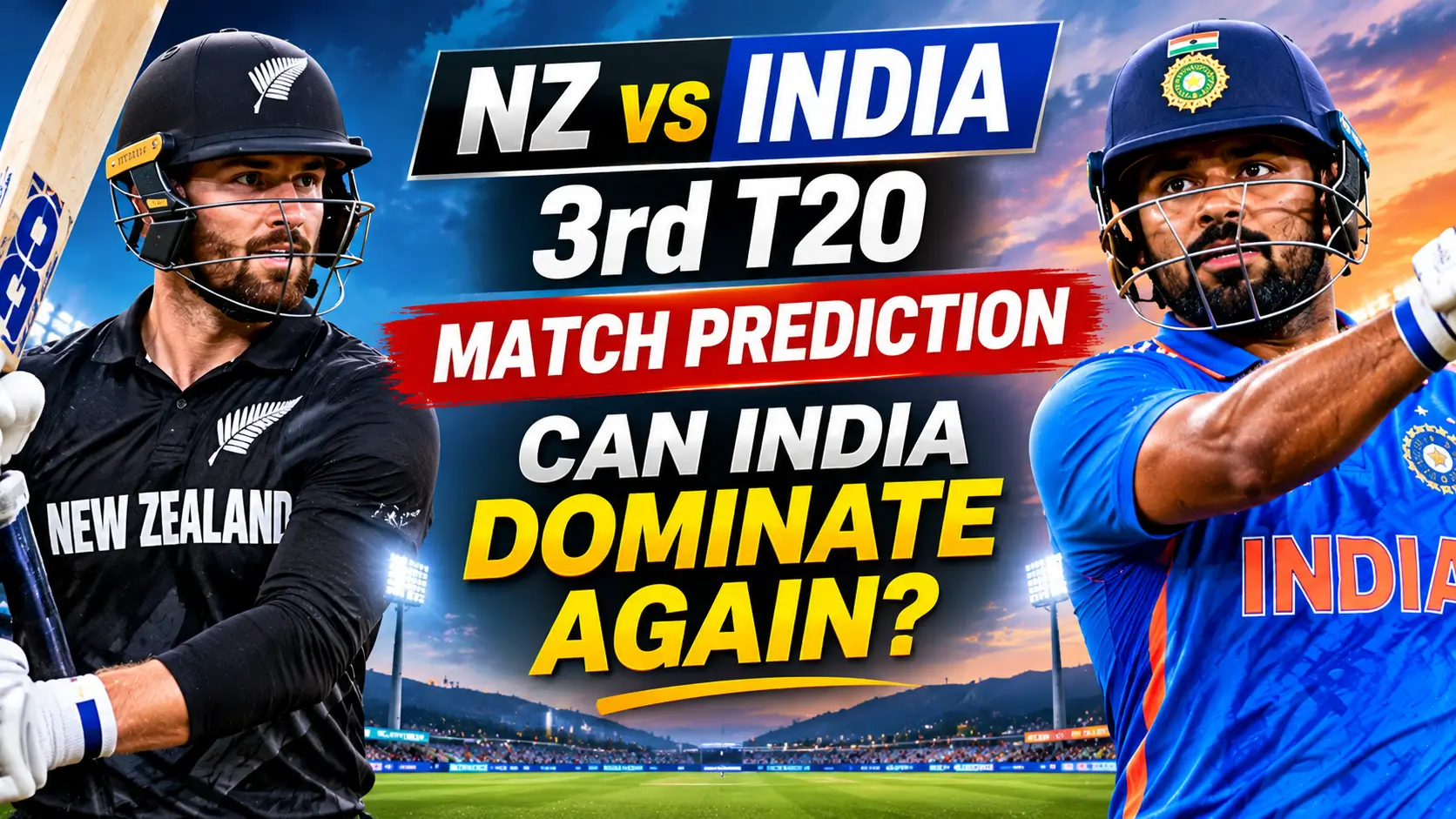
The NZ vs India 3rd T20 Match Prediction comes at a crucial moment in the five-match series. India have won both games in Christchurch, but neither victory was straightforward. Their batting depth helped them chase 226 in the opener and 181 in the second match, while New Zealand repeatedly put the visitors under pressure. The action moves to Wellington on 27 October, where India can clinch the series and New Zealand must win to keep their hopes alive. Captain Shreyas Iyer’s side has momentum, but Mitchell Santner’s team has enough pace, spin and batting power to challenge again. This preview looks at confirmed results, team news, pitch considerations, player matchups and the scenarios that could decide the third T20I. The prediction is based on current form, not a claim about a match that has yet to be played.
- India lead the five-match series 2–0.
- The third T20I takes place on 27 October in Wellington at 12:30 PM IST.
- Both earlier games ended in four-wicket wins for India.
- New Zealand must win to keep the series alive.
- India are the cautious pre-match pick, not a guaranteed winner.
| Match detail | Confirmed information |
|---|---|
| Fixture | New Zealand vs India, 3rd T20I |
| Date | 27 October 2026 |
| Venue | Hnry Stadium, Wellington |
| Start | 8:00 PM local / 12:30 PM IST |
| Series status | India lead 2–0 |
| Captains | Mitchell Santner / Shreyas Iyer |
Why the Third T20I Matters More Than the Scoreline
The third T20I is the first match in the series that India can use to clinch the trophy. Two wins have created a useful cushion, but the scorelines do not tell the story of easy dominance. Both games went deep, both were decided by four wickets, and both gave New Zealand opportunities to change the result. That is why the question of whether India can dominate again needs a careful answer rather than an assumption based on the standings.
The visitors have shown impressive batting depth and the ability to recover from sudden collapses. New Zealand, meanwhile, have repeatedly created strong positions with the ball. Their challenge has been sustaining that advantage until the final delivery. Wellington offers another opportunity to improve their execution under pressure.
A series lead can change tactics. India may feel freer to attack at key moments, but they must avoid treating the remaining fixtures as formalities. New Zealand have no room for another defeat if they want to win the five-match contest. That urgency could influence bowling changes, field placements and batting tempo.
The most useful pre-match question is not simply which side has won twice. It is which side can win the crucial passages that have swung the first two games: the powerplay, the overs immediately after a wicket, and the last four overs of a chase.
What Happened in the First Two T20Is?
India’s opening win in Christchurch was built around an ambitious chase. New Zealand reached 225/4, with Glenn Phillips making an unbeaten 82 from 40 balls. India responded with 230/6 in 19.4 overs, winning by four wickets. Sanju Samson scored 67, while contributions further down the order kept the chase alive after New Zealand fought back.
The first match established that India could pursue a demanding total without losing belief. Yet conceding 225 also raised questions about their bowling plans. New Zealand’s middle-order hitting was effective, and Phillips showed how dangerous he becomes once he finds rhythm. A change of venue does not erase that threat.
The second match followed a different pattern. New Zealand made 180/5, but India slipped to 70/5 in the chase. Mitchell Santner’s wickets helped the hosts build pressure, and the game appeared to be turning towards them. Naman Dhir’s 31 from 17 balls helped stop the slide before Tilak Varma and Nitish Kumar Reddy completed the recovery.
Tilak finished on 51 from 26 balls, while Nitish contributed 26 from 13. Their unbroken 69-run seventh-wicket partnership was the defining feature of the finish. India reached 181/6 in 19.5 overs. Two successful chases have highlighted composure, but the early wickets in the second game remain a concern.
The contrasting totals also warn against reading too much into one surface. A 226-run chase and a 181-run chase required different approaches. Wellington’s conditions must be assessed on match day rather than copied from Christchurch.
| Match | NZ innings | India innings | Result |
|---|---|---|---|
| 1st T20I, 22 Oct | 225/4 (20) | 230/6 (19.4) | India won by 4 wickets |
| 2nd T20I, 24 Oct | 180/5 (20) | 181/6 (19.5) | India won by 4 wickets |
First Two Matches: Team Totals
Wellington Pitch Report and Weather Factors
Hnry Stadium in Wellington hosts the third T20I. Its open setting can expose players to wind, which may affect high catches, lofted shots and the way bowlers deliver into or with the breeze. The strength and direction of any wind on match day remain uncertain, so teams should adjust only after inspecting the ground.
A pitch report cannot be reduced to a guaranteed batting or bowling advantage before the strip is examined. Seam movement, bounce and the pace of the surface can vary between matches. Captains will look for evidence during warm-ups and the toss rather than relying on a generic description of New Zealand conditions.
If there is new-ball assistance, India’s attacking openers may need to select their shots carefully during the first two overs. New Zealand’s seamers could benefit from a disciplined fourth-stump line, while India might look to swing the ball before the hosts settle. If the pitch plays true, both teams have the power to score quickly.
Boundary dimensions and the breeze can also change how a batter targets the ground. A straight hit that looks safe from one end may carry differently from the other. Smart batters should identify the shorter and wind-assisted scoring areas without assuming every aerial shot will clear the rope.
There is no reliable basis at this stage to claim a specific match-day temperature, rain probability or exact first-innings par score. Those details should be updated from a current forecast and the official pitch inspection closer to the start. The toss could matter, but it will not determine the winner by itself.
India Team News, Batting Strength and Selection Questions
India captain Shreyas Iyer leads a squad with several ways to structure the batting order. Sanju Samson and Abhishek Sharma can provide a rapid opening platform, while Tilak Varma offers an option to absorb pressure and accelerate. The lower-order contributions from Naman Dhir and Nitish Kumar Reddy have already proved valuable in the series.
Samson’s 67 in the opening match demonstrated his ability to challenge the new ball. However, the second match showed how quickly an attacking start can become a difficult chase when wickets fall together. India’s first priority in Wellington should be avoiding another cluster of dismissals that forces the middle order into emergency rebuilding.
Ishan Kishan suffered a low-grade right adductor strain in the series opener and was ruled out of the second T20I. His availability for the third match should not be assumed until India issue an updated medical or selection announcement. The side has alternatives, but an injury decision could affect the balance of the batting order.
Vaibhav Sooryavanshi is another player who will attract attention. His brief outing in the second match does not establish what he can contribute over a longer opportunity. If selected, he will need to balance his natural aggression with the demands of a potentially lively Wellington surface.
Bhuvneshwar Kumar’s return adds experience and a potential new-ball swing option. Arshdeep Singh offers left-arm variation, while Axar Patel and Varun Chakaravarthy give the captain spin choices. The precise combination should depend on the surface, workloads and any last-minute fitness developments.
For India, the biggest tactical question is whether to prioritise an extra bowling option or retain the batting depth that has rescued two chases. There is no universally correct answer. A seam-friendly strip could encourage a different balance from a flat pitch where totals above 200 are possible.
| India player | Role / selection question |
|---|---|
| Shreyas Iyer | Captain; middle-order direction |
| Sanju Samson | Attacking opening option |
| Tilak Varma | Second-match finisher, 51* (26) |
| Nitish Kumar Reddy | Second-match support, 26* (13) |
| Ishan Kishan | Fitness update awaited |
| Bhuvneshwar Kumar | New-ball swing option |
New Zealand Team News and the Must-Win Challenge
Mitchell Santner’s side has enough evidence from the opening games to believe it can compete. Glenn Phillips produced a commanding unbeaten 82 in the first match, while Santner’s bowling created a serious opportunity in the second. The hosts have not lacked individual performances; their problem has been turning good passages into a complete win.
The home team will be looking for more consistency from its top order. Early wickets made the second innings difficult to build, even though the middle order recovered to post a competitive total. Against an Indian side that bats deep, losing momentum early can leave bowlers with too little margin at the death.
New Zealand’s fast-bowling options are changing across the series. The ICC reported that Blair Tickner would join the squad for the final three T20Is, while Josh Clarkson would become available for the final two. Those availability updates should not be mistaken for a confirmed Wellington playing XI.
Mark Chapman and Zak Foulkes were ruled out of the series through injury. Their absence reduces some flexibility, although the squad retains experienced players such as Matt Henry, Jacob Duffy, Michael Bracewell and Daryl Mitchell. The coaching staff may also consider workload management for fast bowlers with further international cricket ahead.
New Zealand’s most direct route back into the series is to repeat its best bowling spells and improve the finish. Santner cannot be expected to take decisive wickets in every game. Support from the seamers, smarter field placement and fewer loose balls when the required rate rises could be just as important.
A must-win situation can inspire sharper cricket, but it can also encourage rushed decisions. The hosts need to stay patient when India counterattack rather than chasing wickets with predictable deliveries. Their best moments in Christchurch came when bowlers maintained a clear plan.
| New Zealand player | Why he matters |
|---|---|
| Mitchell Santner | Captain and wicket-taking spin option |
| Glenn Phillips | 82* in the first T20I |
| Matt Henry | Experienced pace option |
| Jacob Duffy | Seam-bowling option |
| Blair Tickner | Added for final three T20Is |
| Josh Clarkson | Available for final two T20Is, not the third |
Key Player Battles That Could Decide the Result

Sanju Samson against New Zealand’s new-ball bowlers is an early contest to watch. Samson can turn an ordinary opening spell into an expensive one with clean hitting, but aggressive strokeplay also exposes him to movement outside off stump. A tight opening over or two could influence the rhythm of India’s entire chase.
Mitchell Santner against India’s middle order is another important matchup. His wickets in the second T20I showed how effective controlled spin can be even when a target appears manageable. India may counter by rotating the strike more frequently rather than allowing dot balls to build pressure.
Glenn Phillips against India’s pace attack is equally significant. His first-match 82 not out showed he can punish errors in length at a high strike rate. India need clear plans for the areas he targets and should avoid offering predictable pace in the closing overs.
Tilak Varma’s role is worth watching after his unbeaten half-century in the second match. He showed the patience to rebuild and the power to finish. If India lose early wickets again, his ability to recognise when to defend and when to attack may matter more than a spectacular start.
Naman Dhir and Nitish Kumar Reddy have made useful contributions under pressure. That does not mean India should plan to depend on lower-order rescues every match. It does mean New Zealand must keep attacking even after removing the top order, because India’s batting resources extend well beyond the first five names.
The contest between the captains will also be tactical. Shreyas Iyer must decide when to use spin and how long to preserve his strike bowlers. Santner must choose the right moments to attack India’s middle order and when to hold back an over for the finish.
NZ vs India 3rd T20 Match Prediction: Winning Scenarios
India enter the match with the stronger recent results and a two-game advantage. That makes them a reasonable pre-match choice, but not a certainty. The first two games were close enough to show that New Zealand can challenge the visitors throughout a full innings.
Cricket fans following match predictions, team performances and T20 statistics may also explore information about Online Betting ID services. However, match predictions should be treated as informed opinions rather than guaranteed outcomes.
An India victory is more plausible if the top order survives the opening spell, the bowlers restrict Phillips and the other middle-order hitters, and the side avoids a collapse. Their proven ability to chase gives them confidence, especially when several batters are capable of making decisive contributions.
A New Zealand victory becomes more plausible if the hosts strike early and maintain pressure after taking wickets. Santner’s effectiveness in the second match offers a useful template, but it needs support. The batting unit must also give its bowlers a target that reflects the conditions rather than relying on one outstanding individual innings.
If India bat first, a controlled powerplay followed by steady acceleration may be more valuable than trying to score at maximum speed from ball one. If New Zealand bat first, the home side will want to protect wickets for Phillips and the finishers to exploit the final overs.
There is no verified statistical model behind a precise win percentage here, so assigning an invented 65–35 or 70–30 probability would be misleading. The assessment is qualitative: India have momentum and depth; New Zealand have home conditions and a genuine opportunity if they execute better at the end.
Our pre-match call is a narrow lean towards India to win the third T20I and clinch the series. It is a forecast, not a reported outcome. A strong New Zealand powerplay or an early Indian collapse could quickly reverse the balance.
Series Position Before Wellington
India’s Chase: Second T20I Turning Points
Frequently Asked Questions
When is the NZ vs India 3rd T20I?
The match is scheduled for Tuesday, 27 October 2026.
Where will the third T20I be played?
Hnry Stadium in Wellington, New Zealand, is the listed venue.
What time does the match begin in India?
The scheduled start is 12:30 PM IST, equivalent to 8:00 PM local time in Wellington.
Who leads the series before the third match?
India lead 2–0 after winning both Christchurch matches by four wickets.
Is Ishan Kishan confirmed to play?
No. He missed the second T20I with an adductor strain, and his third-match availability needs an official update.
Final Verdict: Can India Dominate Again?
The NZ vs India 3rd T20 Match Prediction ultimately rests on whether India’s composure can outweigh New Zealand’s ability to create pressure. India have won twice and shown unusual depth in successful chases. Yet the hosts have been competitive enough to keep both contests alive until the closing overs.
A third Indian win would seal the five-match series with two games remaining. New Zealand, meanwhile, need to turn encouraging spells into a complete performance. The home side’s challenge is especially clear at the death, where missed opportunities have proved costly.
India are the tentative pick based on current series form, but domination should not be assumed. A tighter powerplay, improved new-ball discipline and sharper finishing will matter more than the headline 2–0 lead. Readers should treat this as a pre-match assessment and check confirmed team sheets and weather information at the toss.
Further reading: For the official series context, see the ICC report on India’s second T20I victory.