
Indian Cricket • Comeback Analysis • Updated 31 October 2026
Is Bhuvneshwar Kumar’s comeback already in danger? His long-awaited India return has produced one wicket for 139 runs from 12 overs against New Zealand, followed by omission from the fourth T20I. Yet 45 wickets across IPL 2025 and 2026 suggest his skills have not disappeared. The question is whether they can still succeed consistently in international cricket.
Four years out of India’s T20I side would have ended many international careers. Bhuvneshwar Kumar made his way back at 36 through performances rather than reputation. His reward was a five-match tour of New Zealand in October 2026, where expectations immediately met the reality of aggressive batting, difficult overs and little room for error.
The opening three matches were expensive. India won each game, but the veteran seamer could not deliver the control that had defined his career. He then made way for Mayank Yadav in Auckland on 30 October. That is a serious warning for a returning player, though not a retirement announcement or proof that selectors have closed the door permanently.
Bhuvneshwar Kumar Comeback: What Happened in New Zealand?
Bhuvneshwar’s first T20I appearance in nearly four years came against New Zealand on 22 October 2026. His previous India T20I outing had also been against New Zealand, in November 2022. The symmetry made the comeback compelling, but the numbers quickly created a different story.
| Match | Date | Overs | Figures | Economy |
|---|---|---|---|---|
| 1st T20I, Christchurch | 22 Oct 2026 | 4 | 0/49 | 12.25 |
| 2nd T20I, Christchurch | 24 Oct 2026 | 4 | 1/50 | 12.50 |
| 3rd T20I, Wellington | 27 Oct 2026 | 4 | 0/40 | 10.00 |
| 4th T20I, Auckland | 30 Oct 2026 | — | Not selected | — |
| First three played | — | 12 | 1/139 | 11.58 |
Source: match-by-match figures reported by Cricbuzz and contemporary coverage; fourth-match selection verified by ICC/BCCI. Economy calculated as runs conceded divided by overs bowled.
Runs conceded per match: 2026 New Zealand comeback
Chart 1: Actual runs conceded in four overs per match. Scale: 50 runs = full bar.
The economy improved to 10.00 in the third match, but a wicketless 0/40 was not the decisive recovery he needed. Against modern T20 batting, removing dangerous players can matter as much as restricting runs. His only wicket across the first three matches meant he offered too little of either outcome.
Why the IPL Numbers Still Support His Comeback
The uncomfortable international figures should not erase the performances that earned his recall. Bhuvneshwar was productive for Royal Challengers Bengaluru in both 2025 and 2026, taking 17 wickets in the former season and 28 in the latter. That adds up to 45 wickets across two campaigns.
His 2026 IPL economy of approximately 7.95 also makes the contrast striking. In franchise cricket he repeatedly used subtle movement, careful lengths and game awareness to trouble established batters. Those qualities were the basis for India’s decision to revisit an experienced option, particularly while Jasprit Bumrah was rested.
| Competition | Wickets | Runs conceded | Overs | Economy |
|---|---|---|---|---|
| IPL 2025 | 17 | 483 | 52 | 9.29 |
| IPL 2026 | 28 | 501 | 63 | 7.95 |
| NZ T20Is, first 3, 2026 | 1 | 139 | 12 | 11.58 |
Wickets: IPL 2025 versus IPL 2026
Chart 2: IPL season totals; maximum of 28 wickets equals the full bar.
Has Bhuvneshwar Kumar Lost His Swing or Pace?
His greatest weapon has never been outright speed alone. Bhuvneshwar established himself through late movement, an upright seam, disciplined length and the ability to make batters play early in the innings. Those strengths remain relevant, but there is now concern over whether his current pace provides enough margin when the ball stops moving.
Is the slower pace making him easier to attack?
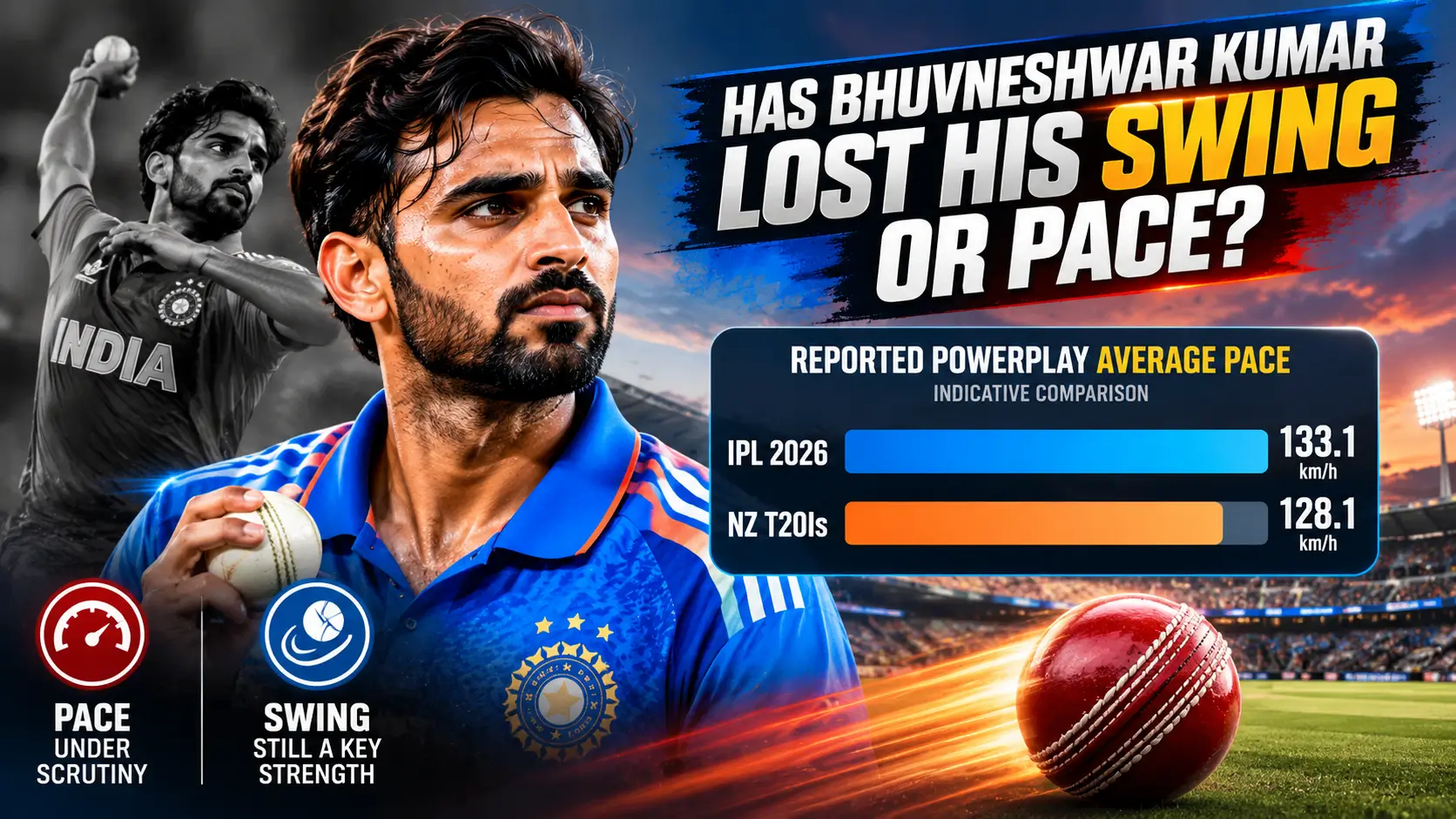
A published technical analysis of the New Zealand matches estimated his available powerplay speed readings at about 128.11 km/h, compared with roughly 133.12 km/h during IPL 2026. These are reported sample averages, not a complete independent ball-by-ball measurement, so they should be interpreted cautiously.
Reported powerplay average pace: indicative comparison
Chart 3: km/h, based on available reported speed data. Bars start at zero and are scaled to the larger value; this is not a complete tracking dataset.
For additional cricket-related reading, visit Casino India. The figures and bowling assessments in this article are discussed independently of that website.
A decline of around five kilometres per hour would not automatically make a swing bowler ineffective. The difficulty arises if reduced pace is combined with a fuller length that does not swing, predictable slower balls or missed yorkers. Modern batters can then move early, access straight boundaries and punish even small execution errors.
Why the new ball matters more than ever
Bhuvneshwar’s strongest route back is the powerplay, when a hard ball may still move. If he attacks the stumps and brings edges into play, he can create value without matching the fastest bowlers. If the ball remains straight, however, he needs a precise defensive plan rather than relying on swing that is not appearing.
The death overs raise a separate challenge. Batters now prepare specifically for wide yorkers, slower bouncers and changes of pace. A bowler must disguise these options and execute under pressure. Experience helps decision-making, but execution decides the scorecard.
Bhuvneshwar Kumar Career Stats: Why His Reputation Matters
One difficult series cannot rewrite a distinguished career. Bhuvneshwar has been a significant contributor for India in all three formats and an enduring presence in the IPL. His international record includes 63 Test wickets and 141 ODI wickets. His T20I total reached 91 wickets after the first three matches of the 2026 New Zealand series.
| Format | Matches | Wickets | Best bowling | Context |
|---|---|---|---|---|
| Tests | 21 | 63 | 6/82 | Career record |
| ODIs | 121 | 141 | 5/42 | Career record |
| T20Is | 91 | 91 | 5/4 | As reflected in updated Oct 2026 profiles |
| IPL | 206 | 226 | 5/19 | Through IPL 2026 |
Source: updated Cricbuzz and Times of India player profiles. T20I appearance totals may include matches where no bowling occurred; compare record dates before republishing.
Why Did India Leave Him Out of the Fourth T20I?
India replaced Bhuvneshwar with Mayank Yadav for the fourth match against New Zealand at Eden Park on 30 October. The switch followed three expensive performances, but the team did not publicly establish a single definitive reason for the change. It is therefore more accurate to describe it as a selection decision amid poor form than to claim he was permanently dropped.
New Zealand won that fourth T20I by 87 runs, scoring 259/7 before restricting India to 172/9. The defeat highlighted broader bowling issues; it did not by itself prove that keeping Bhuvneshwar would have changed the result. Mayank’s pace offers a different tactical option, which selectors could assess alongside the veteran’s experience.
What did Morne Morkel say about the comeback?
Before the third T20I, India bowling coach Morne Morkel publicly acknowledged the pressure of returning after four years. His guidance, reported by the ICC, focused on reducing expectations and allowing Bhuvneshwar to trust the skills that had worked for him in the IPL.
That is a reasonable coaching approach. A bowler attempting to force a wicket every delivery can lose rhythm and miss his length. A calmer plan, supported by realistic field settings, may restore control. Yet international selection ultimately depends on results, not sympathy.
Should India prioritise young fast bowlers?
Arshdeep Singh provides left-arm variation and a proven new-ball threat. Mayank Yadav supplies the potential of high pace. Prince Yadav and other emerging candidates offer further development options. India must balance short-term effectiveness with a longer-term pool of bowlers capable of adapting to different surfaces and pressures.
A veteran and a young quick are not always competing for an identical role. Bhuvneshwar could be useful when conditions reward movement or when a squad needs a specialist powerplay option. But if younger bowlers provide similar control while offering greater pace or versatility, the selection argument becomes harder for him.
Can Bhuvneshwar Kumar Still Make a Successful India Comeback?
Yes, but there are conditions. His IPL record shows that he can remain effective against high-quality batters. The immediate challenge is demonstrating that the same methods work consistently in international cricket, especially when conditions are less favourable and batting sides attack him from the start.
Three practical improvements would strengthen his case. First, he needs earlier wickets rather than only containing runs. Second, he must improve control when his preferred swing is absent. Third, he needs a repeatable death-overs plan that does not depend on occasional perfect yorkers.
| Factor | Reason for optimism | Reason for concern |
|---|---|---|
| New-ball skills | Long history of swing and accuracy | Limited impact in first three NZ matches |
| Recent form | 28 IPL wickets in 2026 | One wicket in 12 NZ overs |
| Experience | Familiar with high-pressure T20 cricket | Younger rivals offer different options |
| Physical profile | Continued franchise-level effectiveness | Questions over pace and recovery |
| Selection outlook | Recall proves the door was reopened | Omitted from fourth T20I |
His next opportunities, whether in the fifth New Zealand T20I on 1 November or subsequent domestic and franchise matches, should be assessed through roles rather than headlines. A useful spell could involve two early wickets at a controlled economy; a wicketless but accurate powerplay might also help the side in a specific match-up.
The crucial difference is between a temporary loss of rhythm and a sustained decline. Three outings provide evidence of a problem, but not enough to diagnose its cause with certainty. Equally, a strong IPL season does not guarantee success at international level. Both claims deserve testing against future performances.
What Can Bhuvneshwar Learn from the Difficult Series?

The first lesson is that a successful IPL season does not automatically translate into a successful international return. In the three New Zealand matches he played, Bhuvneshwar conceded 139 runs in 12 overs. He needs to identify precisely where his lengths, movement and execution differed from the spells that brought him success for Bengaluru.
Rebuild his powerplay plan around movement and accuracy
His most realistic route back is to create pressure with the new ball. That means assessing whether the ball is swinging early, attacking a consistent line and making quick adjustments when batters advance down the pitch. When movement is limited, protecting boundaries and varying the crease can be more effective than repeatedly searching for a perfect outswinger.
Develop a clear alternative when swing disappears
He cannot depend on favourable conditions every time. A more reliable mix of hard lengths, carefully disguised slower deliveries and accurately executed yorkers would give him options against aggressive batting. The priority is not necessarily adding raw pace but ensuring that each delivery has a defined purpose and a realistic margin for error.
Use domestic opportunities to demonstrate measurable improvement
Rather than judging his future on one wicket or one expensive spell, selectors can evaluate his powerplay wickets, dot-ball percentage, boundary frequency and performance against different types of batters. Strong domestic and IPL performances would provide a better test of whether his adjustments are repeatable. His experience remains an asset, but the strongest argument for another India opportunity will be sustained control and wickets on the field.
Final Verdict: Is This the End of the Road?
The decisive question is not whether Bhuvneshwar can recreate his younger self. It is whether he can build a useful modern role around the skills he still possesses. The answer will emerge from execution, fitness, tactical fit and the selection decisions that follow. For now, the road has narrowed, but it has not definitively ended.
Frequently Asked Questions
Has Bhuvneshwar Kumar retired from international cricket?
No. As of 31 October 2026, there is no verified announcement that he has retired from international cricket. He returned to India’s T20I team earlier in the month.
How did Bhuvneshwar Kumar perform against New Zealand in 2026?
Across his first three T20Is, he claimed one wicket and conceded 139 runs in 12 overs, an economy rate of 11.58.
Why was Bhuvneshwar Kumar not selected for the fourth T20I?
India brought Mayank Yadav into the playing XI in Auckland on 30 October. The change followed three expensive Bhuvneshwar spells, although the precise selection rationale was not formally detailed.
How many IPL wickets did Bhuvneshwar take in 2026?
He took 28 wickets during IPL 2026 for Royal Challengers Bengaluru, following 17 wickets in IPL 2025.
What is Bhuvneshwar Kumar’s bowling speed?
A contemporary analysis reported a powerplay average near 128.11 km/h from available New Zealand-series readings, compared with about 133.12 km/h in IPL 2026. Individual deliveries vary.
When did Bhuvneshwar Kumar last play for India before his return?
His previous T20I appearance before the 2026 recall was against New Zealand in November 2022.
Can Bhuvneshwar Kumar play for India again?
Yes. His international future depends on subsequent selection, fitness, form and India’s bowling requirements. Omission from one XI does not automatically mean retirement.
Who could compete with Bhuvneshwar Kumar for a place?
India have options including Arshdeep Singh, Mayank Yadav and Prince Yadav. Selection depends on bowling role, match conditions and available players.