
The India vs West Indies playing XI 2026 story covered eight international matches across three ODIs and five T20Is. India won the ODI series 2–1, while the five-match T20I contest finished level at 2–2 following a rain-affected finale in Bengaluru. This guide lists the confirmed elevens for both teams, identifies selection changes and explains what the combinations revealed.
Quick answer: Shubman Gill captained India in the ODIs and Shreyas Iyer led the T20I side. Shai Hope captained West Indies in both formats. Every table below shows the actual match XI, not merely an announced touring squad. All fixtures took place between 27 September and 17 October 2026.
India vs West Indies 2026: Match Results at a Glance
The tour moved from fifty-over cricket into the shorter format, placing different demands on squad balance. India chased successfully in the first two ODIs before losing the third. The T20I series was more evenly contested: both teams won twice, and the last match produced no result. Here is the complete fixture-by-fixture record.
| Match | Date | Venue | Result |
|---|---|---|---|
| 1st ODI | 27 September 2026 | Thiruvananthapuram | India by 8 wickets |
| 2nd ODI | 30 September 2026 | Guwahati | India by 8 wickets |
| 3rd ODI | 3 October 2026 | New Chandigarh | West Indies by 5 wickets |
| 1st T20I | 6 October 2026 | Lucknow | India by 8 wickets |
| 2nd T20I | 9 October 2026 | Ranchi | West Indies by 6 wickets |
| 3rd T20I | 11 October 2026 | Indore | India by 14 runs |
| 4th T20I | 14 October 2026 | Hyderabad | West Indies by 24 runs |
| 5th T20I | 17 October 2026 | Bengaluru | No result (rain) |
These results matter when reading the lineups. A winning combination is not automatically the best combination for the next venue, particularly when the format, surface or available bowling resources change. For that reason, the ODI and T20I selections are assessed separately.
India vs West Indies ODI Playing XI 2026: All Three Matches
India built the ODI side around an experienced batting core of Rohit Sharma, Shubman Gill, Virat Kohli and KL Rahul. The middle order and lower-order options changed as the series progressed. West Indies also adjusted its personnel, particularly among the all-rounders and fast bowlers.
| Match and venue | India playing XI | West Indies playing XI |
|---|---|---|
| 1st ODI 27 September 2026 Thiruvananthapuram India by 8 wickets | Rohit Sharma, Shubman Gill (c), Virat Kohli, Ruturaj Gaikwad, KL Rahul (wk), Naman Dhir, Ravindra Jadeja, Nitish Kumar Reddy, Gurnoor Brar, Kuldeep Yadav, Prasidh Krishna | John Campbell, Justin Greaves, Keacy Carty, Shai Hope (c/wk), Amir Jangoo, Jewel Andrew, Roston Chase, Matthew Forde, Gudakesh Motie, Alzarri Joseph, Jayden Seales |
| 2nd ODI 30 September 2026 Guwahati India by 8 wickets | Rohit Sharma, Shubman Gill (c), Virat Kohli, Ruturaj Gaikwad, KL Rahul (wk), Naman Dhir, Ravindra Jadeja, Auqib Nabi, Gurnoor Brar, Kuldeep Yadav, Prasidh Krishna | John Campbell, Keacy Carty, Shai Hope (c/wk), Amir Jangoo, Sherfane Rutherford, Roston Chase, Keemo Paul, Alzarri Joseph, Shamar Joseph, Jayden Seales, Vitel Lawes |
| 3rd ODI 3 October 2026 New Chandigarh West Indies by 5 wickets | Rohit Sharma, Shubman Gill (c), Virat Kohli, Ruturaj Gaikwad, KL Rahul (wk), Nitish Kumar Reddy, Naman Dhir, Anshul Kamboj, Kuldeep Yadav, Mohammed Siraj, Gurnoor Brar | John Campbell, Jewel Andrew, Shai Hope (c/wk), Amir Jangoo, Sherfane Rutherford, Keemo Paul, Matthew Forde, Alzarri Joseph, Gudakesh Motie, Jayden Seales, Vitel Lawes |
1st ODI: India start with experience and bowling depth
In Thiruvananthapuram on 27 September, Gill captained an India XI featuring both Rohit and Kohli. Rahul kept wicket, while Jadeja and Nitish Kumar Reddy offered additional skills alongside a frontline attack featuring Kuldeep Yadav and Prasidh Krishna. West Indies selected Hope as captain and keeper, with John Campbell, Justin Greaves and Keacy Carty among the recognised batting choices.
West Indies made 295/7, but India reached 300/2 in 41.4 overs for an eight-wicket win. The successful chase showed why India trusted its experienced top order. It also meant there was little immediate pressure to restructure the batting group for the second fixture.
2nd ODI: Auqib Nabi enters the India XI
For the Guwahati match on 30 September, India introduced Auqib Nabi in place of Nitish Kumar Reddy while keeping the established batting names. West Indies made several adjustments: Sherfane Rutherford and Keemo Paul featured, along with Shamar Joseph and Vitel Lawes. Changes in the Caribbean attack did not prevent another successful Indian pursuit.
West Indies posted a formidable 405/7, yet India reached 406/2 in 43.3 overs. The eight-wicket victory secured the ODI series. For selectors, the more important takeaway was that the same top-order framework could sustain an exceptionally demanding run chase.
3rd ODI: West Indies finish with a win
The final ODI in New Chandigarh on 3 October offered a different outcome. India used Anshul Kamboj and Mohammed Siraj, with Nitish Kumar Reddy returning. Jadeja and Prasidh Krishna were absent from this XI. West Indies included Jewel Andrew, Matthew Forde and Gudakesh Motie as the visitors settled on another combination.
Rahul struck an unbeaten 129 as India totalled 351/7. West Indies nevertheless completed the chase at 352/5 in 48.2 overs to win by five wickets. It was a reminder that an imposing total does not compensate for insufficient control while bowling. India still took the three-match ODI series 2–1.
For more context on the wider cricket publishing landscape, readers can visit Casino India. This is an external website link and not a source for the scorecard figures in this article.
India vs West Indies T20I Playing XI 2026: All Five Matches
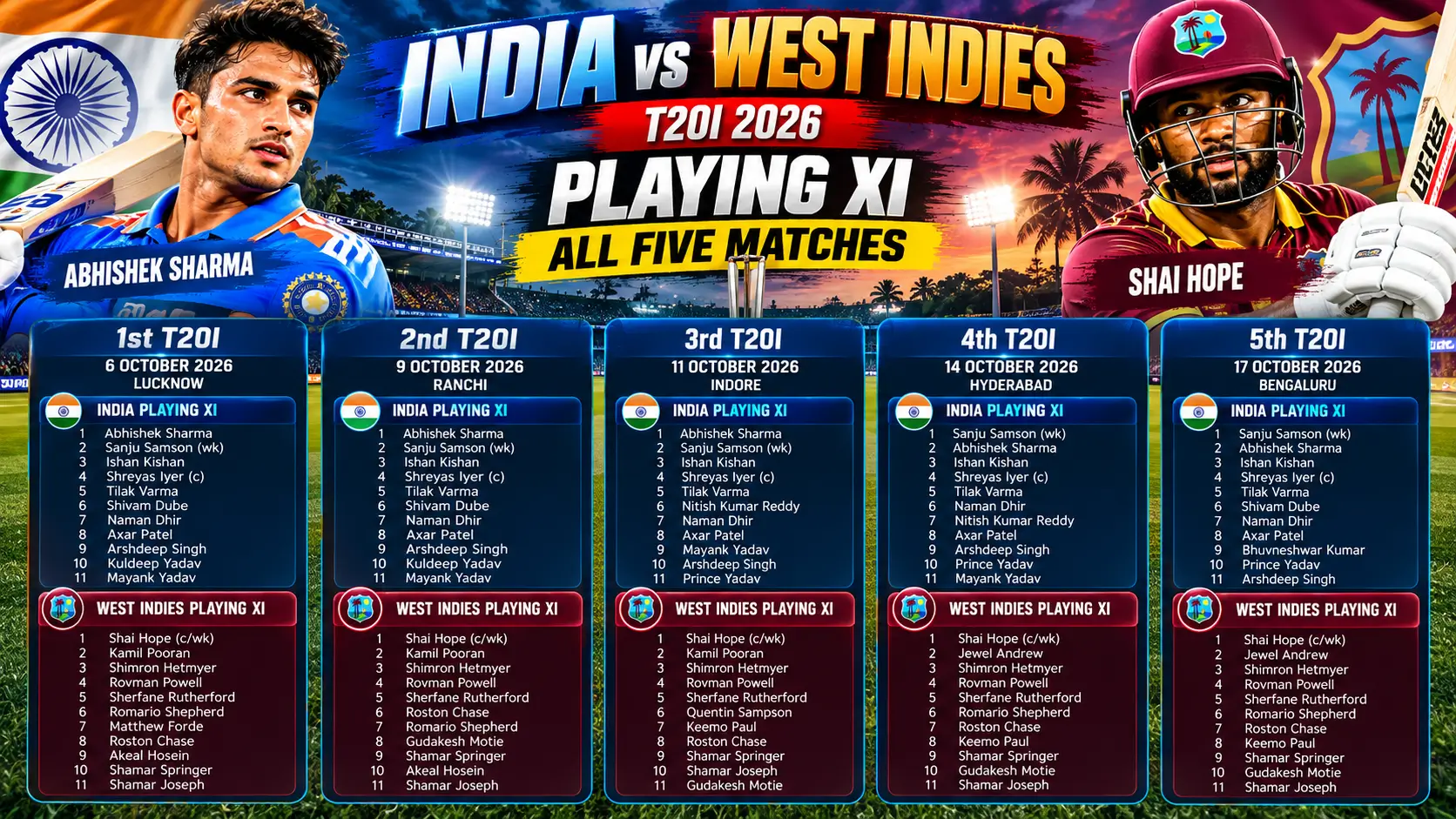
India switched to a specialist T20I leadership group under Shreyas Iyer. Abhishek Sharma, Sanju Samson, Ishan Kishan and Tilak Varma supplied batting options, while Axar Patel gave the XI all-round balance. West Indies leaned on Hope, Shimron Hetmyer, Rovman Powell and a changing mix of seamers, spinners and power-hitting all-rounders.
| Match and venue | India playing XI | West Indies playing XI |
|---|---|---|
| 1st T20I 6 October 2026 Lucknow India by 8 wickets | Abhishek Sharma, Sanju Samson (wk), Ishan Kishan, Shreyas Iyer (c), Tilak Varma, Shivam Dube, Naman Dhir, Axar Patel, Arshdeep Singh, Kuldeep Yadav, Mayank Yadav | Shai Hope (c/wk), Kamil Pooran, Shimron Hetmyer, Rovman Powell, Sherfane Rutherford, Romario Shepherd, Matthew Forde, Roston Chase, Akeal Hosein, Shamar Springer, Shamar Joseph |
| 2nd T20I 9 October 2026 Ranchi West Indies by 6 wickets | Abhishek Sharma, Sanju Samson (wk), Ishan Kishan, Shreyas Iyer (c), Tilak Varma, Shivam Dube, Naman Dhir, Axar Patel, Arshdeep Singh, Kuldeep Yadav, Mayank Yadav | Shai Hope (c/wk), Kamil Pooran, Shimron Hetmyer, Rovman Powell, Sherfane Rutherford, Roston Chase, Romario Shepherd, Gudakesh Motie, Shamar Springer, Akeal Hosein, Shamar Joseph |
| 3rd T20I 11 October 2026 Indore India by 14 runs | Abhishek Sharma, Sanju Samson (wk), Ishan Kishan, Shreyas Iyer (c), Tilak Varma, Nitish Kumar Reddy, Naman Dhir, Axar Patel, Mayank Yadav, Arshdeep Singh, Prince Yadav | Shai Hope (c/wk), Kamil Pooran, Shimron Hetmyer, Rovman Powell, Sherfane Rutherford, Quentin Sampson, Keemo Paul, Roston Chase, Shamar Springer, Shamar Joseph, Gudakesh Motie |
| 4th T20I 14 October 2026 Hyderabad West Indies by 24 runs | Sanju Samson (wk), Abhishek Sharma, Ishan Kishan, Shreyas Iyer (c), Tilak Varma, Naman Dhir, Nitish Kumar Reddy, Axar Patel, Arshdeep Singh, Prince Yadav, Mayank Yadav | Shai Hope (c/wk), Jewel Andrew, Shimron Hetmyer, Rovman Powell, Sherfane Rutherford, Romario Shepherd, Roston Chase, Keemo Paul, Shamar Springer, Gudakesh Motie, Shamar Joseph |
| 5th T20I 17 October 2026 Bengaluru No result (rain) | Sanju Samson (wk), Abhishek Sharma, Ishan Kishan, Shreyas Iyer (c), Tilak Varma, Shivam Dube, Naman Dhir, Axar Patel, Bhuvneshwar Kumar, Prince Yadav, Arshdeep Singh | Shai Hope (c/wk), Jewel Andrew, Shimron Hetmyer, Rovman Powell, Sherfane Rutherford, Romario Shepherd, Roston Chase, Keemo Paul, Shamar Springer, Gudakesh Motie, Shamar Joseph |
1st T20I: Shreyas Iyer sets the tone in Lucknow
India opened the T20I series on 6 October with Samson taking the gloves and Iyer captaining the team. Shivam Dube and Naman Dhir strengthened the batting options, while Arshdeep Singh, Kuldeep Yadav and Mayank Yadav formed the principal bowling group. West Indies relied on Hope, Hetmyer, Powell and Rutherford, backed by Romario Shepherd and multiple specialist bowlers.
West Indies were bowled out for 171 in 19.1 overs. India replied with 172/2 in 14.4 overs to win by eight wickets. Iyer struck 102 from 43 deliveries, an innings that highlighted the aggressive intent behind the batting-heavy selection.
2nd T20I: Unchanged India, different outcome
India retained precisely the same starting XI for the Ranchi match on 9 October. West Indies changed their attack, bringing Gudakesh Motie into the XI instead of Matthew Forde. India reached 249/5, helped by Samson’s 82 from 41 deliveries, yet the visitors chased down the target with 252/4 in 18.3 overs.
Hope’s unbeaten 102 from 45 balls was central to the six-wicket victory. The match illustrates an important selection distinction: retaining an XI can preserve batting continuity, but it cannot guarantee suitable bowling answers to an unusually high-scoring contest.
3rd T20I: India change the bowling combination
At Indore on 11 October, Nitish Kumar Reddy and Prince Yadav came into the India XI, replacing Dube and Kuldeep. India kept Axar alongside the pace options. West Indies introduced Quentin Sampson and Keemo Paul, alongside a different spin combination that included Motie.
India scored 223 all out in 20 overs and restricted West Indies to 209/7, winning by 14 runs. Arshdeep Singh contributed three wickets for 44 runs. The outcome supported India’s decision to vary its attack, although a single result should not be treated as definitive proof that one particular selection caused victory.
4th T20I: West Indies level the series in Hyderabad
India continued with the same eleven players in Hyderabad on 14 October. West Indies replaced Kamil Pooran and Quentin Sampson with Jewel Andrew and Romario Shepherd. The visitors amassed 247/3 and then limited India to 223/9 in 19.3 overs, securing a 24-run win.
The result levelled the T20I series at 2–2. West Indies demonstrated that their batting depth and attacking approach could overwhelm the hosts even after India had revised their bowling options earlier in the contest. Selection alone was only one part of the story: execution under pressure was equally important.
5th T20I: Bhuvneshwar Kumar returns, rain intervenes
The 17 October finale in Bengaluru began as a reduced nine-over match after a lengthy delay. India brought Shivam Dube and Bhuvneshwar Kumar into the XI, while Mayank Yadav and Nitish Kumar Reddy made way. West Indies retained the same XI used in Hyderabad.
India raced to 118/5 after 7.4 overs before further rain ended play. Ishan Kishan scored 30 from ten balls and Naman Dhir remained unbeaten on 24 from six. No result was possible, and the T20I series ended level. Although Bhuvneshwar was named in the XI, he did not get an opportunity to bowl because the West Indies innings never began.
Biggest Playing XI Changes and Selection Trends
The ODI and T20I lists should not be combined into a single appearance ranking because they were effectively separate squads with different captains. Across the ODIs, Rohit, Gill, Kohli and Rahul played all three matches, creating consistency at the top. Bowling and all-rounder roles changed more frequently, especially for the third ODI.
In T20Is, India made no changes between matches one and two. The first major reshuffle came before the third encounter, when Prince Yadav and Nitish Kumar Reddy entered. The fourth XI was unchanged, and the fifth saw the return of Dube alongside Bhuvneshwar. Those decisions reflected attempts to balance batting depth with pace and spin resources.
West Indies were willing to rotate bowling personnel in the early T20Is while retaining key batting leaders. Their stable XI for the last two matches followed an important victory in Hyderabad. Rotations also show the danger of describing every touring-squad member as a confirmed starter: Vaibhav Sooryavanshi, for example, was named in India’s T20I squad but did not appear in any of the five match XIs.
India vs West Indies 2026: Important Stats and Charts
The figures below summarise completed-match outcomes and notable performances. They are descriptive statistics, not projections or betting probabilities. Results from the abandoned fifth T20I are excluded from win totals, while the runs actually scored in that match are retained when discussing individual performances.
Scale: three wins equals a full bar. One additional T20I finished without a result.
| Category | India | West Indies |
|---|---|---|
| ODI victories | 2 | 1 |
| T20I victories | 2 | 2 |
| T20I no-results | 1 shared | 1 shared |
| ODI highest team total | 406/2 (2nd ODI) | 405/7 (2nd ODI) |
| T20I highest team total | 249/5 (2nd T20I) | 252/4 (2nd T20I) |
The second ODI produced the largest India total of the fifty-over series, while Ranchi delivered the largest totals for both sides in T20Is. High scores, however, should be assessed in context: India won their 406-run ODI chase but lost after scoring 249 in the Ranchi T20I.
Different scopes: Hope’s 261 is a T20I series aggregate; the other entries are individual match innings. Included to illustrate scale, not a like-for-like ranking.
Hope finished as the leading run-scorer in the T20I series with 261 runs and was named Player of the Series. Keemo Paul collected eight wickets from three matches, according to the ICC. These performances underline why the Caribbean side could share the T20I honours despite India taking the ODI trophy.
What the 2026 Playing XIs Tell Us About Team Strategy
India’s ODI selections favoured proven run-makers and a rotating supporting cast. The plan delivered two emphatic chases, though the third match exposed limits to the attack’s ability to defend a substantial total. In T20Is, India maintained a core of attacking top-order batters but adjusted its pace resources more than once.
West Indies placed a premium on aggressive top-order scoring and flexible all-rounders. Hope offered leadership and wicketkeeping continuity across formats. Their most memorable performances came while chasing, including the 405-run ODI pursuit and the 250-run target in Ranchi. The fourth T20I then demonstrated that the visitors could set a challenging total as well.
For readers checking official international cricket updates beyond this series, the ICC report on the tied T20I series explains the rain-affected finish and Player of the Series award. It also clarifies why the final fixture counts as a no-result rather than a victory for either side.
Frequently Asked Questions
Who was India’s captain against West Indies in 2026?
Shubman Gill captained India in the three ODIs, while Shreyas Iyer led India in the five-match T20I series.
Who captained West Indies in the 2026 India tour?
Shai Hope captained West Indies in both the ODI and T20I matches and also served as a wicketkeeper.
Did Vaibhav Sooryavanshi play against West Indies in 2026?
He was included in the announced India T20I squad but did not feature in any of the five confirmed T20I playing XIs.
Did Bhuvneshwar Kumar play in the fifth T20I?
Yes. He was selected in India’s XI for the fifth T20I in Bengaluru, but rain prevented the West Indies innings and he did not bowl.
Who won the India vs West Indies ODI series in 2026?
India won the three-match ODI series 2–1, with victories in Thiruvananthapuram and Guwahati.
What was the result of the 2026 T20I series?
The series finished 2–2 after both teams won twice and the fifth match ended without a result because of rain.
How can I verify every India vs West Indies playing XI?
Consult the match-specific squad and scorecard pages linked below. They identify the eleven starters, unlike a general series squad list.
Conclusion
The complete India vs West Indies playing XI 2026 record reveals two contrasting phases of the tour. India’s experienced ODI batting core secured a 2–1 series victory, while the T20Is developed into a far closer contest. Both teams adjusted personnel to suit match conditions, batting needs and available bowling combinations.
For a reliable assessment, readers should compare confirmed match XIs rather than announced squads and should not overlook the no-result in Bengaluru. The tables above preserve every match lineup in one place, making it easier to follow player selection, captaincy and the changes that shaped the series.
Pingback: India vs West Indies 2026 T20I: 7 Best Wicket-Takers
Pingback: India vs West Indies T20I Most Wickets: Top 10 Best Bowlers
Pingback: India vs West Indies ODI Most Wickets: 10 Greatest Bowlers