

India Cricket • ODI Series Review • October 2026
India vs West Indies 2026 ODI player stats: Shubman Gill finished as the leading run-scorer with 334 runs in three matches, while Kuldeep Yadav topped the bowling chart with seven wickets. India won the series 2–1 after two eight-wicket victories. West Indies avoided a clean sweep by chasing 352 in the final ODI at New Chandigarh.
The three-match contest, played from 27 September to 3 October 2026, produced exceptional batting numbers. Gill scored two centuries, Shai Hope also made two hundreds, and the second ODI featured five individual centuries. This guide separates ODI figures from the five-match T20I leg of the wider tour and explains which performances made the biggest difference.
India vs West Indies 2026 ODI Series Results
India took control of the series by winning the first two matches by eight wickets. The opening game was played in Thiruvananthapuram, while the second took place at Barsapara Cricket Stadium in Guwahati. West Indies responded in New Chandigarh, winning the third ODI by five wickets with ten balls remaining.
| ODI | Date | Venue | India | West Indies | Result |
|---|---|---|---|---|---|
| 1st | 27 Sep 2026 | Thiruvananthapuram | 300/2 (41.4) | 295/7 (50) | India won by 8 wickets |
| 2nd | 30 Sep 2026 | Guwahati | 406/2 (43.3) | 405/7 (50) | India won by 8 wickets |
| 3rd | 3 Oct 2026 | New Chandigarh | 351/7 (50) | 352/5 (48.2) | West Indies won by 5 wickets |
All six innings reached at least 295 runs, and no side was bowled out. Across the three games, the scorecards add up to 2,109 runs. The second ODI alone produced 811 runs, making it the highest-scoring match of the series. These figures explain why batting dominated the headlines, even though Kuldeep’s seven wickets gave India its most productive bowling return.
India vs West Indies 2026 ODI Top Run-Scorers
Gill led the run chart with 334 runs from three innings at an average of 167.00 and a strike rate of 135.22. Hope was second with 278, followed by Amir Jangoo on 239. Rohit Sharma, John Campbell and Virat Kohli also passed 150 runs, giving both teams several major contributions.
| Rank | Player | Team | Matches | Runs | Average | Strike rate | 4s / 6s |
|---|---|---|---|---|---|---|---|
| 1 | Shubman Gill | India | 3 | 334 | 167.00 | 135.22 | 39 / 9 |
| 2 | Shai Hope | West Indies | 3 | 278 | 139.00 | 112.10 | 26 / 6 |
| 3 | Amir Jangoo | West Indies | 3 | 239 | 119.50 | 135.80 | 25 / 5 |
| 4 | Rohit Sharma | India | 3 | 225 | 75.00 | 115.38 | 22 / 12 |
| 5 | John Campbell | West Indies | 3 | 173 | 57.67 | 128.15 | 17 / 8 |
| 6 | Virat Kohli | India | 3 | 168 | 84.00 | 155.56 | 13 / 10 |
| 7 | KL Rahul | India | 3 | 129 | — | 148.28 | 10 / 6 |
| 8 | Ruturaj Gaikwad | India | 3 | 101 | 101.00 | 80.80 | 3 / 4 |
| 9 | Justin Greaves | West Indies | 1 | 101 | 101.00 | 93.52 | 12 / 0 |
Source basis: ODI-filtered series batting leaderboard. KL Rahul played one innings, so a batting average is not meaningful in the table.
What the batting leaderboard tells us
India had four players in the top eight, while West Indies placed three. Gill’s lead over Hope was 56 runs, but Hope’s average of 139.00 shows how productive he was in his three innings. Jangoo’s 239 runs at 119.50 also gave West Indies a strong second support act behind their captain.
Justin Greaves deserves a mention despite playing only one match. He scored 101 in the opening ODI, giving West Indies another century in a series where his side produced several large individual scores. A single-innings contribution should not be compared directly with a three-match total, but it was still an important performance.
For more cricket coverage, match explainers and tournament updates, readers can explore Casino India. The statistics in this article remain limited to the three ODIs, so they are not mixed with performances from the separate T20I fixtures played later on the tour.
Shubman Gill and Shai Hope: The Two Standout Batters
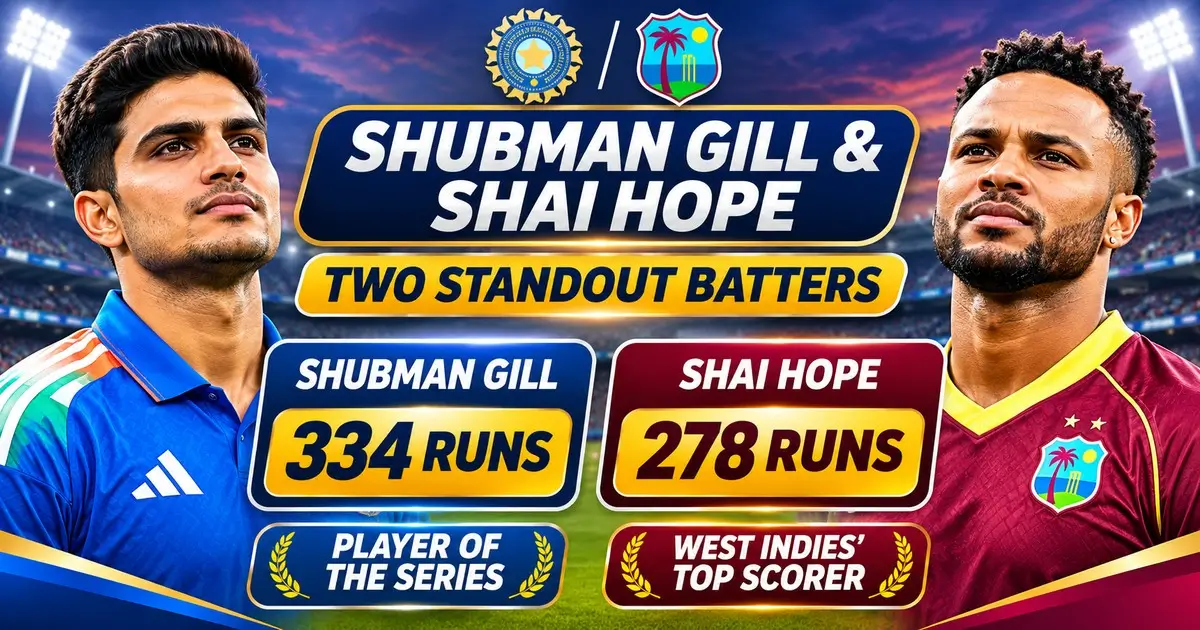
Shubman Gill finished with 334 runs
Gill’s series was built around consistency and one extraordinary double-century. He scored 110 in the first ODI, an unbeaten 223 in Guwahati and one run in the final match. His 334 runs came at an average of 167.00, with 39 fours and nine sixes. He was named Player of the Series.
His 223 not out came from 133 balls in the second ODI. It included 26 fours and eight sixes, and helped India chase 406 in only 43.3 overs. The innings was not simply a high score: it kept the required rate under control while the target was still large. Gill and Rohit added 255 runs for the opening wicket, taking the chase away from West Indies.
Gill’s first-match 110 also mattered. It gave India a strong platform in a chase of 296, before Kohli’s unbeaten 139 completed the eight-wicket win. His only low score came in the final ODI, when Jayden Seales removed him for one. By then, India had already secured the series.
Shai Hope led West Indies with 278 runs
Hope scored 12 in the first ODI, 104 in the second and an unbeaten 162 in the third. He finished with 278 runs at an average of 139.00, a strike rate of 112.10 and two centuries. His unbeaten 162 from 143 balls was the defining innings in West Indies’ successful chase of 352.
Hope’s final-match hundred showed a different kind of control from Gill’s double-century. West Indies had to chase a demanding total after losing wickets at important moments. Hope stayed until the target was reached, supported by Jangoo and Keemo Paul. His innings turned the final match into a victory and prevented India from completing a 3–0 sweep.
Leading Wicket-Takers in the 2026 ODI Series
Kuldeep Yadav finished first with seven wickets in three matches. Jayden Seales was West Indies’ leading wicket-taker with four, while Prasidh Krishna and Gurnoor Brar took three each. The bowling list was shorter than the batting leaderboard because the series featured high totals and long partnerships.
| Rank | Bowler | Team | Matches | Overs | Wickets | Runs conceded | Average | Economy |
|---|---|---|---|---|---|---|---|---|
| 1 | Kuldeep Yadav | India | 3 | 30 | 7 | 167 | 23.86 | 5.57 |
| 2 | Jayden Seales | West Indies | 3 | 25 | 4 | — | — | — |
| 3 | Prasidh Krishna | India | 2 | 15 | 3 | — | — | — |
| 4 | Gurnoor Brar | India | 3 | 29.1 | 3 | — | — | — |
| 5 | Ravindra Jadeja | India | 2 | 20 | 2 | — | — | — |
Only verified overs and wicket totals are shown for bowlers outside the leading Kuldeep Yadav entry. Unavailable figures have been left blank rather than estimated.
Kuldeep Yadav was India’s most effective bowler
Kuldeep took 4/40 in the first ODI, 2/65 in the second and 1/62 in the third. Across 30 overs, he conceded 167 runs and finished with an average of 23.86 and an economy rate of 5.57. His best figures came in Thiruvananthapuram, where he helped restrict West Indies to 295/7.
His seven wickets were especially valuable in a series where teams scored freely. The figures also show the difference between wicket-taking and run control. Kuldeep’s economy was the best among the leading wicket-takers listed, and he regularly broke partnerships rather than allowing the innings to run without interruption.
Jayden Seales led the West Indies attack
Seales took four wickets in three matches, the best return for a West Indies bowler. He also struck early in the final ODI, dismissing Gill and Kohli in the opening stages. That start gave the visitors a chance to put India under pressure, even though Rahul and Rohit later rebuilt the innings.
India vs West Indies 2026 ODI Stats: Visual Comparison
The charts below use the published ODI leaderboard and completed scorecards. They make the gap between the leading performers easier to see without replacing the full statistics tables.
Top five run-scorers
Bar lengths are proportional to runs; Gill’s 334 is the 100% reference.
Leading wicket-takers
Bar lengths are proportional to wickets; Kuldeep’s seven is the 100% reference.
Total runs scored in each ODI
Match totals are the sum of both teams’ innings. The second ODI was the highest-scoring game.
Biggest Records and Match-Winning Contributions
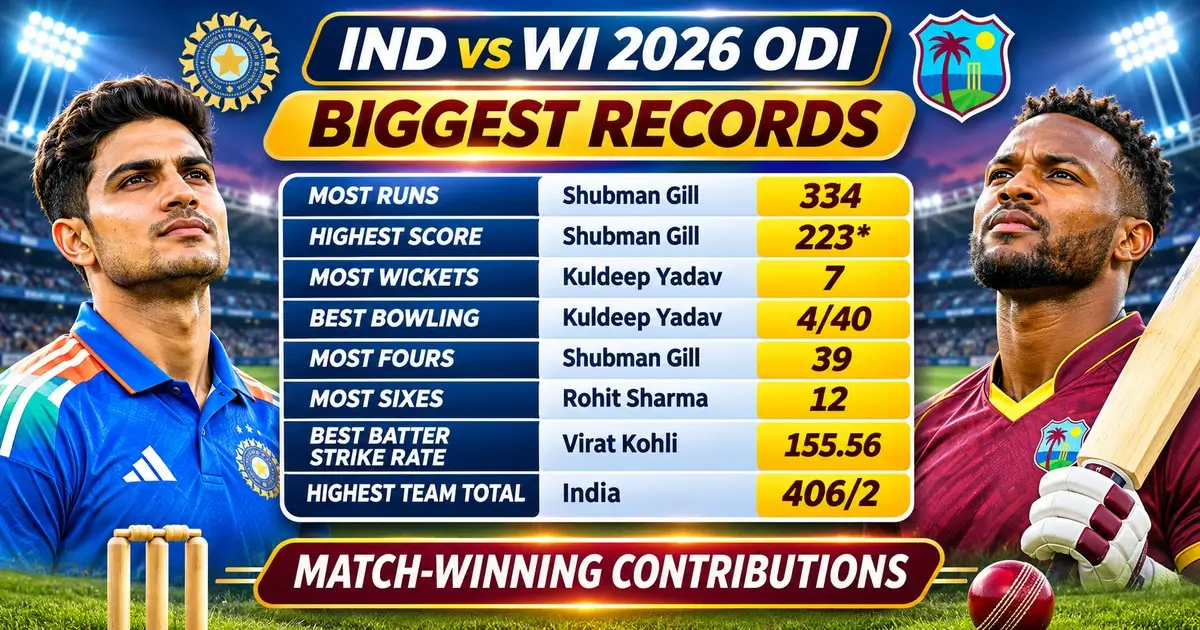
| Series record | Player / team | Figure |
|---|---|---|
| Most runs | Shubman Gill | 334 |
| Highest individual score | Shubman Gill | 223 not out |
| Most wickets | Kuldeep Yadav | 7 |
| Best bowling figures | Kuldeep Yadav | 4/40 |
| Most fours | Shubman Gill | 39 |
| Most sixes | Rohit Sharma | 12 |
| Best strike rate among listed batters | Virat Kohli | 155.56 |
| Highest team total | India | 406/2 |
| Highest successful chase | India | 406/2 in 43.3 overs |
Three matches, three different stories
First ODI, Thiruvananthapuram: West Indies made 295/7, led by Justin Greaves’ 101 and Campbell’s 62. Kuldeep took 4/40. India chased the target in 41.4 overs, with Gill scoring 110 and Kohli finishing unbeaten on 139. The pair added 151 for the second wicket.
Second ODI, Guwahati: West Indies posted 405/7, with centuries from Campbell, Hope and Jangoo. India responded with 406/2 in 43.3 overs. Gill’s 223 not out and Rohit’s 101 powered a 255-run opening stand. Five centuries were scored in the match, which produced 811 runs.
Third ODI, New Chandigarh: India recovered from an early collapse to score 351/7. Rahul made 129 not out and Rohit scored 92. Hope’s unbeaten 162 then anchored West Indies’ chase, with Jangoo adding 67 and Keemo Paul contributing 44. The visitors reached 352/5 in 48.2 overs.
What Decided the 2026 ODI Series?
India’s top-order batting was the clearest difference across the first two matches. Gill scored heavily in both games, while Rohit and Kohli each produced a century. The team chased 296 and 406 with eight wickets in hand on both occasions, showing that it could handle very different target sizes without losing control of the innings.
West Indies had enough batting quality to compete. Greaves, Campbell, Hope and Jangoo all scored hundreds, and the visitors crossed 400 in Guwahati. Their final-match victory showed that they could also chase a large total. The key difference was that India produced match-winning batting performances in two games, while West Indies’ best collective response arrived after the series had already been decided.
Bowling was more difficult for both sides because of the scoring conditions. Kuldeep’s seven wickets stood out, and Seales’ early strikes in the final ODI gave West Indies a route into the match. But the overall pattern was clear: partnerships and high individual scores shaped the series more than low-scoring spells.
The official scorecard and match details are available through the BCCI third ODI match centre. It records the New Chandigarh result, Hope’s Player of the Match award and Gill’s Player of the Series recognition.
Frequently Asked Questions
Who scored the most runs in the India vs West Indies 2026 ODI series?
Shubman Gill was the leading run-scorer with 334 runs in three matches. He averaged 167.00 and scored two centuries, including an unbeaten 223.
Who was West Indies’ highest run-scorer in the ODI series?
Shai Hope led West Indies with 278 runs at an average of 139.00. His unbeaten 162 in the third ODI was the highest score by a West Indies batter in the series.
Who took the most wickets in the 2026 ODI series?
Kuldeep Yadav topped the bowling chart with seven wickets from 30 overs. His best figures were 4/40, and his economy rate was 5.57.
What was the highest individual score in the series?
Shubman Gill scored 223 not out from 133 balls in the second ODI at Guwahati. The innings included 26 fours and eight sixes.
Who hit the most sixes in the India vs West Indies ODIs?
Rohit Sharma hit the most sixes, with 12 across the three matches. Gill hit nine sixes, while Kohli struck 10.
Who won the India vs West Indies 2026 ODI series?
India won the three-match series 2–1. They won the first two ODIs by eight wickets before West Indies claimed the third match by five wickets.
Conclusion: India vs West Indies 2026 ODI Player Stats
The India vs West Indies 2026 ODI player stats underline Gill’s outstanding series, Hope’s strong response and Kuldeep’s value with the ball. Gill’s 334 runs and unbeaten 223 made him the leading batter, while Kuldeep’s seven wickets placed him first among the bowlers. India won 2–1, but West Indies finished with a memorable chase in New Chandigarh.
Pingback: India vs West Indies 1983 World Cup Final: 5 Amazing Moments