

Series review | Updated 28 October 2026
IND vs WI ODI 2026: Top 5 Players Who Made an Impact
India defeated West Indies 2–1 in the three-match ODI series held between 27 September and 3 October 2026. Yet the result tells only part of the story. A record-breaking double-century, a remarkable Caribbean chase and a standout spin-bowling performance made this an unusually memorable bilateral contest.
The IND vs WI ODI 2026 series produced huge totals and several individual centuries. India won the first two matches by eight wickets each to seal the trophy, before West Indies responded with a five-wicket victory in New Chandigarh. Choosing the most influential players therefore requires more than simply ranking the highest run-scorers.
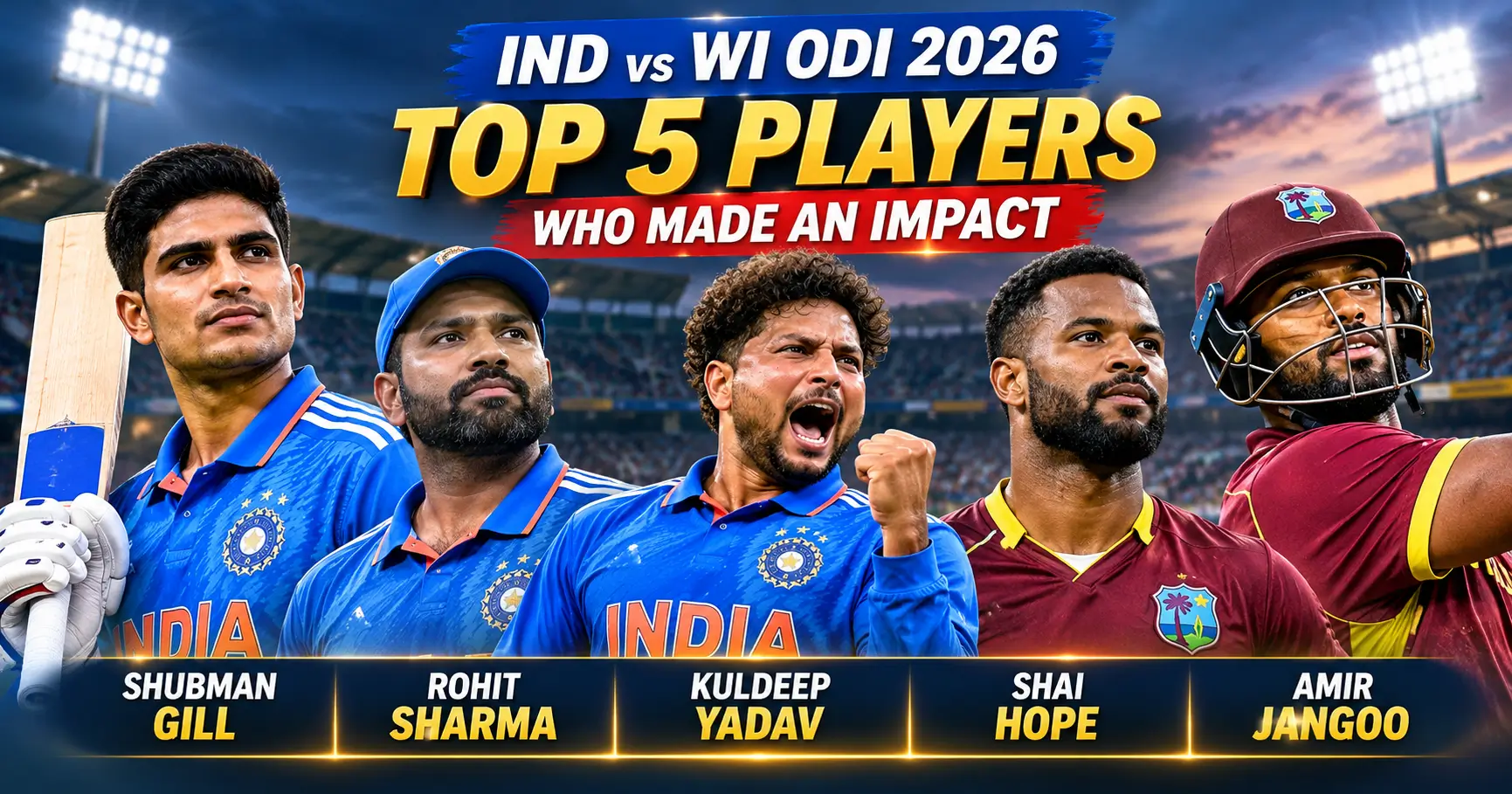
This review examines five players who shaped the series: Shubman Gill, Shai Hope, Amir Jangoo, Rohit Sharma and Kuldeep Yadav. It combines verified series numbers, key turning points, batting and bowling comparisons, and an assessment of why each contribution mattered. Statistics refer to the three ODIs only, not the subsequent T20I series.
IND vs WI ODI 2026: Series Results at a Glance
The series began in Thiruvananthapuram, moved to Guwahati and concluded in New Chandigarh. India chased successfully in the first two ODIs, with their second win including an extraordinary pursuit of 406. West Indies then completed a record national chase of their own to finish strongly.
| Match and date | Venue | West Indies | India | Result |
|---|---|---|---|---|
| 1st ODI, 27 Sep | Thiruvananthapuram | 295/7 | 300/2 (41.4 overs) | India won by 8 wickets |
| 2nd ODI, 30 Sep | Guwahati | 405/7 | 406/2 (43.3 overs) | India won by 8 wickets |
| 3rd ODI, 3 Oct | New Chandigarh | 352/5 (48.2 overs) | 351/7 | West Indies won by 5 wickets |
India’s series-clinching win in Guwahati was particularly significant because the side reached 406/2 with 39 balls remaining. Gill’s 223 not out and Rohit Sharma’s attacking century gave the chase its defining partnership. The final ODI demonstrated that West Indies could also convert a demanding target into a result.
IND vs WI ODI 2026: Top 5 Players’ Stats
The following shortlist balances run-scoring volume against match-winning performances and the importance of taking wickets on batting-friendly surfaces. A player appearing lower in the runs chart could still have exerted significant influence through bowling or the timing of an innings.
| Player | Team | ODIs | Runs | Batting average | Defining impact |
|---|---|---|---|---|---|
| Shubman Gill | India | 3 | 334 | 167.00 | 223* in record chase |
| Shai Hope | West Indies | 3 | 278 | 139.00 | 162* in third ODI |
| Amir Jangoo | West Indies | 3 | 239 | 119.50 | Consistent middle-order runs |
| Rohit Sharma | India | 3 | 225 | 75.00 | 101 in Guwahati |
| Kuldeep Yadav | India | 3 | — | — | Series-leading 7 wickets |
Graph 1: Top 5 Impact Players – Runs and Wickets
Batting – runs scored
Bowling – wickets taken (separate scale)
Batting bars are scaled to 334 runs; Kuldeep’s bowling bar is independently scaled to 7 wickets. Runs and wickets are different measures and should not be compared by bar length. All figures cover the three ODIs.
1. Shubman Gill: 334 Runs and Player of the Series
Shubman Gill combined captaincy with an extraordinary batting return. The India skipper made 334 runs from three innings at an average of 167.00, and his two centuries were central to India’s early control of the series. His performance was not merely about accumulation; he repeatedly dictated the tempo of difficult chases.
In the opening ODI at Thiruvananthapuram, Gill scored 110 from 108 balls as India reached 300/2 in response to West Indies’ 295/7. The innings provided a measured start to the series. He ensured that India did not waste the advantage offered by a stable top order and helped convert a target approaching 300 into a comfortable victory.
His defining achievement arrived in the second ODI. Facing 405/7, Gill struck an unbeaten 223 from 133 deliveries, including 26 fours and eight sixes. He reached his double-century in 117 balls, a record-breaking milestone reported by the ICC. His unbeaten knock carried India to 406/2 in only 43.3 overs.
Gill and Rohit shared a 255-run opening stand, turning an intimidating target into an increasingly manageable one. Gill maintained control after his partner departed. His ability to score quickly without surrendering his wicket distinguished this innings from a conventional attacking hundred.
There was also a leadership dimension. India had already secured the series before the third ODI, and Gill was subsequently named Player of the Series. His solitary run in the final match does not erase the influence of two centuries that effectively decided the trophy. Among all players in this contest, he delivered the clearest combination of consistency, individual records and series-winning value.
For broader cricket and entertainment coverage, readers may also explore Casino India. The statistical conclusions in this article are based on independently listed cricket scorecards and records rather than that website.
2. Shai Hope: The Captain Who Led a Historic Chase
West Indies captain Shai Hope finished second among the ODI run-scorers with 278 runs at an average of 139.00. He registered two centuries and brought an authoritative presence to a batting unit that repeatedly faced pressure from India’s attack and imposing totals.
Hope’s most consequential innings came in the final ODI at New Chandigarh. Chasing 352, West Indies reached 352/5 in 48.2 overs, with Hope unbeaten on 162 from 143 balls. He remained at the crease until the target was completed, helping his team avoid a series whitewash.
The ICC identified that pursuit as West Indies’ highest successful chase in men’s ODIs. Hope’s 162 not out was also a remarkable individual achievement for a wicketkeeper-captain. Those records explain why the innings ranks alongside Gill’s double-century as one of the series’ great performances.
Hope’s contribution went beyond a single explosive passage. In a high-scoring contest, batting through the chase meant preserving stability while supporting the scoring required at the other end. Where India had used a dominant opening partnership to win in Guwahati, West Indies relied on their captain to shepherd a substantial pursuit to the finish.
Although his side lost the ODI series 2–1, Hope delivered a meaningful answer to India’s early superiority. His final-ODI performance changed the tone of the tour by proving that West Indies could withstand scoreboard pressure and still win away from home. On match-winning significance alone, he comfortably merits a place near the top of this list.
3. Amir Jangoo: The Consistent West Indies Run-Getter
Amir Jangoo did not receive the same attention as the two captains, but his figures tell a compelling story. The West Indies batter accumulated 239 runs in three ODI innings, averaging 119.50 with a strike rate of 135.80. That made him the third-highest run-scorer in the series.
Jangoo’s contributions were important because West Indies needed considerable batting depth to compete. Totals of 295/7 and 405/7 in the first two matches demonstrated their scoring capacity, but India chased both. The Caribbean side nevertheless showed that its batting line-up contained more than one reliable source of runs.
With one century and two fifty-plus scores recorded across his three appearances, Jangoo provided evidence of both consistency and acceleration. His highest score was 114, while his 25 fours and five sixes showed he could locate boundaries without depending exclusively on six-hitting.
Jangoo earns his selection through repeat production rather than a single headline-making moment. In a series featuring several famous names, finishing ahead of Rohit Sharma and Virat Kohli in the run chart was a substantial achievement and a positive signal for West Indies’ ODI batting resources.
4. Rohit Sharma: The Opener Who Made 406 Look Chaseable
Rohit Sharma scored 225 runs from three innings at an average of 75.00 and a strike rate of 115.38. His century in the second ODI was especially influential because of its timing and partnership value. Without his aggressive start, India’s pursuit of 406 would have posed a much greater challenge.
Rohit struck 101 from 75 balls in Guwahati, hitting ten fours and six sixes. Alongside Gill, he helped India reach 255 before the first wicket fell. That opening stand dramatically changed the required scoring equation and allowed the remaining batters to build upon an excellent foundation.
The ICC reported that Rohit’s innings was his 35th ODI century and that he crossed 12,000 ODI runs during the match. Those career milestones enhanced the occasion, but their relevance to this series was secondary to the attacking intent he brought to a massive chase.
Rohit also scored 92 from 85 balls in the final match. Although India lost that game, the innings demonstrated that he remained capable of performing across different match situations. He finished the series with 12 sixes, the highest total among the ODI batters, reflecting a willingness to take on the bowling.
5. Kuldeep Yadav: Leading Wicket-Taker With 7 Wickets
High-scoring ODI cricket often places bowlers at a disadvantage, making Kuldeep Yadav’s performance especially notable. The left-arm wrist-spinner collected seven wickets in three matches, comfortably finishing as the leading wicket-taker in the ODI series.
Across 30 overs, Kuldeep conceded 167 runs. That gave him a bowling average of 23.86 and an economy rate of approximately 5.57 runs per over. His best figures were 4/40. These numbers were particularly impressive given the extreme batting conditions evident during the Guwahati match.
Wickets taken in the middle overs also alter batting plans. A set batter dismissed before the closing overs may prevent an innings from reaching its full potential. Kuldeep’s record indicates that India had an effective wicket-taking option even though West Indies still posted large totals in multiple matches.
Including Kuldeep makes this a more balanced impact list. Five leading batters would reflect the tournament’s enormous scores, but overlook the importance of taking wickets. His seven dismissals and economical 30 overs gave India a dependable bowling contribution alongside their headline batting performances.
| Bowler | Team | Wickets | Overs | Economy | Best figures |
|---|---|---|---|---|---|
| Kuldeep Yadav | India | 7 | 30 | 5.57 | 4/40 |
| Jayden Seales | West Indies | 4 | 25 | 6.88 | 3/62 |
| Prasidh Krishna | India | 3 | 15 | 7.00 | 2/60 |
| Gurnoor Brar | India | 3 | 29.1 | 7.54 | 2/96 |
Graph 2: Most Wickets in the ODI Series
Other Players Who Deserve Recognition

Several players narrowly missed this top-five selection. Virat Kohli scored 168 runs at a strike rate of 155.56, including an unbeaten 139, which underlined his ability to accelerate. KL Rahul contributed a vital unbeaten 129 off 87 balls in the third ODI when India needed recovery after early setbacks.
For West Indies, John Campbell made 173 runs, while Jayden Seales took four wickets, including three in the final ODI. Seales’ early dismissals of Gill and Kohli in New Chandigarh gave West Indies a route back into the contest and highlighted the contribution of the visitors’ bowling attack.
IND vs WI ODI 2026: Key Statistical Takeaways
Both teams displayed remarkable batting strength, but there were differences in how they achieved success. India’s victories were founded on commanding top-order partnerships and unusually fast chases. West Indies’ win was built around Hope’s ability to stay unbeaten during a difficult pursuit. Across the series, even totals exceeding 350 could not be assumed safe.
For the authoritative account of the series’ final turning point, read the ICC report on West Indies’ record chase. The report explains how Hope’s unbeaten century helped the visitors close the ODI series with a historic victory.
IND vs WI ODI 2026: Frequently Asked Questions
Who won the India vs West Indies ODI series in 2026?
India won the three-match ODI series 2–1. They claimed the first two ODIs by eight wickets before West Indies won the final match by five wickets.
Who was Player of the Series?
India captain Shubman Gill was named Player of the Series after scoring 334 runs, including centuries of 110 and 223 not out.
Who scored the most runs in IND vs WI ODIs in 2026?
Shubman Gill led the series with 334 runs. Shai Hope followed with 278, and Amir Jangoo scored 239.
Who took the most wickets?
Kuldeep Yadav topped the wicket chart with seven wickets from three games, including best figures of 4/40.
What was the highest individual score?
Shubman Gill’s unbeaten 223 from 133 balls in the second ODI at Guwahati was the highest individual score of the series.
Why was the third ODI significant?
West Indies chased 352 in New Chandigarh, reaching 352/5 in 48.2 overs. It was their highest successful run chase in men’s ODI cricket.
Final Verdict: Who Had the Biggest Impact?
Shubman Gill was the standout individual because he scored the most runs and produced the innings that secured India’s series triumph. Shai Hope deserves close recognition for leading West Indies to a historic victory. Jangoo supplied consistency, Rohit transformed a difficult chase through his attacking opening partnership, and Kuldeep provided India’s strongest bowling return.
Impact goes beyond run totals: match situation, partnerships, wickets and results all matter. These five players shaped a memorable ODI series.
Pingback: India vs West Indies ODI Most Runs: Top 10 Greatest Batters
Pingback: India vs West Indies Test Most Runs: 10 Legendary Batters