
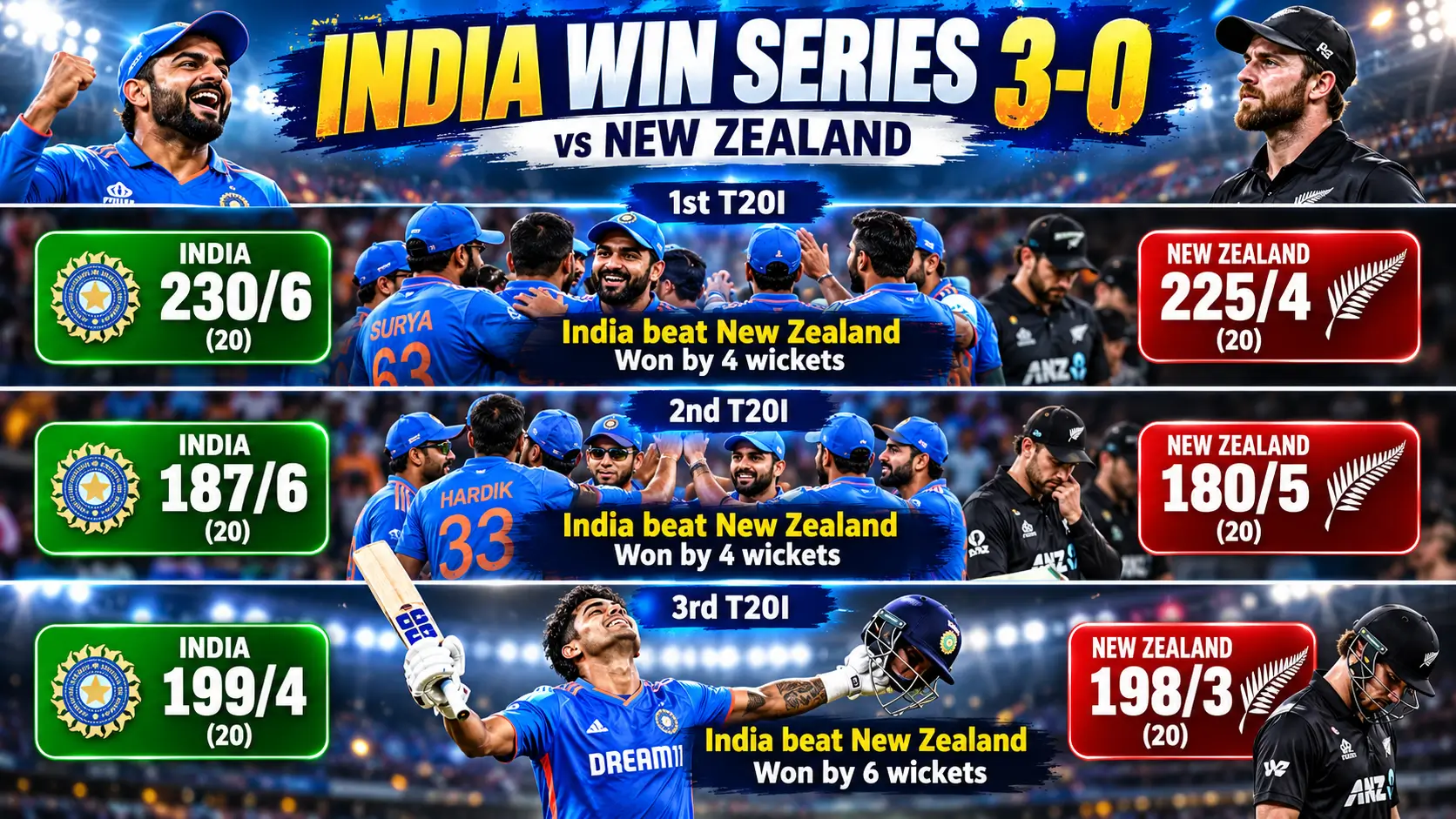
India have won the five-match T20I series against New Zealand after taking a 3–0 lead on 27 October 2026. India won the first two games by four wickets each and the third by six wickets. The team sealed the series in Wellington with two matches still to play. New Zealand can win the remaining games, but they can no longer win the series.
The three victories came in different ways. India had to fight through two close chases in Christchurch before producing a much faster chase in Wellington. Several batters helped the side at key moments, and the bowlers created chances in every match. Here is how India built their lead and why the result matters.
India vs New Zealand T20I Series 2026: Results at a Glance
| Match and date | New Zealand | India | Result |
|---|---|---|---|
| 1st • 22 Oct • Christchurch | 225/4 | 230/6 (19.4 overs) | India won by 4 wickets |
| 2nd • 24 Oct • Christchurch | 180/5 | 181/6 (19.5 overs) | India won by 4 wickets |
| 3rd • 27 Oct • Wellington | 198/3 | 199/4 (13.2 overs) | India won by 6 wickets |
All three games ended with India chasing the target. Across these matches, New Zealand scored 603 runs, while India scored 610 runs. Those totals are not a full measure of bowling strength because India ended each chase once the target was reached. The clear result is that India won three matches in a row and secured the series.
What Does India’s 3–0 Lead Mean?
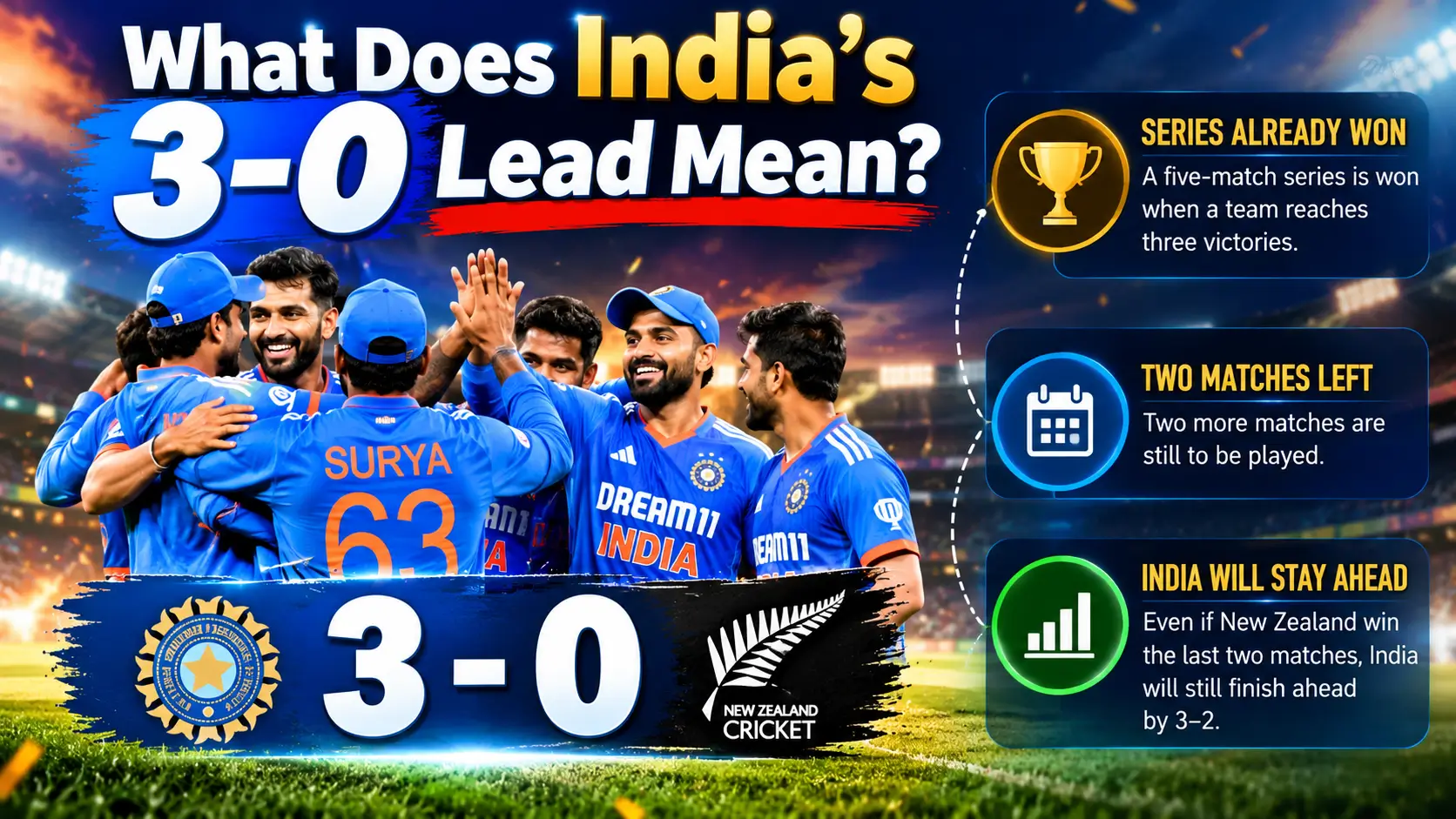
A five-match series is won when one team reaches three victories. India have already done that, so their lead cannot be overturned. Even if New Zealand win the fourth and fifth matches, India would still finish ahead by 3–2. The final series score is not yet known because two games remain.
First T20I: India Chase 226 in Christchurch
The series began on 22 October at Hagley Oval in Christchurch. New Zealand scored 225/4 after India chose to field first. A chase of 226 was a difficult opening test for the visitors. India answered with 230/6 in 19.4 overs and won by four wickets.
Sanju Samson gave India a strong start with 67 runs from 33 balls. His shots helped the visitors stay close to the required scoring rate. India still faced pressure when wickets fell in the middle overs. The match stayed alive deep into the chase.
Naman Dhir then played an important finishing role. He remained unbeaten on 42 from only 15 balls and hit boundaries when the target looked difficult. His quick runs helped India finish with two balls left. The win gave India a 1–0 lead and showed that the lower order could handle pressure.
Second T20I: Another Close Four-Wicket Win
The teams met again at Hagley Oval on 24 October. New Zealand made 180/5 from their 20 overs. India needed 181 to move two matches ahead in the series. The visitors reached 181/6 in 19.5 overs and won by four wickets again.
The second chase required patience as well as power. New Zealand kept taking wickets and made the final overs tense. Tilak Varma scored 51 from 26 balls and received the player-of-the-match award. Nitish Kumar Reddy also helped India reach the winning total.
This result mattered because the match was not won by one early burst of runs. India had to build partnerships, recover from setbacks and use nearly all their overs. The second victory moved them to a 2–0 lead. New Zealand now needed to win all three remaining matches to take the series.
Third T20I: India Seal the Series in Wellington
The third T20I took place at Hnry Stadium in Wellington on 27 October. India won the toss and asked New Zealand to bat. The hosts reached 198/3 after 20 overs and set a target of 199. A strong batting display by India then ended the contest in only 13.2 overs.
India scored 199/4 and won by six wickets with 40 balls remaining. Abhishek Sharma made 113 from 38 balls and reached his hundred in 35 deliveries. Vaibhav Sooryavanshi added 45 from 19 balls at the top of the order. The opening pair helped India score 118 runs in the six-over powerplay.
The quick start took away much of the pressure from the chase. New Zealand had posted a challenging total, but their bowlers could not slow the early scoring. India reached the target well before the last over. That win completed the three victories needed to secure the series.
New Zealand’s 198/3 Was Still a Strong Total

The scorecard shows that New Zealand did not lose the third match because of a low total. Daryl Mitchell scored 89 not out from 52 balls and led the innings. Finn Allen made 40 from 25 balls, while Bevon Jacobs finished unbeaten on 39. Those efforts lifted the hosts close to 200 runs.
New Zealand also recovered after losing an early wicket. The batters kept scoring through the middle and closing overs, which gave their bowlers something to defend. Yet a strong total can become too small when the other team attacks from the start. India’s rapid opening partnership changed the match more than the first-innings score suggested.
Cricket fans who enjoy following exciting matches like India vs New Zealand may also be interested in learning about a betting exchange ID. A betting exchange allows users to place bets against other users rather than directly against a bookmaker. Before using any platform, it is important to understand how betting exchanges work, check the rules and legal requirements in your location, and be aware of the financial risks involved. Always choose a secure platform and make responsible decisions.
How India Won Three Matches in Different Ways
The first two victories were close because India needed runs near the end. In Christchurch, the visitors showed that they could stay calm when wickets fell. Different batters stepped forward in the key moments. Those finishes mattered as much as the big shots played earlier.
The third win came through speed rather than a last-over finish. India chased 199 with 40 balls left and did not give New Zealand time to build pressure. It showed another side of the team’s batting. Across all three games, India found ways to respond to different match situations.
Three Results That Shaped the Series
Based on the completed first three matches; higher bars show more runs scored by New Zealand.
| Match | Target for India | Balls left | India’s winning margin |
|---|---|---|---|
| 1st T20I | 226 | 2 | 4 wickets |
| 2nd T20I | 181 | 1 | 4 wickets |
| 3rd T20I | 199 | 40 | 6 wickets |
The first and second matches were nearly full-length chases. India won with two balls left in the opener and just one ball left in the next game. Wellington was very different, as the winning runs came during the 14th over. Comparing these finishes shows why the 3–0 lead includes both close battles and a dominant victory.
India’s Batting Depth Makes the Difference
A strong T20 side cannot depend on one player in every match. India had useful scores from several batters across the series. Samson and Dhir were important in the first win, while Tilak helped guide the second chase. In the third, Abhishek and Sooryavanshi made most of the early runs.
This spread of contributions helped India handle different situations. When a wicket fell, the next batter still had a chance to change the game. When an opener started well, the side could score much faster than expected. That balance was a major part of India’s series success.
What Went Wrong for New Zealand?

New Zealand made competitive totals in all three matches, but they could not defend any of them. The home side scored 225, 180 and 198 runs in its innings. Those totals created opportunities to win, especially in the first two games. The bigger problem was allowing India to reach every target.
In Christchurch, New Zealand took six wickets in each match but could not finish the job. In Wellington, the hosts faced an opening attack that turned the chase into a short contest. Bowlers need early wickets and quiet overs to protect a target. New Zealand did not find enough of either at the key times.
What Records Stood Out in the Third T20I?
Wellington produced the biggest moment of the series so far. India scored 118 runs in the first six overs, setting a new men’s T20I powerplay record. Their chase of 199 took only 13.2 overs. The speed of that finish made it one of the fastest successful chases of a target of 190 or more.
Abhishek’s fourth T20I century was another major highlight. His 113 helped India stay far ahead of the required scoring rate. However, the series victory belongs to the whole team rather than to one innings. India had already won twice before the Wellington performance sealed the contest.
What Happens in the Remaining Two T20Is?
| Match | Date | Venue |
|---|---|---|
| 4th T20I | 30 October 2026 | Eden Park, Auckland |
| 5th T20I | 1 November 2026 | Seddon Park, Hamilton |
The fourth game is scheduled for Friday, 30 October, at Eden Park in Auckland. The fifth is due on Sunday, 1 November, at Seddon Park in Hamilton. These matches still count as international results even though the series winner has been decided. Both sides have reasons to keep playing hard.
India can try to finish with four or five victories and keep their strong form going. New Zealand will aim to end the losing run and regain confidence at home. Teams may also use the matches to study combinations and player roles. The remaining results will decide whether the final series score is 3–2, 4–1 or 5–0.
Why This Series Win Matters for India
Winning three games away from home is a valuable result for any side. India faced three different targets and completed each chase. The close wins tested their ability to stay calm, while the Wellington win showed their scoring power. Together, these matches offer evidence of a balanced and confident batting group.
The series also gives India useful lessons for future T20 games. A team needs more than one plan when the pitch, score and match pressure change. India showed that they could take different routes to victory. The challenge now is to keep that form in the final two matches and future tours.
Frequently Asked Questions
Did India win the T20I series against New Zealand in 2026?
Yes. India won the first three matches of the five-game series and took an unbeatable 3–0 lead on 27 October 2026.
Is the final series result 3–0?
No. India have clinched the series at 3–0, but the fourth and fifth matches are still scheduled.
Where did India win the third T20I?
India won the third T20I at Hnry Stadium in Wellington on 27 October 2026.
How many wickets did India win the third T20I by?
India won by six wickets after reaching 199/4 in 13.2 overs.
What happened in the first T20I?
India chased New Zealand’s target of 226 and won by four wickets in Christchurch on 22 October.
Who won the second T20I?
India won by four wickets on 24 October after reaching 181/6 in 19.5 overs.
How many matches are left in the series?
Two matches remain, scheduled for 30 October in Auckland and 1 November in Hamilton.
Can New Zealand still win the series?
No. New Zealand can win the last two games, but India already have the three wins needed to secure the five-match series.
What was New Zealand’s score in Wellington?
New Zealand made 198/3 in 20 overs, with Daryl Mitchell scoring 89 not out.
What was India’s powerplay score in the third T20I?
India scored 118 runs in the first six overs of the Wellington chase.
Final Word: India Seal the Series with Two Games Left
India have beaten New Zealand in the first three T20Is of the 2026 series. Their four-wicket wins in Christchurch and six-wicket victory in Wellington gave them an unbeatable 3–0 lead. The three matches showed calm finishing, useful partnerships and powerful batting. India now hold the series trophy regardless of what happens next.
New Zealand still have two chances to win a match before the T20I contest ends. The remaining games in Auckland and Hamilton will decide the final scoreline. For now, the main story is simple: India won three matches in a row and secured the series with two games left.