
Looking for the India vs West Indies T20 squad 2026? This complete guide brings together India’s updated squad, West Indies’ players, captains, wicketkeepers, bowlers, all-rounders, selection changes and tactical comparisons from the five-match October series.
India and West Indies assembled contrasting teams for the 2026 T20I contest. India relied on top-order aggression, diverse spin options and emerging fast bowlers. West Indies combined established power hitters with a deep group of all-rounders. Both approaches contributed to a closely contested series, which finished level after rain prevented a result in the fifth match.
India vs West Indies T20I 2026: Series overview
The teams played in Lucknow, Ranchi, Indore, Hyderabad and Bengaluru from 6 to 17 October 2026. India won the first and third games, and West Indies won the second and fourth. The Bengaluru finale produced no result because of rain, leaving the series drawn 2–2.
With both sides able to recover from defeats, the series provided a useful test of squad depth. India’s young batting options had to respond to West Indies’ hard-hitting line-up, while both captains needed carefully balanced bowling combinations for Indian surfaces. The squad lists are more informative when read alongside those differing responsibilities.
India T20I Squad 2026 vs West Indies: Full players list
The BCCI initially announced 15 players in September. On 1 October, Naman Dhir replaced Washington Sundar as India prioritised Sundar’s preparation for red-ball cricket. Later, Bhuvneshwar Kumar was added before the fifth game following a shoulder injury concern for Arshdeep Singh. The following 16 names reflect the BCCI’s updated squad dated 16 October.
| India player | Primary role |
|---|---|
| Shreyas Iyer (C) | Middle-order batter / captain |
| Tilak Varma (VC) | Top/middle-order batter |
| Abhishek Sharma | Opening batter / part-time spinner |
| Vaibhav Sooryavanshi | Opening batter |
| Ishan Kishan (WK) | Wicketkeeper-batter |
| Sanju Samson (WK) | Wicketkeeper-batter |
| Shivam Dube | Batting all-rounder |
| Axar Patel | Spin-bowling all-rounder |
| Kuldeep Yadav | Left-arm wrist-spinner |
| Ravi Bishnoi | Leg-spinner |
| Nitish Kumar Reddy | Seam-bowling all-rounder |
| Arshdeep Singh | Left-arm fast bowler |
| Prince Yadav | Right-arm fast bowler |
| Mayank Yadav | Right-arm fast bowler |
| Naman Dhir | Batting all-rounder |
| Bhuvneshwar Kumar | Right-arm swing bowler |
Player roles are editorial descriptions of usual strengths, not official selection categories. Captain (C); vice-captain (VC); wicketkeeper (WK).
How India’s squad was constructed
Shreyas Iyer anchored the leadership group, with Tilak Varma offering another reliable middle-order option. Abhishek Sharma and Vaibhav Sooryavanshi were aggressive choices at the top, while Ishan Kishan and Sanju Samson provided specialist wicketkeeping coverage. India could adjust its attack to conditions through three contrasting spin options and a group of fast bowlers with different strengths.
Axar Patel, Shivam Dube, Nitish Kumar Reddy and Naman Dhir gave the selection a flexible all-round core. Their presence made it easier to lengthen the batting line-up without losing every secondary bowling option. India also had both express pace and the swing-bowling experience of Bhuvneshwar Kumar available in its final updated group.
India: squad composition by primary role
Classification counts each player once. For example, Abhishek Sharma is listed primarily as a batter even though he can bowl spin.
Shreyas Iyer and Tilak Varma: Leadership roles
As captain, Iyer’s chief task was to balance a largely attack-minded batting unit with a bowling plan suitable for different pitches. He also had to decide when to trust a specialist spinner and when to use additional pace. Tilak Varma, as vice-captain, brought left-handed variety and the capacity to rebuild or accelerate through the middle overs.
West Indies T20I Squad 2026: Players and roles
West Indies entered the tour under Shai Hope, whose combination of wicketkeeping, batting technique and leadership made him integral to the side. The Caribbean squad was notable for its all-round depth, with several seam-bowling options capable of contributing valuable lower-order runs.
| West Indies player | Primary role |
|---|---|
| Shai Hope (C) | Wicketkeeper-batter / captain |
| Jewel Andrew | Wicketkeeper-batter |
| Shimron Hetmyer | Middle-order batter |
| Kamil Pooran | Top-order batter |
| Rovman Powell | Power-hitting batter |
| Quentin Sampson | Batting all-rounder |
| Roston Chase | Spin-bowling all-rounder |
| Matthew Forde | Seam-bowling all-rounder |
| Keemo Paul | Seam-bowling all-rounder |
| Sherfane Rutherford | Batting all-rounder |
| Romario Shepherd | Seam-bowling all-rounder |
| Akeal Hosein | Left-arm orthodox spinner |
| Gudakesh Motie | Left-arm orthodox spinner |
| Shamar Joseph | Right-arm fast bowler |
| Shamar Springer | Right-arm fast bowler |
West Indies’ strongest selection advantage
Romario Shepherd, Keemo Paul, Matthew Forde and Roston Chase allowed West Indies to mix bowling options with batting depth. Sherfane Rutherford and Rovman Powell increased the team’s finishing potential, while Shimron Hetmyer remained a dangerous middle-order hitter. Akeal Hosein and Gudakesh Motie offered left-arm spin, a useful option when India fielded numerous aggressive batters.
Shai Hope was the central batter and leader. A captain with the ability to build an innings and accelerate helped West Indies avoid relying solely on late-over hitting. The side’s balance was not simply a matter of playing as many all-rounders as possible: it depended on deploying their skills in the right overs.
India vs West Indies: updated/original squad role counts
India’s updated squad has 16 members; the West Indies list shown has 15. Role grouping is an editorial comparison, not a measure of ability.
India vs West Indies players stats and performance roles
A squad announcement explains who was selected, but it does not show how each player performed. Batting position, bowling phase and opportunities to field or keep wicket can all shape a player’s impact. A designated finisher may face only a handful of deliveries, while a wrist-spinner can influence a result with one decisive over.
For a more detailed performance breakdown, read the India vs West Indies players stats guide.
Key India squad players to watch
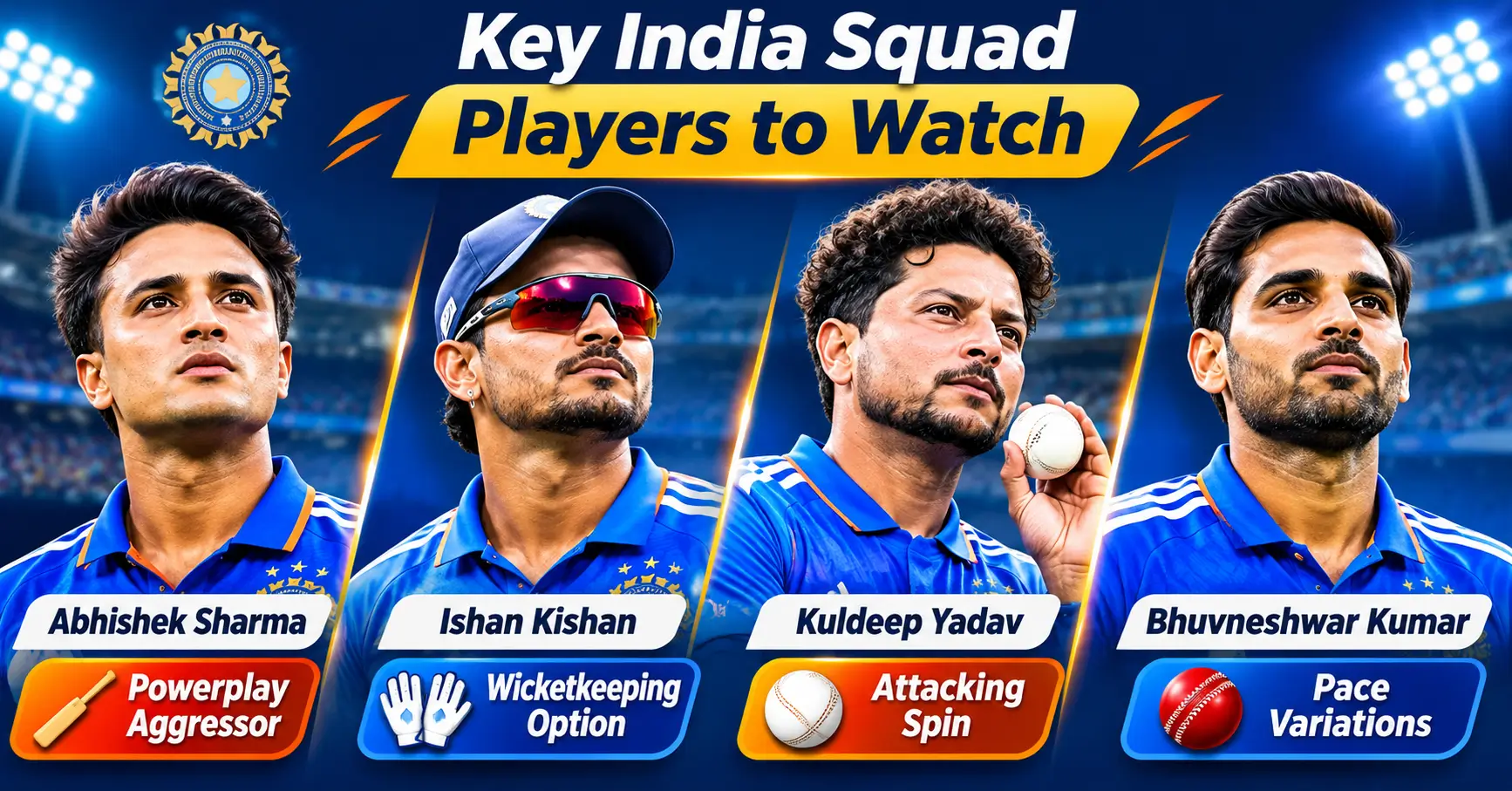
Abhishek Sharma: The powerplay aggressor
Abhishek’s primary assignment was to attack fielding restrictions and force opposition bowlers to change their preferred lengths. His left-handed approach also gave India a useful tactical variation. However, early aggression carries risk, especially when the ball swings or seams. Strong support from a partner or the middle order can keep the innings balanced.
Ishan Kishan and Sanju Samson: Wicketkeeping options
Both players offered wicketkeeping experience and the ability to bat positively. Selection between them — or deploying both in a batting combination — depended on the balance India wanted. Kishan brought a left-handed option, while Samson offered flexible positioning. Their presence created useful alternatives for the top and middle order.
Kuldeep Yadav and Ravi Bishnoi: Attacking spin
Kuldeep and Bishnoi represented two different styles of wrist spin. Kuldeep’s angles and changes of flight could invite attacking strokes, while Bishnoi’s pace and variations helped challenge batters through the middle overs. Alongside Axar’s left-arm orthodox bowling, they gave India several routes to match-ups rather than one fixed combination.
Arshdeep Singh, Mayank Yadav and Bhuvneshwar Kumar: Pace variations
Arshdeep’s left-arm angle and death-over skill provided variety. Mayank offered genuine pace, while Bhuvneshwar’s swing and experience were valuable new-ball traits. The late squad change involving Bhuvneshwar also illustrated the importance of keeping cover ready when players sustain injuries during a condensed series.
Key West Indies players and their T20I responsibilities
Shai Hope: Captain and innings controller
Hope could set a platform while retaining the ability to find boundaries. His measured style complemented the explosive options around him. For a captain, controlling the batting tempo is especially valuable when early wickets fall or a target demands a carefully timed acceleration. His strong series reinforced his importance to the West Indies line-up.
Shimron Hetmyer and Rovman Powell: Middle-over power
Hetmyer and Powell were capable of shifting momentum quickly through boundary hitting. Their challenge against India was to select the correct bowlers to target. Attacking every delivery would increase dismissal risk, but smart match-up choices could reduce the pressure on the remaining batting line-up and make high chases more manageable.
Romario Shepherd and Roston Chase: Useful dual skills
Shepherd could bowl seam and produce late runs; Chase offered stability with the bat and a spin option. Together with the other all-rounders, they gave West Indies more ways to adapt. This flexibility mattered when pitches favoured spin, when dew affected bowling plans or when a batting collapse required additional resistance.
India vs West Indies T20I 2026 schedule and results
| Match | Date | Venue | Result |
|---|---|---|---|
| 1st T20I | 6 October | Lucknow | India won by 8 wickets |
| 2nd T20I | 9 October | Ranchi | West Indies won by 6 wickets |
| 3rd T20I | 11 October | Indore | India won by 14 runs |
| 4th T20I | 14 October | Hyderabad | West Indies won by 24 runs |
| 5th T20I | 17 October | Bengaluru | No result (rain) |
Series result breakdown
Bars represent the percentage of five scheduled matches.
Why squad balance mattered in this series

Powerplay intent and early wickets
India’s batting approach placed a premium on rapid starts. Batting aggressively in the first six overs can push the required rate in a chase down quickly or create a stronger platform when batting first. However, losing multiple wickets early exposes the middle order to an unfamiliar rebuilding role. West Indies faced a similar balance between taking advantage of restrictions and protecting Hope or its later hitters from unnecessary pressure.
Middle-over spin match-ups
Spin brought a different challenge. Wrist-spinners such as Kuldeep and Bishnoi offered wicket-taking potential, while finger-spinners could force batters to manufacture scoring shots. Both captains had to consider whether a particular batter was comfortable attacking spin and which end of the pitch provided the better dimensions. The correct decision was situational rather than automatic.
Death overs and finishing
As run rates rose, pace execution became crucial. Yorker length, slower balls, wide lines and boundary field placements were all potential tools, but a powerful batting group can punish even slight errors. West Indies’ late-order hitting and India’s flexible all-rounders kept the final overs strategically important throughout the series.
Important India squad changes in October 2026
The BCCI explained that the Washington Sundar change was related to preparation for red-ball cricket ahead of the New Zealand Test series. The later Bhuvneshwar addition was different: it was an injury-cover decision made during the T20I series. Readers should not confuse the original September announcement, the October replacement list and the final 16-player update.
It is also important to distinguish squad membership from an appearance in the playing XI. Being named in a team list does not guarantee that a player featured in a particular game, and the same player may perform different functions depending on combinations and conditions.
What the drawn T20I series taught India and West Indies
For India, the series offered a valuable look at young batting talent against experienced Caribbean hitters and a varied bowling unit. It also exposed the challenge of selecting a team that is aggressive enough to score freely but sufficiently controlled to defend totals. Injury cover and role clarity mattered as much as raw individual talent.
For West Indies, sharing the series in Indian conditions demonstrated the competitiveness of their batting group and the value of an experienced captain. All-round strength gave the management alternatives in both innings, although having several multi-skilled players still required careful decisions about who would bowl the decisive overs.
More broadly, the contest reinforced a familiar principle in T20 cricket: teams need adaptable plans. The best combination can differ by venue, opponent, batting order or weather. Captains who identify match-ups early, respond to momentum shifts and preserve suitable bowlers for the closing stages give their side a better chance in tight contests.
Official sources for squad verification
The BCCI official India T20I squad announcement records the initial September selection. Its later notices document the replacement of Washington Sundar and the addition of Bhuvneshwar Kumar. These primary sources are the best way to establish which players were selected at each stage.
Frequently asked questions
Who captained India against West Indies in the 2026 T20I series?
Shreyas Iyer captained India, and Tilak Varma was vice-captain.
Who captained West Indies in the 2026 T20I series?
Shai Hope led West Indies and also served as a wicketkeeper-batter.
How many players were named in India’s squad?
India initially named 15 players. The updated list released before the fifth T20I contained 16 players.
Were Virat Kohli and Rohit Sharma in India’s T20I squad?
No. They were named for the ODI portion of the home series, not the T20Is.
Who were India’s wicketkeepers?
Ishan Kishan and Sanju Samson were India’s designated wicketkeeping options.
Why was Bhuvneshwar Kumar added?
He joined ahead of the final T20I as pace cover after Arshdeep Singh sustained a blow to his bowling shoulder.
Who won the India vs West Indies T20I series in 2026?
The series finished 2–2. The fifth and final match in Bengaluru ended without a result due to rain.
Where can I check the complete squad and player roles?
The tables above contain India’s final updated 16-player squad and West Indies’ squad, with primary cricketing roles.
Conclusion
The India vs West Indies T20 squad 2026 brought together contrasting strengths: India’s varied spin attack, aggressive batters and young pace options against West Indies’ powerful middle order and multiple all-rounders. Shreyas Iyer and Shai Hope led squads capable of adapting, and the 2–2 result reflected the competitive balance.
For a reliable understanding of this series, check both the original squad and its subsequent changes. Player roles explain why each cricketer was selected; actual performances and match conditions explain how those roles developed on the field.
Pingback: India vs West Indies T20 Most Runs: Top 10 Best Batters