
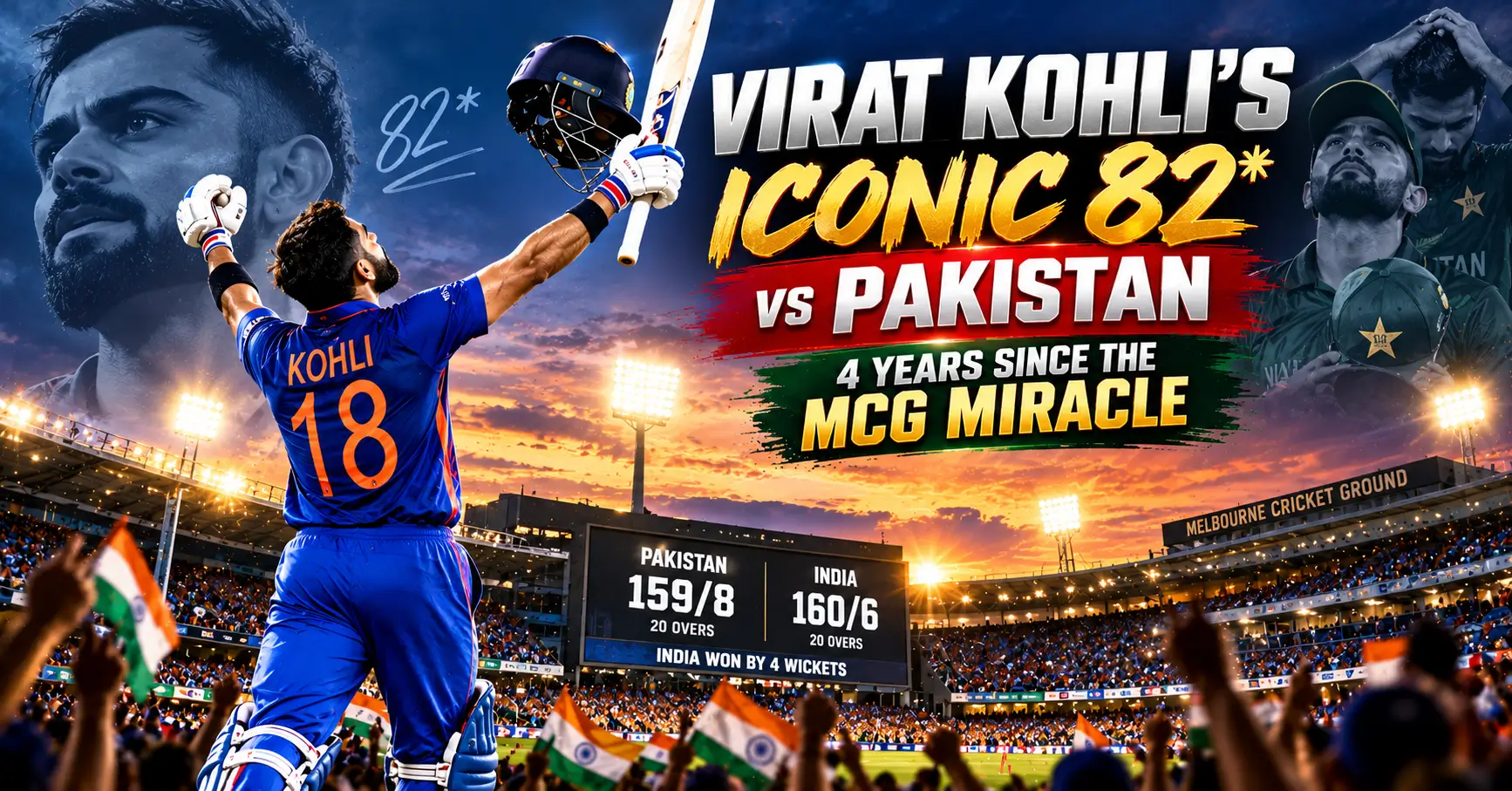
On 23 October 2026, cricket fans mark four years since Virat Kohli’s unforgettable 82 not out against Pakistan at the Melbourne Cricket Ground. Virat Kohli 82 vs Pakistan remains one of the defining stories of the 2022 Men’s T20 World Cup. On 23 October 2022, a packed Melbourne Cricket Ground watched India recover from 31/4 to chase Pakistan’s 159/8 off the last ball. Kohli stayed unbeaten on 82 from 53 deliveries, but the numbers alone cannot capture the pressure, the timing of his attacking shots or the drama of the final over. This was a match in which every phase changed the apparent favourite. Pakistan’s fast bowlers controlled the opening exchanges, Hardik Pandya helped rebuild the innings, and two remarkable sixes against Haris Rauf changed the final calculation. Four years later, the innings still rewards a closer look—not only as an individual performance, but as an example of how a T20 chase can be rescued through patience, partnerships and precise decision-making.
This fourth-anniversary retrospective revisits the 23 October 2022 contest—not a match played in 2026. The score, turning points and final-over details below refer to that original T20 World Cup encounter.
- India beat Pakistan by four wickets at the MCG on 23 October 2022.
- Kohli’s unbeaten 82 came from 53 balls, with six fours and four sixes.
- India slipped to 31/4 before Kohli and Hardik Pandya added 113.
- India needed 48 from the last three overs and 16 from the final over.
- Ravichandran Ashwin scored the winning run from the last delivery.
Virat Kohli 82 vs Pakistan: Match Summary and Setting
India and Pakistan arrived at the Melbourne Cricket Ground for their opening Super 12 fixture of the tournament. India captain Rohit Sharma won the toss and chose to field. The contest carried familiar rivalry pressure, but it also offered an important early opportunity to collect points in a difficult group.
Pakistan recovered from a shaky start to make 159/8. India appeared well placed to compete with that target, yet the chase unravelled almost immediately. The result eventually came down to the final ball, giving the fixture a shape that few scripted finishes could have matched.
| Fixture | India vs Pakistan, Men’s T20 World Cup, Super 12 |
|---|---|
| Date | 23 October 2022 |
| Venue | Melbourne Cricket Ground, Melbourne |
| Pakistan | 159/8 in 20 overs |
| India | 160/6 in 20 overs |
| Result | India won by four wickets, final ball |
| Player of the Match | Virat Kohli |
The winning margin was narrow, but the wider significance came from the contrasting phases. Pakistan had strong control with the new ball and still looked likely to defend the target late in the chase. India’s eventual success depended on an unusually calm response to those changing circumstances.
For readers following major rivalries beyond this single fixture, YoBook cricket coverage provides a starting point for other match stories and analysis.
Site note: online betting ID is a separate third-party topic and is not part of this match analysis or an official cricket source.
How Pakistan Reached 159/8
Early wickets gave India the advantage
India’s new-ball bowling put Pakistan under immediate pressure. Arshdeep Singh removed both Babar Azam and Mohammad Rizwan, breaking up the opening partnership before it could establish a platform. Babar fell without scoring, while Rizwan made four. Pakistan needed a recovery rather than a straightforward acceleration.
Shan Masood and Iftikhar Ahmed supplied that recovery in different ways. Iftikhar attacked the bowling and reached 51 from 34 balls, while Masood played a more measured innings, remaining unbeaten on 52 from 42. Their contributions were essential because Pakistan’s top order had not provided the fast start expected in a T20 contest.
A competitive target, not an overwhelming one
Pakistan’s 159/8 was defensible in the conditions, particularly with a pace attack capable of exploiting movement and bounce. Yet it was not a total that demanded reckless batting from India. A composed chase with wickets in hand would normally have been enough.
That distinction matters. The difficulty of India’s eventual win did not arise simply from a huge target. It arose because Pakistan’s bowlers reduced the chase to a crisis, forcing Kohli to rebuild before he could attack. The contrast between the target and India’s early collapse made the comeback extraordinary.
| Batter | Runs | Balls | Role |
|---|---|---|---|
| Shan Masood | 52* | 42 | Anchored innings |
| Iftikhar Ahmed | 51 | 34 | Middle-over acceleration |
| Others and extras | 56 | — | Remainder of 159 |
Pakistan’s 159 runs by contribution
Share of Pakistan’s innings total; calculated from the match scorecard. Percentages are rounded.India at 31/4: Why the Chase Looked Lost
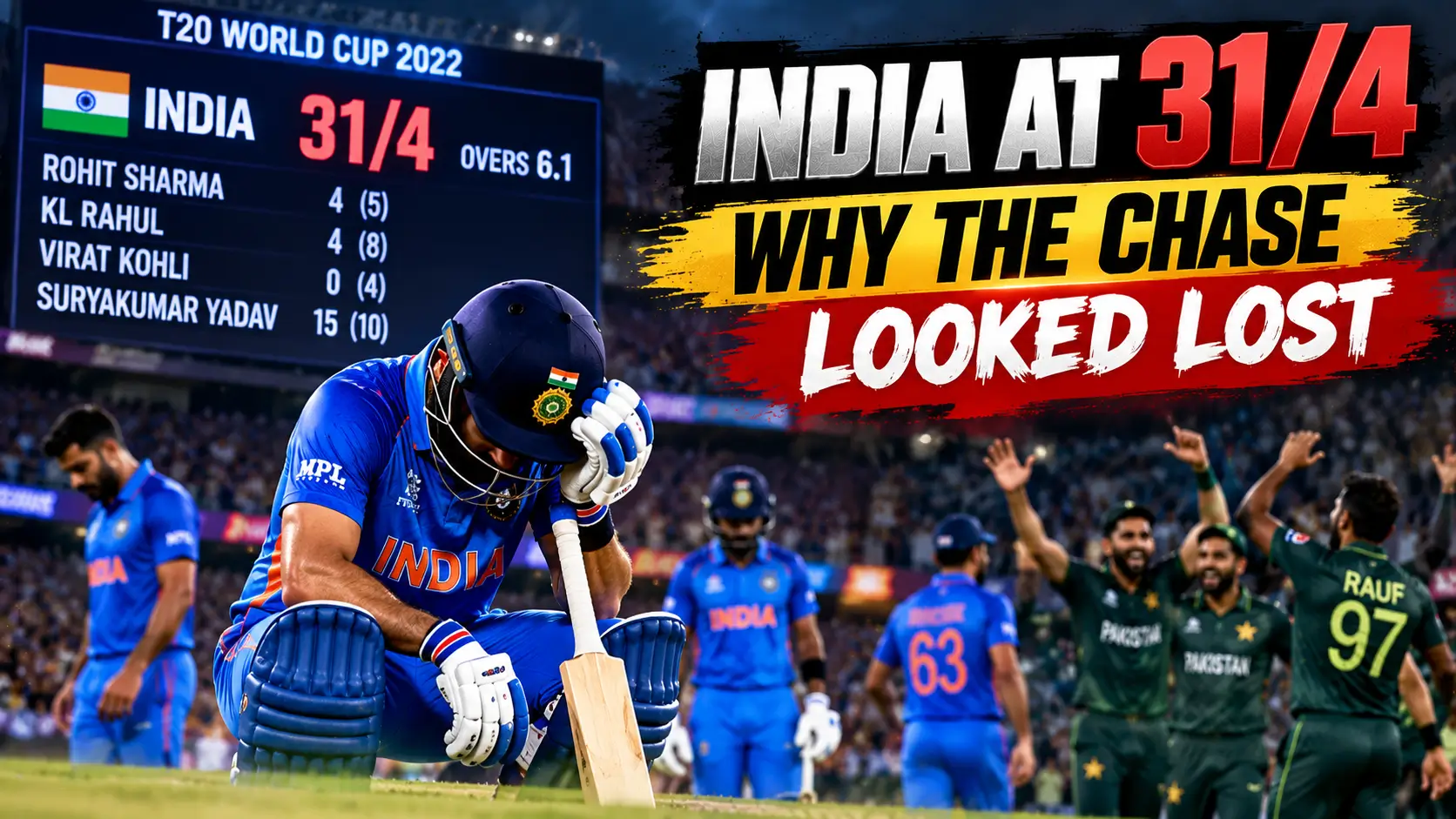
The first six overs did not resemble the beginning of a famous victory. KL Rahul was bowled by Naseem Shah for four, Rohit Sharma fell to Haris Rauf for four, and Suryakumar Yadav managed 15 before also being dismissed by Rauf. Axar Patel was run out for two. By 6.1 overs, India were 31/4.
That score changed the entire job facing Kohli. He could not simply target every boundary ball because another wicket would expose the lower order too early. Pakistan could maintain attacking fields, use their strongest bowlers with confidence and make the required rate feel increasingly uncomfortable.
Kohli’s response was to preserve the chase rather than chase the scoreboard immediately. He rotated the strike, assessed the bowling and trusted Hardik Pandya to share responsibility. Their partnership was built around the recognition that survival and scoring were not opposing goals: staying together would make a late assault possible.
The fifth-wicket stand that kept hope alive
Kohli and Hardik added 113 runs for the fifth wicket. Hardik’s 40 from 37 balls was not a conventional high-strike-rate cameo, but its value was immense. He absorbed pressure, gave Kohli a reliable partner and helped prevent the innings from disintegrating.
The stand took India from 31/4 to 144/5. Hardik was dismissed at the start of the final over, so his wicket did not erase the platform the pair had created. Without that partnership, the later sixes and final-over drama would probably never have been possible.
India’s recovery through the fifth wicket
India’s score at key wickets and at the finish; source: match scorecard. Bar scale is 160 runs.The sequence also explains why judging an innings only by its strike rate can be misleading. Kohli needed to manage both the fall of wickets and the climbing target. The late acceleration was effective precisely because he had kept himself at the crease.
The Two Haris Rauf Sixes That Changed Everything
India needed 48 from the final three overs. That equation gave Pakistan the advantage, especially because Haris Rauf had bowled with pace and control. Kohli first helped India make progress against Shaheen Shah Afridi in the 18th over, but the match’s most memorable turning point arrived in the 19th.
With 28 required from eight balls, Kohli faced Rauf and produced two consecutive sixes. The first, a straight hit from a hard-length delivery, has become the defining visual of the innings. It was a technically demanding shot: Kohli maintained balance, met the ball with a stable bat face and sent it high over the bowler’s head.
The next delivery disappeared over fine leg. Suddenly, the required equation fell to 16 from six balls. Pakistan still had a defendable total, but the psychological direction of the game had shifted. India no longer needed a near-impossible finish; one exceptional final over could win it.
Why the first six is remembered so vividly
Many T20 sixes are hit from full deliveries that allow the batter to swing freely. Kohli’s straight strike against Rauf came from a more awkward length, making its timing and trajectory unusually impressive. The shot combined anticipation, power and technique under extreme pressure.
The second six mattered just as much on the scoreboard. It confirmed that the first was not an isolated moment and forced Pakistan to defend a much smaller equation. Together, the two strokes changed both the mathematics and the mood inside the stadium.
The sequence is central to the legacy of Virat Kohli 82 vs Pakistan. It is possible to remember the innings as a sequence of spectacular boundaries, but the more revealing story is how long Kohli waited before selecting the moment to take his greatest risk.
Inside the Dramatic Final Over
Mohammad Nawaz had 16 runs to defend from the last six legal balls. The over became a test of execution, nerve and knowledge of the playing conditions. It also produced a series of moments that fans continue to debate.
Hardik fell from the first delivery, caught after mistiming an attempted big shot. Dinesh Karthik took a single, and Kohli then collected three runs across the next two balls. With three legal balls remaining, India still needed 13.
Kohli struck a high full toss for six, and the umpires called a no-ball for height. The boundary plus the extra reduced the requirement dramatically and created a free hit. Nawaz then bowled a wide, meaning the free hit carried over to the next delivery.
On that free hit, the ball struck Kohli’s stumps, but he could not be dismissed bowled. India ran three byes. Karthik was then stumped, leaving Ashwin to face the final moments. Nawaz sent down another wide to level the scores, and Ashwin lifted the last delivery over the infield for the winning single.
| Delivery | Event | India still needed |
|---|---|---|
| 19.1 | Hardik out | 16 from 5 |
| 19.2 | Karthik single | 15 from 4 |
| 19.3 | Kohli two | 13 from 3 |
| 19.4 no-ball | Kohli six + no-ball | 6 from 3 |
| Wide | Free hit continues | 5 from 3 |
| 19.4 free hit | Three byes | 2 from 2 |
| 19.5 | Karthik stumped | 2 from 1 |
| Wide | Scores level | 1 from 1 |
| 19.6 | Ashwin single | India win |
The no-ball and free-hit sequence drew intense attention, but the basic rules explain why the three byes were allowed. Because the delivery was a free hit, Kohli was not out bowled when the ball hit the stumps; the ball remained live and the batters could run.
For a contemporary explanation of that extraordinary finish, see the ICC’s breakdown of the final over.
What Made Kohli’s 82* So Special?
Adaptability before aggression
Kohli finished with 82 not out from 53 balls, hitting six fours and four sixes. His strike rate was 154.71, an excellent return in a chase that had collapsed to 31/4. Yet the defining quality was his ability to change tempo without losing control of the innings.
Early on, a rash attempt to recover the required rate could have ended the match. Kohli instead kept his options open. As the target became urgent, he shifted from controlled placement to deliberate boundary-hitting, while still choosing bowlers and deliveries rather than swinging at everything.
Pressure management
The setting magnified every decision. India and Pakistan were meeting in a global tournament, the MCG was packed, and a defeat looked likely for much of the chase. Kohli had to process the scoreboard while facing elite international bowlers who understood the match situation.
His composure did not mean the chase was effortless. It meant he could keep making purposeful choices even when the numbers looked unfavourable. The straight six against Rauf is often celebrated for its execution, but it also showed the confidence to attempt an unusual shot when safer options were no longer enough.
Contribution beyond the headline score
Hardik’s partnership, the late extras and Ashwin’s final-ball single were all indispensable. Calling the win a one-man achievement would diminish those contributions. Kohli’s performance was the central factor, but the result depended on several players making useful decisions at different moments.
India’s leading batting contributions
Shares of India’s 160-run total, calculated from the scorecard; rounded percentages may total 100.1%.Those shares underline Kohli’s importance. He personally scored more than half of India’s runs, and he was at the crease from the early collapse through the final delivery. Still, the broader lesson is that individual brilliance is often enabled by a partnership that survives long enough to make brilliance decisive.
Comparing the Innings With Other Great T20 Chases
Cricket supporters often ask whether this was India’s greatest T20 World Cup win. There is no official measurement for that claim. Different fans place different weight on tournament stakes, quality of opposition, difficulty of the chase and historical significance.
What makes Melbourne stand apart is the combination of circumstances. India lost four early wickets, required 48 from 18 balls and still needed 16 from the final over. Kohli then delivered a technically remarkable late assault, while the match remained unresolved until the final delivery.
Other famous Indian T20 victories have involved larger targets, title-winning stakes or decisive bowling spells. Melbourne was a group-stage game, not a final, so describing it as unquestionably the greatest would ignore those different contexts. But as an individual rescue act under rivalry pressure, it has an exceptionally strong case.
| Criterion | Melbourne 2022 evidence |
|---|---|
| Early adversity | India 31/4 in 6.1 overs |
| Partnership value | 113-run fifth-wicket stand |
| Late pressure | 48 needed from 18 balls |
| Individual performance | Kohli 82* from 53 |
| Finish | Won from the last ball |
| Tournament stage | Super 12 group match |
These categories make the debate more useful than a simple ranking. They explain why a relatively modest target of 160 produced a match that felt enormous. The narrative changed repeatedly, and the batter who carried the chase was still present at the end.
The Lasting Legacy of the Melbourne Thriller
Great sports moments often survive because one image becomes shorthand for a much larger story. For this match, that image is Kohli standing tall and striking Rauf straight back over his head. It captures the improbable nature of the recovery without needing to explain every delivery.
But the deeper legacy is tactical. Kohli showed that a T20 chase can be rescued without constant boundary-hitting from the beginning. The partnership with Hardik created the necessary time; the late attack exploited the bowling resources Pakistan had left. The innings was therefore both emotional and carefully constructed.
It also demonstrated how quickly a match can change. Pakistan’s position was strong after the powerplay and remained promising late into the innings. A handful of exceptional deliveries from Kohli and a chaotic final over reversed the result. That volatility is part of what makes the shortest international format compelling.
For younger batters, the innings offers lessons about reading match situations, trusting a partner and maintaining enough technical control to hit difficult deliveries under pressure. For fans, it remains a reminder that a game can appear decided and still produce a completely different ending.
Frequently Asked Questions
How many runs did Virat Kohli score against Pakistan in the 2022 T20 World Cup?
Kohli scored an unbeaten 82 from 53 balls, including six fours and four sixes.
Where was the India vs Pakistan 2022 T20 World Cup match played?
The match was played at the Melbourne Cricket Ground in Melbourne, Australia, on 23 October 2022.
How many runs did India need from the final three overs?
India needed 48 runs from the final 18 balls and 16 from the last over.
Who partnered Kohli during India’s recovery?
Hardik Pandya scored 40 from 37 balls and shared a 113-run fifth-wicket partnership with Kohli.
Who scored the winning run for India?
Ravichandran Ashwin scored the winning single from the final delivery bowled by Mohammad Nawaz.
Conclusion: A Chase That Still Defines Big-Match Composure
Four years later, on 23 October 2026, the innings remains a compelling example of how a controlled chase can turn in a handful of deliveries. The anniversary offers a reason to revisit the game, not to rewrite its history.
Virat Kohli 82 vs Pakistan was not simply a collection of spectacular shots. It was a complete chase under pressure: an early collapse, a disciplined partnership, an extraordinary acceleration and a finish that tested everyone involved. India won by four wickets on the final ball, but the result was uncertain almost to the end.
Whether it ranks as India’s greatest T20 World Cup victory remains a matter of opinion. Its place among the most memorable, however, is easy to understand. Kohli’s unbeaten innings combined technique, timing and temperament at a moment when India needed all three. The two sixes off Rauf will continue to dominate highlight reels, while the full scorecard reveals how much work was required to make those shots count.