
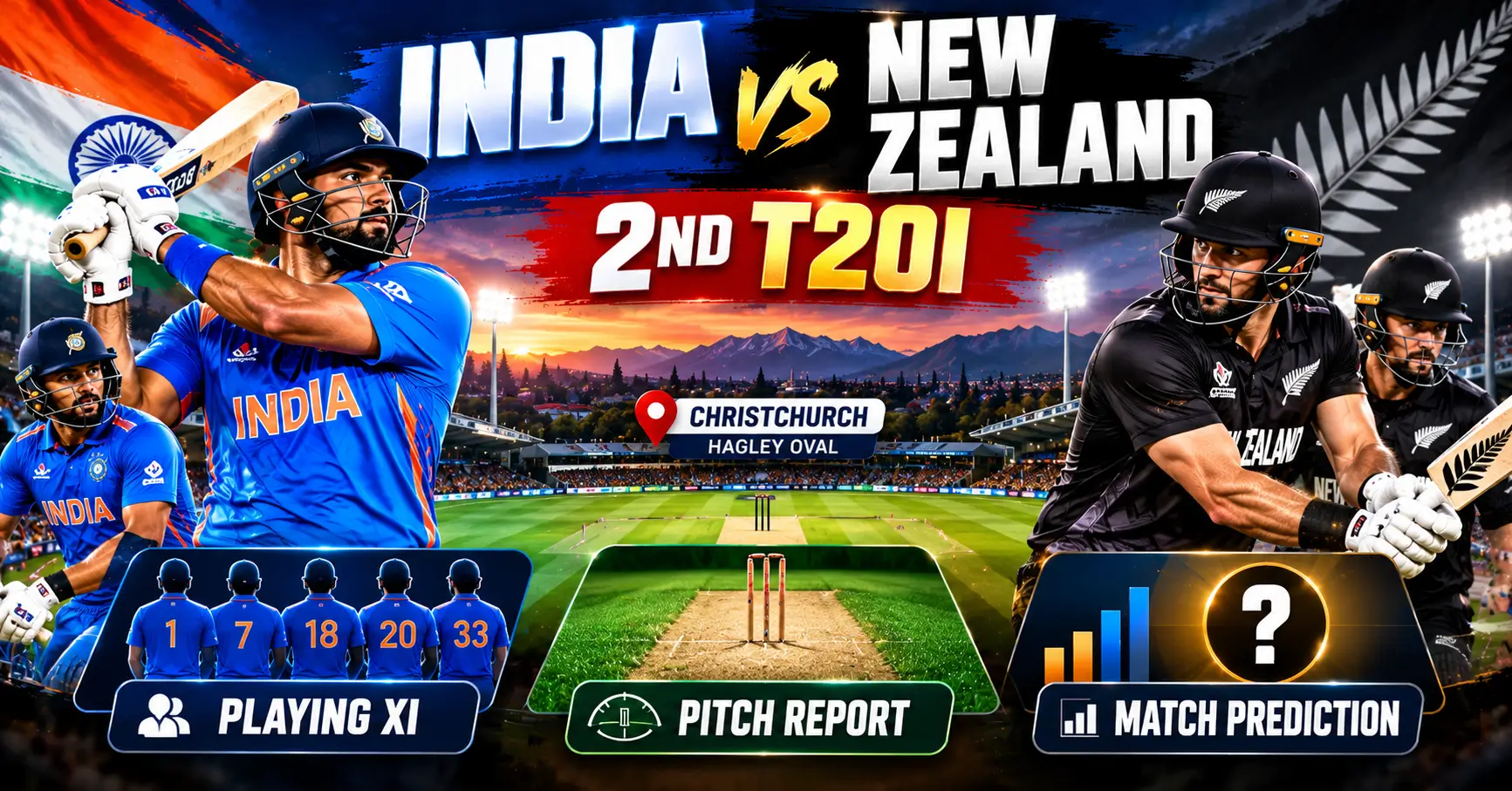
The India vs New Zealand 2nd T20I brings both sides back to Hagley Oval in Christchurch on Saturday, 24 October 2026. India enter the contest with a 1–0 lead after completing a remarkable chase in the series opener, but New Zealand have plenty of reasons to believe they can respond. Both batting units crossed 225 in the first match, making bowling plans, fielding and selection particularly important before the rematch.
This preview examines the confirmed schedule, the latest squad news, probable playing XIs, pitch behaviour and the contests that could decide the game. It also explains what can and cannot be learned from one extraordinary high-scoring match. Our winner assessment is editorial analysis, not a certain outcome. The final XIs, toss and actual surface conditions will only be known close to the start.
India vs New Zealand 2nd T20I: Match Details and Series Context
The two teams meet at the same ground only two days after the opening encounter. That short turnaround creates an unusual advantage for analysts: the first match provides a recent look at how both batting line-ups handled this venue. It does not guarantee that the next pitch will behave in the same way. Grounds often use different strips, and weather can change the balance between bat and ball.
| Match detail | Verified information |
|---|---|
| Fixture | New Zealand vs India, 2nd T20I |
| Date | Saturday, 24 October 2026 |
| Venue | Hagley Oval, Christchurch |
| Start time | 8:00 PM NZDT / 12:30 PM IST |
| Series | Five-match T20I series |
| Series position | India lead 1–0 |
| Confirmed playing XIs | Not yet announced at publication |
The schedule is confirmed by the BCCI tour announcement and the Cricbuzz fixture list. India can establish a 2–0 lead with another victory. New Zealand, meanwhile, have the opportunity to level the series before the teams travel to Wellington.
The opening result should influence tactical discussions, but it should not be treated as proof that either team will repeat the same scoring pattern. The second T20I starts with a fresh scorecard and potentially a different surface.
What the First T20I Tells Us About the Rematch
New Zealand scored 225/4 from 20 overs in the first match. Finn Allen contributed 45 from 24 deliveries, while Glenn Phillips remained unbeaten on 82 from 40. Bevon Jacobs added 31 from 16, helping the hosts finish with an imposing total. India then reached 230/6 with two balls remaining. The official match result was a four-wicket win for India.
Sanju Samson gave India momentum with 67 from 33 balls, and Abhishek Sharma scored 29 from 12. Shreyas Iyer added 42 from 28 before Naman Dhir produced a decisive unbeaten 42 from 15 balls. These are verified scorecard figures, not projections for the next match. The full numbers are available in the first T20I scorecard.
| Measure | New Zealand | India |
|---|---|---|
| Runs | 225 | 230 |
| Wickets lost | 4 | 6 |
| Overs faced | 20.0 | 19.4 |
| Run rate | 11.25 | 11.69 |
| Powerplay runs | 65 | 94 |
| Highest individual score | Glenn Phillips 82* | Sanju Samson 67 |
First T20I powerplay scoring
Editorial analysis: India’s 94-run powerplay was arguably the biggest early difference. It reduced the pressure of a steep target and gave later batters room to absorb wickets. New Zealand, however, still created chances by removing four Indian batters before the halfway point of the chase. Their bowlers were not completely out of the contest despite the eventual result.
For the rematch, the most useful question is not whether both teams can reach 225 again. It is which bowling attack can disrupt the opposition’s preferred scoring rhythm. Even a reduction of ten or fifteen runs during the first six overs could change how the remainder of an innings unfolds.
India vs New Zealand 2nd T20I Pitch Report: Hagley Oval
Early movement and the new-ball challenge
Hagley Oval is often associated with seam movement, bounce and conditions that reward accurate pace bowling. A fresh surface can encourage batters to play cautiously at first, especially if there is movement through the air or off the pitch. Yet the first T20I demonstrated that strong attacking batting can still produce a very high score here. Pitch reputation alone is not a dependable score forecast.
The exact strip selected for Saturday is not yet verified. It would be misleading to claim the ball will definitely swing for a fixed number of overs or that a particular total will be safe. The surface inspection, boundary dimensions and early overs will provide better evidence than generic venue descriptions.
What could change in the second innings?
The match is scheduled for an evening start in Christchurch. Cooler conditions, wind and possible moisture may affect the ball, but the extent of any impact is uncertain. Dew is a possibility rather than a certainty. Captains should weigh the benefit of chasing against the risk of facing fresh-ball movement at night.
The first game also illustrates why venue averages need context. A ground that has hosted low-scoring matches can still stage an unusually high-scoring contest when conditions, form and tactics align. One game does not establish a new normal. The sensible approach is to consider multiple matches while giving the most recent surface observations appropriate weight.
First-match innings run rates
What is a competitive total?
Editorial analysis: A first-innings total around 180 could be competitive on a surface offering meaningful assistance to bowlers. On a pitch similar to the first match, teams might require substantially more. These are conditional scenarios, not measured forecasts or promises. The score needed to win depends on wicket preservation, the bowling attack and how easily batters can hit through the line.
A more useful live indicator is the balance between wickets and runs after six overs. A side reaching 55/0 may be better positioned than one reaching 75/4, even though the second team has scored more quickly. Match context matters more than an isolated run-rate number.
Probable Playing XI: India and New Zealand
Probable XIs are editorial selections based on the first-match teams, published squads and current reports. They are not official announcements. India’s potential change is particularly important because Ishan Kishan has reportedly been ruled out with a right adductor injury. Vaibhav Sooryavanshi is one possible replacement, but his inclusion has not been confirmed.
India probable XI
Abhishek Sharma, Sanju Samson (wk), Vaibhav Sooryavanshi, Shreyas Iyer (captain), Tilak Varma, Axar Patel, Naman Dhir, Nitish Kumar Reddy, Bhuvneshwar Kumar, Arshdeep Singh, Mayank Yadav.
This projection retains most of the winning combination and uses Sooryavanshi as a possible replacement for Kishan. The batting order is illustrative and could change. India also have Shivam Dube, Kuldeep Yadav, Varun Chakaravarthy and Prince Yadav available in the announced squad. A different bowling balance is possible if the team management expects more spin or wants an extra specialist.
New Zealand probable XI
Finn Allen, Tim Seifert (wk), Daryl Mitchell, Glenn Phillips, Bevon Jacobs, Michael Bracewell, Mitchell Santner (captain), Nathan Smith, Adam Milne, Matt Henry, Lockie Ferguson.
This is the XI used in the first match, presented as a possible unchanged line-up. Devon Conway, Kyle Jamieson, Jacob Duffy, Josh Clarkson and Blair Tickner are alternatives. New Zealand Cricket confirmed that Mark Chapman and Zak Foulkes were ruled out of the T20I series and replaced in the squad by Clarkson and Tickner. See the official New Zealand Cricket injury update.
| Selection question | India | New Zealand |
|---|---|---|
| Top-order approach | Maintain attacking starts while protecting wickets | Contain India’s openers; improve powerplay control |
| Potential personnel change | Kishan replacement reportedly required | Unchanged XI possible; alternatives available |
| Spin options | Axar, plus Kuldeep or Varun if selected | Santner and Bracewell |
| Pace options | Bhuvneshwar, Arshdeep, Mayank | Henry, Milne, Ferguson, Smith |
| Status | Probable, not confirmed | Probable, not confirmed |
Selection decisions may change after fitness checks, training observations or the toss. Readers should consult the official team sheets before treating any projected combination as final. Even a single change can alter batting depth, bowling phases and fielding positions.
Five Player Battles That Could Decide the Second T20I
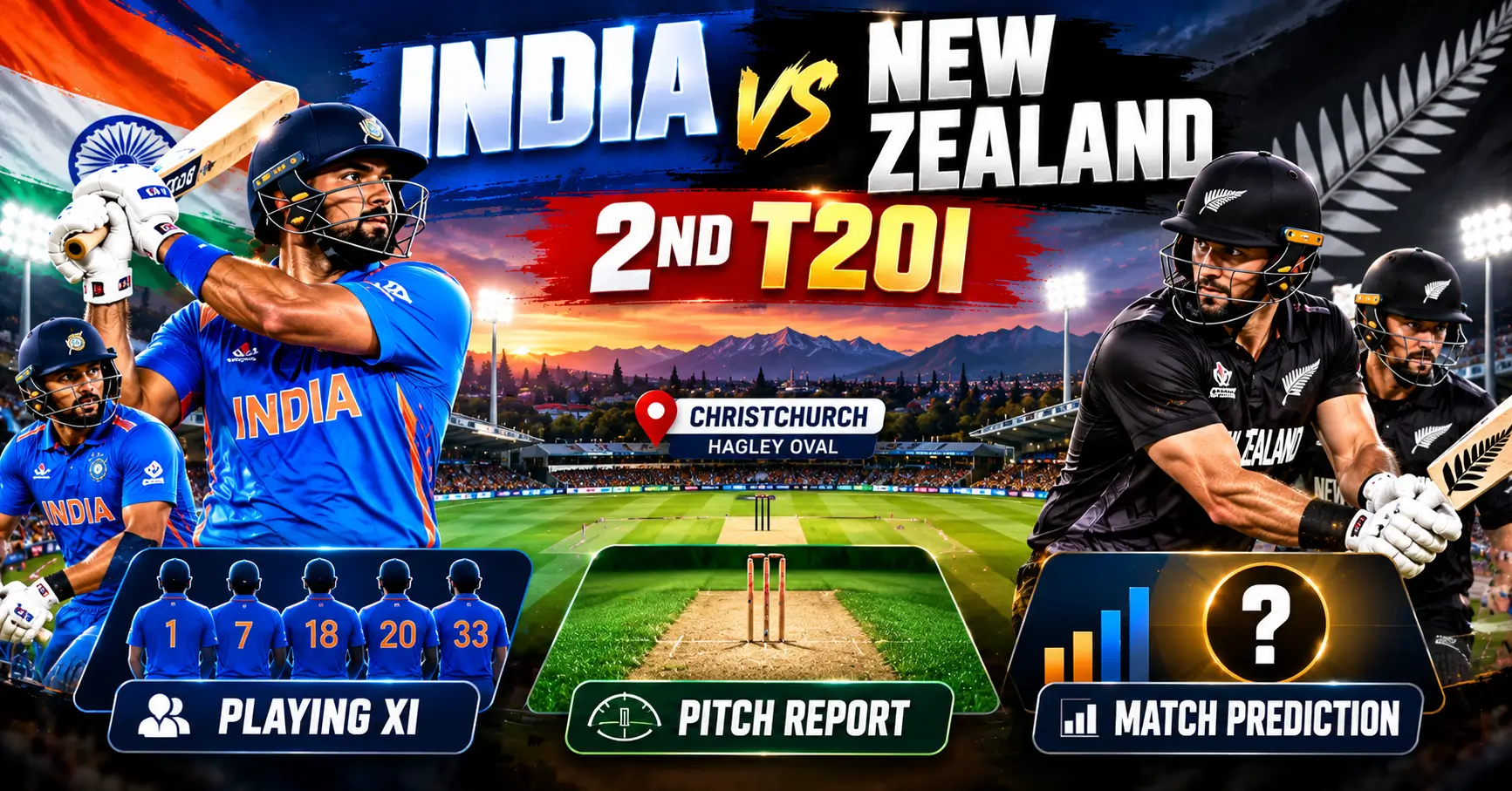
Sanju Samson against the new-ball attack
Samson’s 67 from 33 balls set the tone in the first match. New Zealand will want to limit the width and length that allow him to score freely. Matt Henry, Adam Milne and Lockie Ferguson offer different styles, so their deployment during the powerplay could be a central tactical decision. The objective is not necessarily to remove Samson immediately; even a sequence of dot balls could raise the required rate.
Finn Allen against India’s seamers
Allen’s 45 from 24 deliveries showed how quickly he can change the opening phase. India need a plan for his attacking intent, particularly when fielding restrictions are in place. Arshdeep Singh’s angle and Bhuvneshwar Kumar’s experience provide possible responses, but execution will matter more than reputation.
Glenn Phillips against India’s middle-over plans
Phillips was New Zealand’s highest scorer with an unbeaten 82. His ability to maintain momentum after wickets makes him a difficult player to contain. India may consider variations in pace and field placement, while keeping enough overs from their most reliable bowlers for the closing stages. Any specific match-up advantage remains an editorial hypothesis until supported by a sufficiently large ball-by-ball sample.
Naman Dhir against New Zealand’s death bowlers
Dhir’s 42 not out from 15 balls was a major reason India completed the chase. New Zealand must decide whether to attack him with pace, hard lengths or slower deliveries. Predicting a repeat of that innings would be unreasonable. What his performance does show is that India have a finisher capable of making the final overs productive.
Santner and Bracewell against India’s middle order
Mitchell Santner and Michael Bracewell each took two wickets in the opener. Together, they demonstrated that spin could still play a role despite the high total. India may counter by rotating strike more consistently and selecting match-ups carefully. If the second pitch is slower, this contest could become even more important.
Tactical Keys: Powerplay, Middle Overs and Death Overs
T20 matches are often shaped by three distinct phases. The powerplay offers boundary opportunities because of fielding restrictions, the middle overs reward adaptable batting and accurate spin, and the death overs test execution under pressure. Each team has evidence from the opening game about where it succeeded and where it was vulnerable.
India scored 94 in the first six overs compared with New Zealand’s 65, a gap of 29 runs. That is a striking difference, but it does not mean India will dominate the powerplay again. New Zealand can change their lengths, use different bowlers or take advantage of a less favourable batting surface. India must avoid assuming the opening game’s tempo is automatic.
Selected first-match batting contributions
Editorial analysis: New Zealand’s biggest improvement opportunity is their bowling during India’s first six overs. India’s challenge is preventing the kind of middle-innings wicket cluster that briefly threatened their chase. Neither team can rely solely on a strong finish to compensate for repeated errors earlier in the innings.
Fielding could also be decisive. At high scoring rates, a saved boundary or a completed run-out has an immediate effect. Bowlers need support from clear catching calls, disciplined positioning and reliable ground fielding. Those elements do not always dominate a scorecard, but they frequently shape close T20 contests.
Who Will Win India vs New Zealand 2nd T20I?
Editorial analysis — India have a slight advantage. The visitors have recent winning momentum, a demonstrated ability to chase a large target at this venue and several players who contributed with the bat. That makes India the marginal pick before the toss. This is a qualitative judgement, not a statistically calibrated probability or guaranteed outcome.
New Zealand remain fully capable of levelling the series. Their batting produced 225/4, Phillips was outstanding and their spin pair took four wickets. A better start with the ball, improved control of extras or a timely early wicket could make the second game very different. Playing at home also gives the hosts familiarity with local conditions, although familiarity alone does not determine results.
The prediction would move closer to New Zealand if the surface offers sustained seam movement and their fast bowlers exploit it. India’s case becomes stronger if the wicket plays true and their top order settles early. A late team change or injury could also shift the balance. No numerical win percentage is assigned because a validated predictive model has not been used.
For fans asking who will win, the most useful answer is therefore conditional: India are the editorial favourite at publication, but the margin is narrow. Watch the toss, confirmed XIs, first three overs and how the ball behaves before making stronger claims about either team’s position.
What Happens Next in the Five-Match T20I Series?
The second T20I is an important early contest rather than a series decider. India would move 2–0 ahead with a win, placing New Zealand under greater pressure in the remaining fixtures. A New Zealand victory would restore parity at 1–1 and give the hosts momentum before the series moves away from Christchurch. For readers exploring match predictions alongside Betting ID information, understanding team form, playing conditions, and recent performances can provide useful cricket insights, although no analysis can guarantee a match result.
| Match | Date | Venue |
|---|---|---|
| 2nd T20I | 24 October 2026 | Christchurch |
| 3rd T20I | 27 October 2026 | Wellington |
| 4th T20I | 30 October 2026 | Auckland |
| 5th T20I | 1 November 2026 | Hamilton |
The dates and venues above come from the BCCI’s official tour schedule. The two sides will have to adapt to different grounds as the series progresses. That is why a balanced squad, bowling flexibility and sensible rotation can become more important than any single high-scoring performance.
Readers following the wider tour can also explore an in-depth T20 match prediction guide to understand how pitch, player form and team balance should be weighed. The framework is useful for cricket analysis, but it cannot eliminate uncertainty.
Frequently Asked Questions
When is the India vs New Zealand 2nd T20I?
The match is scheduled for Saturday, 24 October 2026, starting at 12:30 PM IST.
Where will the second T20I be played?
The venue is Hagley Oval in Christchurch, New Zealand.
Who is likely to win the second T20I?
India have a narrow advantage in our editorial assessment, but the result is uncertain and depends on conditions and performance.
What is the pitch report for Hagley Oval?
The venue can offer seam movement and bounce, although the first T20I was high-scoring. The specific second-match pitch has not yet been verified.
Are the India and New Zealand playing XIs confirmed?
No. The line-ups in this preview are probable XIs. Final teams are announced around the toss.
Conclusion: Final Verdict on the Christchurch Rematch
The India vs New Zealand 2nd T20I should be an absorbing contest because both teams have already shown how dangerous their batting can be. India’s first-match victory gives them confidence, but New Zealand scored enough runs to prove they are serious challengers. The contest is likely to turn on powerplay control, disciplined bowling and how effectively each side adjusts to the selected surface.
Final verdict — India are the slight favourites, not overwhelming favourites. New Zealand have realistic routes to victory, especially if their seamers reduce India’s early scoring and Phillips receives support again. Check the confirmed XIs and toss before publication updates; the match outcome cannot be known in advance.