
India vs West Indies • 5th T20I • 17 October 2026 • Bengaluru
Published: 15 October 2026 | Preview written before the fifth T20I. Scores and fourth-match details verified against match reports.

The final India vs West Indies T20I in Bengaluru is more than a contest between batters trying to hit the most sixes. It is an examination of how quickly two international sides can study a defeat, change their plans and execute under the pressure of a series decider.
The scoreline reads 2-2 after four matches. India won in Lucknow and Indore, while West Indies prevailed in Ranchi and Hyderabad. On 17 October 2026 at 7:00 PM IST, the teams return for one last tactical battle at M. Chinnaswamy Stadium. The headline question is whether India can stop the West Indies power hitters without surrendering too much attacking intent of their own.
Hyderabad supplies the clearest clues: West Indies made 247/3, India were dismissed for 223 and the game swung on batting tempo, middle-over wickets and execution at the death. Those themes frame this analytical preview.
India vs West Indies T20I 2026: Results at a glance
| Match / venue | WI runs | IND runs | Outcome |
|---|---|---|---|
| 1st — Lucknow | 171 | 172 | India won by 8 wickets |
| 2nd — Ranchi | 253/4 | 249/5 | West Indies won by 6 wickets |
| 3rd — Indore | 209 | 223 | India won by 14 runs |
| 4th — Hyderabad | 247 | 223 | West Indies won by 24 runs |
Note: runs columns show each team’s innings total; wickets/overs differ by match.
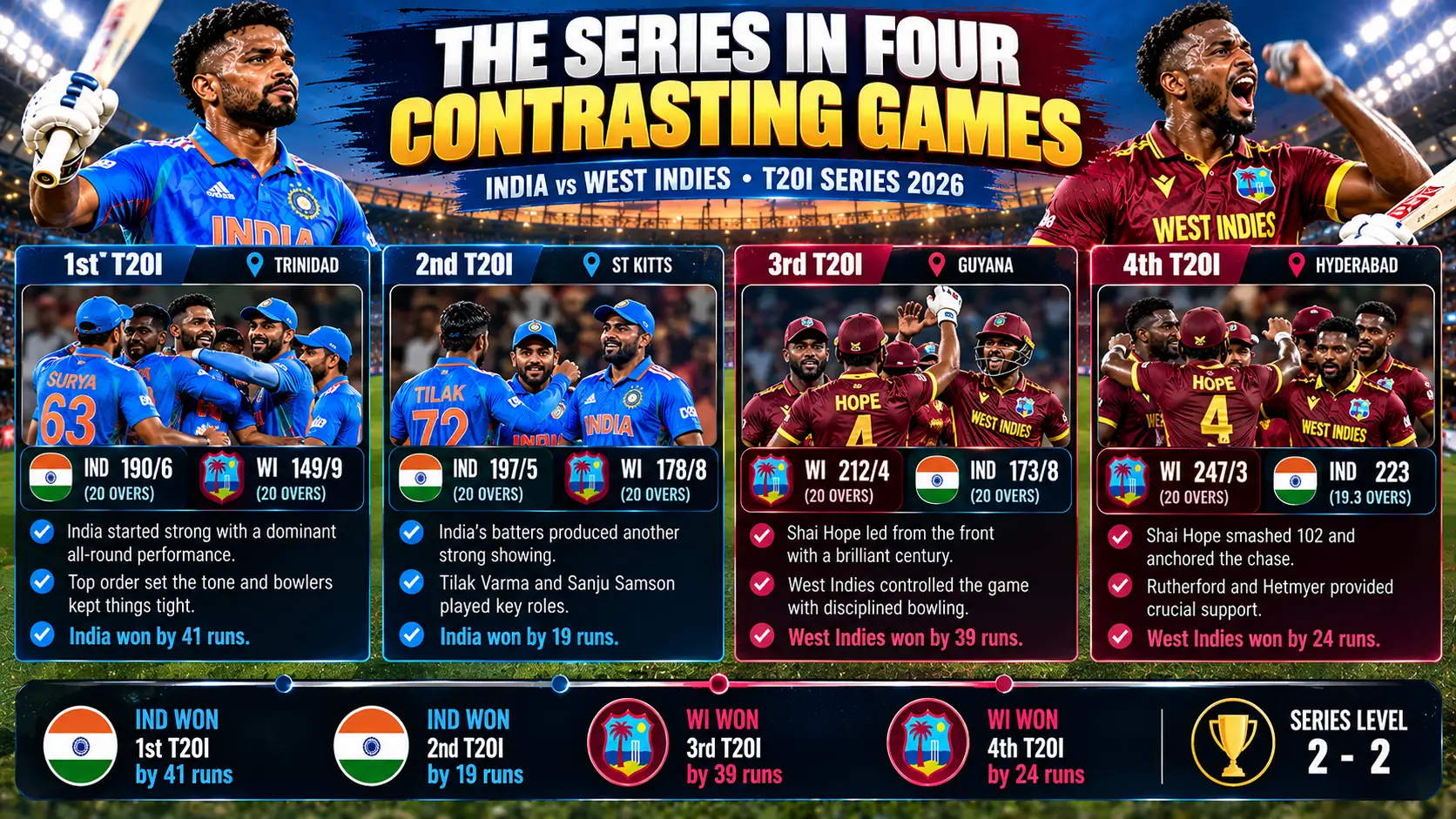
The series in four contrasting games
Lucknow offered an example of a controlled chase. India reached 172/2 against a West Indies total of 171, winning with eight wickets to spare. Ranchi showed the opposite extreme: India posted 249/5 but West Indies hunted down the target with six wickets remaining. No total seemed immune to a well-timed assault.
In Indore, India made 223 and defended it by 14 runs, providing evidence that an aggressive total could still be protected with effective wickets and planning. Hyderabad exposed the fine margins again. The visiting side accumulated 247/3, then used incisive wicket-taking spells to hold India to 223. Across the four games, the match winner has frequently been the team that handled one decisive phase better.
Fourth T20I scorecard snapshot
| Fourth T20I, Hyderabad | Performance |
|---|---|
| West Indies innings | 247/3 (20 overs) |
| India innings | 223 all out (19.3 overs) |
| Match result | West Indies won by 24 runs |
| Shai Hope | 102* off 50 balls |
| Sherfane Rutherford | 49* off 26 balls |
| Sanju Samson | 56 off 23 balls |
| Tilak Varma | 43 off 25 balls |
| Nitish Kumar Reddy | 41 runs |
| Keemo Paul | 5 wickets for 41 runs |
| Gudakesh Motie | 2 wickets for 13 runs |
4th T20I analysis: where Hyderabad was won
India chose to bowl after winning the toss, seeking to use the conditions and then chase under lights. West Indies disrupted that plan early. Openers Shai Hope and Jewel Andrew put on 52 from 26 balls; Andrew was dismissed for 21, but Hope continued attacking and reached his fifty from 28 balls. By the midpoint, the visitors had 118/2, an excellent foundation for late acceleration.
Hope was unbeaten on 102 from 50 deliveries, striking nine sixes and four fours. His pace of scoring forced field changes and reduced India’s margin for error. Rutherford’s 49 not out from 26 balls delivered a powerful finishing contribution. A total of 247/3 was not automatically unchaseable, but it left India needing a demanding 12.4 per over throughout.
Sanju Samson answered with 56 from 23 balls. That burst temporarily shifted pressure back onto West Indies, yet India’s middle order could not convert an aggressive start into a match-long chase. Tilak Varma made 43 and Nitish Kumar Reddy added 41, but the required rate and falling wickets eventually intersected.
The bowling turning point came when Gudakesh Motie struck twice in the middle overs, slowing India’s attempt to consolidate. Keemo Paul then collected five wickets for 41 runs, including a decisive late burst. India finished 223 all out after 19.3 overs and West Indies won by 24 runs. The final margin hides how competitive the early chase had appeared.
Tactical question one: can India interrupt the Hope-Rutherford engine?
Against a hitter in form, simply pushing more fielders to the rope can surrender easy singles and allow momentum to persist. India need wicket-taking intentions in the powerplay, perhaps with disciplined lines that limit Hope’s preferred scoring areas. The objective should be to change his options, not merely reduce the damage of a favourite stroke.
Rutherford presents a different challenge. Entering after a solid platform, he can attack from his first few balls. India need a death-over plan developed in advance: who bowls which over, where the boundary riders are placed and which delivery is the intended escape ball when a yorker is missed. Clear decisions are especially important on a venue known for fast scoring.
Tactical question two: what should India do after a flying start?
A strong powerplay is valuable, but it is only the opening phase of a chase. Samson proved in Hyderabad that he can slash the required rate quickly. The deeper question is whether the next pair can preserve that advantage rather than allow dot balls and dismissals to restore the pressure.
India could be better served by assigning complementary jobs: one batter retains an aggressive role while the other rotates strike and attacks only favourable matchups. Against bowlers using slower deliveries, waiting for the ball and targeting open spaces may be better than reaching early for a big hit. Disciplined batting can still be fearless batting.
Tactical question three: how much should India attack Motie and Paul?
After Motie’s influential spell and Paul’s five-for, India will anticipate more variation. Batters can prepare by watching release points, considering the speed change and identifying where boundary opportunities are statistically more realistic. The best response need not be to attack every delivery; it can be to deny wickets to the bowlers currently exerting control.
Conversely, West Indies will want to keep Paul’s most deceptive options available when India’s required rate begins to climb. That creates a strategic duel between batting resource management and bowling allocation. The side that best anticipates the next two overs may be more successful than the side reacting only to the previous ball.
Venue and score expectations: avoid false certainty
M. Chinnaswamy Stadium is often described as a batting-friendly venue because of its boundary dimensions and history of white-ball scoring. But a historical reputation cannot establish the exact conditions of a surface that has yet to be played on. The new ball, moisture, length of grass and potential evening dew remain essential variables.
It is tempting to announce a fixed par score or a confident toss-based result. Neither would be grounded before match-day inspection. A more useful framework asks whether the pitch rewards hitting through the line, whether slower balls grip and whether the side batting second can maintain traction and ball control.
What the numbers reveal — and what they do not
The first four encounters contain two West Indies totals above 240 and two India totals above 220, indicating genuine hitting power on both sides. Yet the fourth-match score of 247 did not tell the whole story: the innings mattered because Hope stayed until the end, and the defence mattered because bowlers took wickets rather than solely managing run rate.
The figures support a conclusion about momentum and match phases, but they do not independently support claims about exact win percentages. Small sample sizes, varying venues and changing conditions make precise pre-match probabilities unreliable without a declared model.
Prediction: the adjustment battle
India’s clearest route to victory begins with early wickets, a more economical finish with the ball and a chase or defence that avoids sudden batting collapses. West Indies’ route is to keep the Hope-led top order productive and make the Indian batters take risks against their most effective bowlers.
The series is evenly poised, and Bengaluru is unlikely to forgive prolonged inaccuracy from either attack. The strongest pick is not a team with a made-up percentage attached: it is the team that wins the pivotal two-over stretches, uses its specialist bowlers wisely and adapts fastest after the toss.
Cricket analysis and responsible online betting research
Readers researching cricket match analysis and the term betting ID should distinguish verified match statistics from predictions. A betting ID is not a measure of match outcome, and no preview can guarantee a winning result. For readers exploring cricket-related online services, casinoindia.vip is an external commercial website, not an official cricket statistics source. Check local laws, age restrictions, licensing and financial risks before using any wagering service.
Frequently asked questions
When is the India vs West Indies 5th T20I 2026?
Saturday, 17 October 2026, at 7:00 PM IST.
Where is the fifth T20I being played?
At M. Chinnaswamy Stadium in Bengaluru.
What happened in the fourth T20I?
West Indies made 247/3 and dismissed India for 223 to win by 24 runs in Hyderabad on 14 October.
Who scored a hundred in the fourth T20I?
West Indies captain Shai Hope scored 102 not out from 50 balls.
Who took the most wickets in the fourth T20I?
Keemo Paul recorded figures of 5/41 for West Indies.
Who is leading the series?
Neither side; the five-match series is tied 2-2 heading into the final.
Schedule, results and player figures were checked using these references. Analysis and predictions are editorial interpretations, not guaranteed outcomes.