The phrase Betting ID commonly appears in searches about online gaming accounts, while terms such as Casino Betting ID and Online Casino Betting are often used in the same context. Live Casino Games describes streamed versions of table games. These terms do not establish that a service is authorised or legal. Casino games come in many formats, from spinning reels and numbered wheels to card tables, dice and digital number draws. Each has its own rules, pace and mathematical structure. Some formats rely almost entirely on random outcomes, while others include decisions about cards or game actions. This guide explains ten well-known casino game categories, how their basic formats work and the terminology readers may encounter when researching them in 2026.
Casino Game Types: Visual Overview
Number of examples from the 10 game categories covered in this guide, grouped by their main presentation format.
This chart counts the examples listed in this article only. It is not a market-share, popularity, odds or payout comparison.
Casino Game Formats at a Glance
| Format | Examples | What Defines It? |
|---|---|---|
| Reel-based | Slots | Reels, symbols and title-specific rules |
| Wheel-based | Roulette | A ball settles in a numbered wheel pocket |
| Card-based | Blackjack, Poker, Baccarat | Card values, hand rankings or drawing rules |
| Dice-based | Craps, Sic Bo | Outcomes determined by dice combinations |
| Number-draw | Keno | Selected numbers compared with a random draw |
| Digital card format | Video Poker | Electronic presentation of poker-style hands |
| Live-streamed | Live Dealer Games | Video presentation of a dealer operating a table game |
What Does Betting ID Mean?
A Betting ID is a term commonly used to describe an account identifier, username or login reference associated with an online betting or gaming service. The exact meaning can differ between websites and apps. The related phrase Casino Betting ID is often used in searches about casino account access, while Online Casino Betting refers more broadly to online services that present casino-style games.
Live Casino Games is a different term: it describes games presented through a live video stream, often showing a dealer and physical table equipment. An account identifier, a game category and a streaming format are not the same thing. Most importantly, the use of labels such as “Betting ID” does not prove that an operator is licensed, safe or legally permitted to offer a service in a particular location.
This article explains these terms for informational purposes only. It does not provide instructions for obtaining a Betting ID, opening a real-money gaming account, making deposits or accessing online money games. Readers in India should review the legal information later in this guide before considering any online gaming service.
Understanding the Main Types of Casino Games
The phrase “casino games” covers several different types of entertainment. A slot game uses reels and symbols, roulette uses a wheel, and blackjack and baccarat use playing cards. Dice games such as craps and Sic Bo are based on the combinations produced by dice, while Keno uses a random number draw. Video poker presents a card-game format through a digital interface.
These categories should not be treated as interchangeable. A game may be offered in a physical venue, as a digital simulation or through a live video stream. The interface can change how the game is presented, but it does not remove the need to understand the rules, the randomness of outcomes or the applicable law.
There is also an important distinction between a game’s mechanics and its financial features. A free-to-play version may be designed for entertainment without money stakes or cash prizes. A version that involves deposits, monetary stakes and expected winnings can fall into a different legal category. The label used by a website or app is not, by itself, a reliable guide to legal status.
Top 10 Casino Games Explained
1. Slot Games
Slot games are among the best-known casino formats. A traditional slot machine has reels marked with symbols. When the reels stop, the symbols appear in a particular arrangement. The game’s rules explain which combinations, if any, correspond to a result. Digital versions often use animated reels and may include several paylines, ways-to-win systems or feature rounds.
Modern slot themes vary widely. Some use fruit symbols and familiar arcade-style visuals, while others use adventure, mythology, films or fantasy settings. A game may include wild symbols, scatter symbols, free-spin features or a bonus round. These features change the presentation and rules of a particular title; they do not provide a way to predict the next result.
Many digital slot games use a random number generator (RNG) to determine outcomes. The exact design and certification arrangements depend on the product and jurisdiction. Previous spins do not make a particular symbol “due”, and a long sequence of one result does not establish what will happen on the next spin.
What to understand: Learn the meaning of the paytable, symbols, paylines and any special features. Do not assume that two games with similar artwork use identical rules or probabilities.
2. Roulette
Roulette is a wheel-based game. A dealer spins a wheel and releases a small ball, which eventually settles in one of the numbered pockets. The standard European wheel has numbers 1 to 36 plus a single zero. The standard American wheel includes both zero and double zero. The extra pocket changes the mathematical probabilities of the game.
The wheel’s numbered pockets are coloured red or black, with the zero pocket shown in green. Roulette layouts also display groups of numbers and other categories. Historically, the game has included many kinds of wagers, but the basic idea is that the ball’s final pocket determines the result of a spin.
European and American roulette are not identical. Their wheel layouts differ, so readers should identify which version a description refers to. A digital roulette game may reproduce a wheel visually or use a software-based random outcome; the interface alone does not establish how the result is generated.
What to understand: Check the wheel variant, number layout and rules. A red or black result on one spin does not influence the colour of the next spin.
3. Blackjack
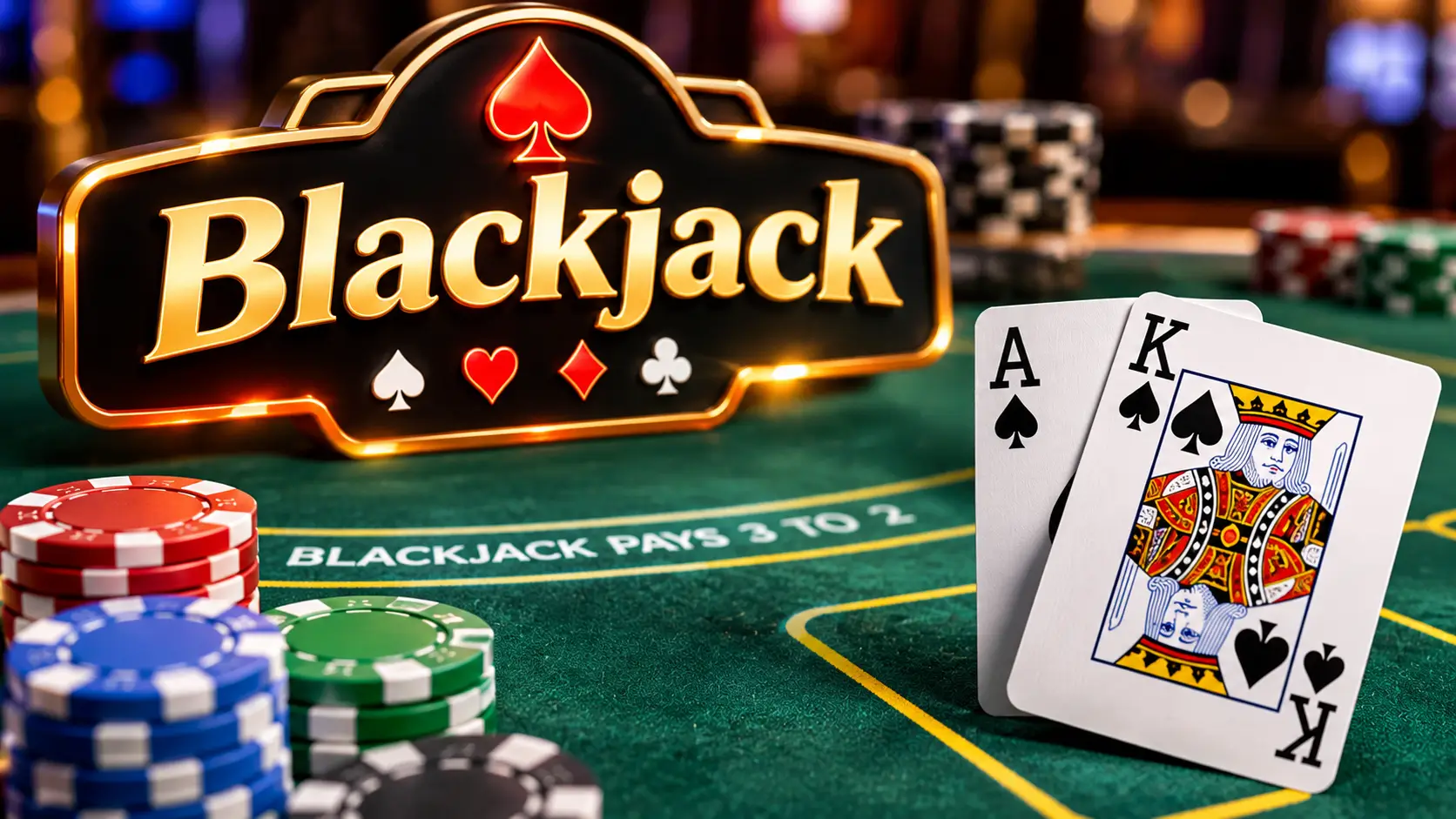
Blackjack is a card game built around the target total of 21. The central objective in the standard version is to finish with a hand value closer to 21 than the dealer’s hand without going over 21. Number cards generally count at face value, picture cards count as 10, and an ace can count as either 1 or 11 depending on the hand.
Players may encounter terms such as hit, stand, split and double down. A hit means taking another card, while standing means keeping the current hand. Splitting may be available when the first two cards form a pair, and doubling down is an option under specified rules to increase the stake in exchange for receiving a further card. Availability and restrictions vary by table.
Blackjack includes decisions that can affect the mathematical expectation of a hand. However, strategy does not guarantee a favourable result, and rules such as the number of decks, dealer actions and payout terms can vary. A basic explanation of the game should therefore not be confused with a promise of winning.
What to understand: Learn how card values work and read the table rules. The dealer’s procedures and the permitted player actions are important parts of each version.
4. Poker
Poker is a family of card games rather than one single format. Many versions use ranked five-card hands, but the way cards are dealt and how rounds proceed can be different. Texas Hold’em is widely recognised: each player receives private cards and uses them with shared community cards to make the strongest available five-card hand.
Other familiar variations include Omaha, Seven-Card Stud and Five-Card Draw. In Omaha, players receive four private cards and must use a specific combination of private and community cards. Seven-Card Stud does not use the same community-card structure as Hold’em. Five-Card Draw gives players a hand and a chance to replace selected cards, subject to the rules.
Poker combines probability, hand rankings, decision-making and interaction with other players. In formats where players compete against one another, the outcome is not simply a comparison with a dealer’s hand. Different versions can have different betting structures, table limits and rules, so the name of the variation matters.
What to understand: Identify the poker variation first, then learn its hand rankings, dealing sequence and round structure. Do not assume that rules from Texas Hold’em apply to every poker game.
5. Baccarat
Baccarat is a card game commonly described through two hands: Player and Banker. A third possible result is a Tie. The aim is to identify which hand finishes with a total closest to nine. In the standard scoring system, cards from 2 to 9 count at face value, aces count as one, and tens and picture cards count as zero. If a hand’s total reaches double digits, only the last digit is used.
For example, a hand with a 7 and an 8 has a total of 15, which is counted as 5. The drawing rules determine whether another card is dealt. In common baccarat formats, these rules are largely fixed rather than chosen freely by the participant, which is one reason the basic flow can be relatively straightforward to follow.
There are different baccarat variants and table procedures. The terms Player and Banker refer to the two hands in the game; they should not be confused with the identity of a person using a platform. Commission rules and the treatment of particular outcomes can also differ by version.
What to understand: Learn the card values, the way totals are calculated and the rules for drawing a third card. A simple-looking format still has specific rules.
6. Craps
Craps is a dice game that uses two six-sided dice. A round begins with a roll, often called the come-out roll in the standard Pass Line format. The sum of the two dice determines what happens next under the game’s rules. Depending on the point established, further rolls may be required before the round is resolved.
Craps has a large betting layout and a vocabulary that can seem unfamiliar to new readers. Terms such as Pass Line, Don’t Pass, Come, Don’t Come and odds refer to different parts of the game. Not every option has the same mathematical properties, and side bets can have different rules from the main line bets. For more cricket coverage, match explainers and tournament updates, readers can explore Casino India.
Because the game includes several possible wagers and stages, a short description cannot explain every craps rule. A proper rules guide should define the starting roll, point number, resolution conditions and the meaning of each bet before discussing any variation.
What to understand: Start by learning how the two dice determine a total and how a point is established. The layout is easier to interpret once the sequence of a round is clear.
7. Sic Bo
Sic Bo is a traditional dice game that uses three six-sided dice. The dice are rolled together, and the resulting combination determines the outcome under the game’s rules. A layout may show options relating to individual numbers, total sums, doubles, triples or other combinations.
Since three dice are involved, there are many possible combinations. Some outcomes are more common than others because different combinations can produce the same total. For example, a middle total can be formed in more ways than an extreme total. This is a basic probability concept, not a prediction of a particular future roll.
Different versions may display different betting categories or rules. A reader should not assume that every Sic Bo table has the same layout or that a particular term has identical treatment in every jurisdiction or product.
What to understand: Identify the three-dice format, the possible totals and the exact definition of each outcome category shown in the rules.
8. Keno
Keno is a number-draw game. A set of numbers is selected from a larger pool, and a random draw produces the result. In many versions, a participant marks a group of numbers before the draw and the result is assessed by comparing the selected numbers with those drawn.
The number pool, how many numbers are drawn and how the result is evaluated depend on the version. Some formats display a ticket-like grid, while digital versions animate the draw on screen. The visual style can resemble a lottery, but the precise rules and number ranges are product-specific.
Keno is relatively easy to describe at a basic level, but its probability structure depends on the number of selections and the draw rules. A result from one round does not make a chosen number more or less likely in an independent later draw.
What to understand: Read the number range, selection limit and draw rules. Avoid relying on patterns or claims that past draws can reliably predict future random results.
9. Video Poker
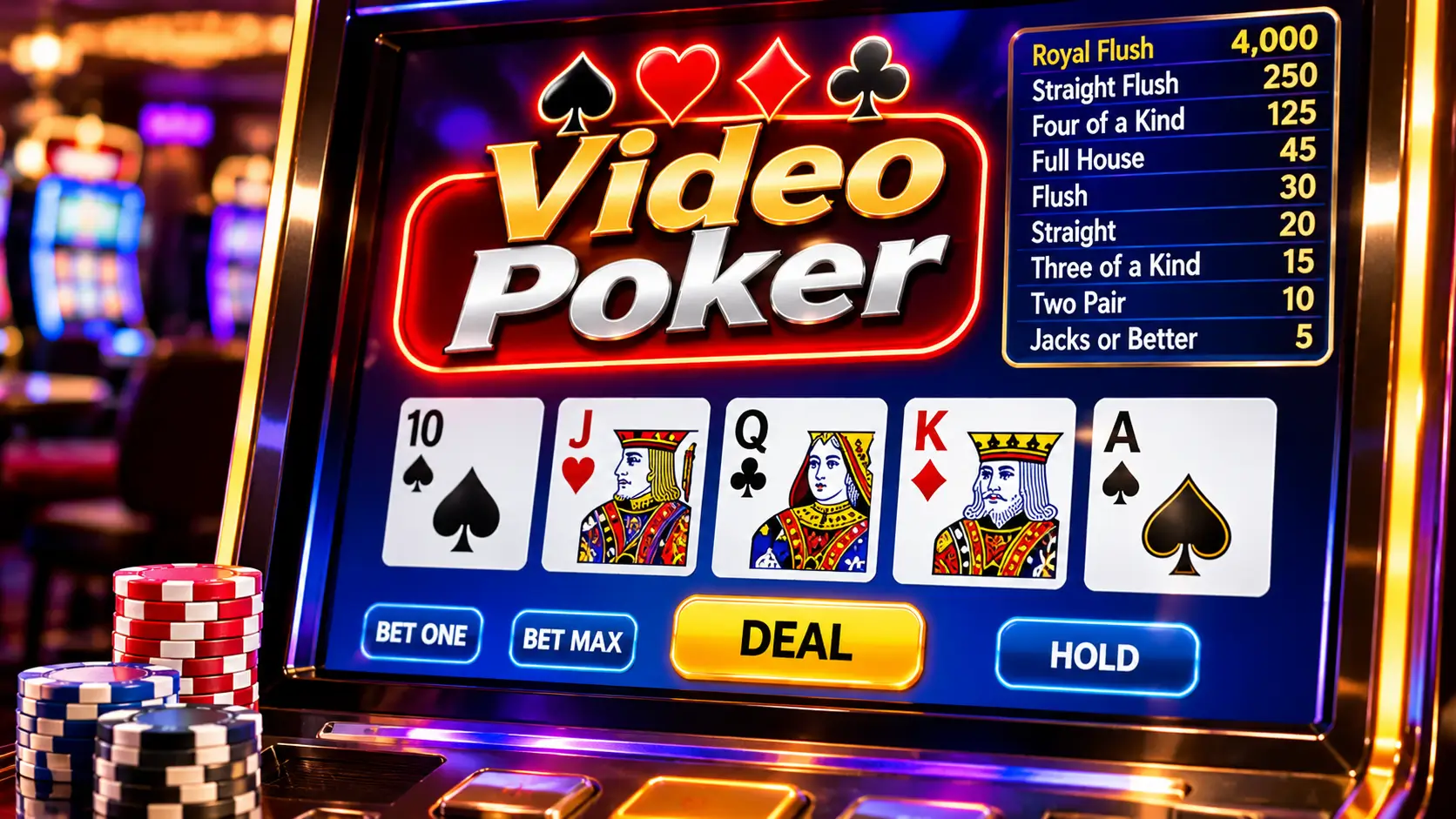
Video poker presents a poker-style card game through a digital screen. A common format deals a five-card hand and allows the player to choose which cards to hold and which to replace. The final hand is compared with the game’s paytable, which lists the combinations recognised by that version.
Video poker is not identical to a slot game, even though both may use a machine or digital interface. Its core presentation is based on playing cards and poker hand rankings. Different titles can use different paytables, rules and deck configurations, so the title alone does not tell a reader everything about the game.
Some versions are named after the hands or paytable structure they use. The expected mathematical return can vary substantially with the paytable and the decisions allowed by the game. Any published return figure should be understood as a theoretical calculation under stated assumptions, not a forecast of an individual session.
What to understand: Learn the hand rankings and read the exact paytable. Do not transfer the rules of one video poker title to another without checking its instructions.
10. Live Dealer Games
Live dealer games are a delivery format for casino-style table games. A video stream shows a real dealer operating physical equipment, such as a roulette wheel or card table. Depending on the production, viewers may see a studio table, multiple camera angles, on-screen game information and a chat feature.
Common live-streamed formats include roulette, blackjack and baccarat. The underlying rules are based on the relevant table game, while the streaming layer changes how the experience is presented. A live stream should not be mistaken for proof that a service is authorised or lawful in every location.
It is also useful to distinguish a live dealer table from an automated digital game. In a live format, the visible dealer and equipment are part of the presentation. In an automated format, the game may use software-generated animation or other digital systems. The operator should explain the format and applicable rules clearly.
What to understand: Identify the underlying game, read its rules and distinguish the video presentation from questions about licensing, location restrictions and legal availability.
Comparison of 10 Popular Casino Game Formats
The table below summarises the basic format of each category. It is a descriptive comparison, not a ranking by quality, payout, safety or legality. Individual products can differ from the general descriptions.
| Game | Main format | Basic mechanic | Important distinction |
|---|---|---|---|
| Slots | Reels and symbols | Symbols form an outcome when reels stop | Rules and features vary by title |
| Roulette | Numbered wheel | A ball settles in a numbered pocket | European and American wheels differ |
| Blackjack | Playing cards | Hand values are compared with 21 and the dealer’s hand | Player decisions and table rules matter |
| Poker | Playing cards | Players form ranked card hands | Several distinct variations exist |
| Baccarat | Playing cards | Two hands are compared with a target of nine | Fixed drawing rules are common |
| Craps | Two dice | Dice totals resolve stages of a round | Many named bet categories |
| Sic Bo | Three dice | Dice combinations determine outcomes | Several number and total categories |
| Keno | Number draw | Selected numbers are compared with a draw | Number pools vary by version |
| Video poker | Digital cards | Cards are held or replaced to form a hand | Paytables differ by title |
| Live dealer | Video-streamed table | A dealer presents a traditional table game | Streaming is a format, not a separate set of rules |
How Randomness, RTP and House Edge Are Different
Casino-game descriptions often use terms such as random number generator, return to player (RTP) and house edge. These terms describe different parts of a game’s mathematics and should not be treated as guarantees about an individual outcome.
Random number generator
A random number generator is a software mechanism used in many digital games to produce outcomes. In a properly designed random game, previous results do not provide a dependable method for predicting the next result. Readers should not trust claims that a game can be beaten by tracking a short sequence of spins, cards or number draws.
Return to player
RTP is a theoretical percentage describing how much a game is designed to return over a very large number of plays under specified conditions. It is not a promise that a user will receive that percentage back during a short session. Actual results can vary widely, and the stated RTP may apply only to a particular version or configuration.
House edge
House edge is a mathematical measure of the operator’s expected advantage in a game or wager over time. It is generally expressed as a percentage of the amount wagered. It does not mean that every individual round produces a loss of that exact percentage. The figure can change with the game variant, rules, paytable and wager type.
When comparing published figures, readers should check the source, version, assumptions and date. A number quoted without those details can be misleading. No RTP or house-edge figure removes the uncertainty of individual results or makes gambling a reliable way to earn income.
How to Read Casino Game Rules and Game Information
Before assessing any game description, identify its exact title and format. Two games may share a familiar name but use different rules, paytables or features. A reliable rules page should explain how an outcome is determined, what each symbol or card value means, and how any special feature works.
- Check the game variant: Confirm whether the description refers to European roulette, American roulette, Texas Hold’em, Omaha or another specific version.
- Read the full rules: Look for definitions of symbols, card values, dice outcomes, drawing procedures and round endings.
- Understand mathematical terms: RTP and house edge are long-run theoretical measures, not short-term predictions.
- Distinguish free play from money play: A free entertainment version may have different features and legal treatment from a product involving monetary stakes or prizes.
- Check the law where you are: A website being accessible does not prove that its service is permitted in your location.
Readers should also be cautious of promotional language such as “guaranteed win”, “fixed result” or “sure-shot strategy”. Random outcomes cannot be made certain by a tip, a pattern or a sequence of previous results. Treat unsupported claims as a warning sign rather than as reliable game information.
Are Online Casino Games Legal in India in 2026?
India’s legal framework changed with the Promotion and Regulation of Online Gaming Act, 2025. The Act received presidential assent in August 2025, and the Central Government appointed 1 May 2026 as its commencement date. The Promotion and Regulation of Online Gaming Rules, 2026 also came into force on 1 May 2026.
The Act addresses online money games and online money gaming services. Its provisions prohibit offering, aiding, abetting, inducing or otherwise engaging in the offering of an online money game or online money gaming service. It also addresses advertisements that directly or indirectly promote or induce participation in online money games, as well as the facilitation of related fund transfers.
The Act’s definition and operation should be read from the official legislation rather than inferred from a platform’s marketing description. In particular, describing a product as a game of skill, a casino entertainment product or an offshore service does not by itself establish that it is outside the law. The legislation and relevant rules should be considered together, and other applicable laws may also matter.
For an authoritative reference, read the official text of the Promotion and Regulation of Online Gaming Act, 2025 published by the Ministry of Electronics and Information Technology. For additional reading about online casinos, see this online casinos resource. This article is general information, not legal advice. Readers should consult the latest official notifications or a qualified lawyer for a specific question.
It is important to distinguish learning how a traditional game works from accessing an online service involving money stakes or monetary winnings. This guide explains game mechanics for informational purposes and does not direct readers to register, deposit funds or participate in online money gaming.
Frequently Asked Questions About Casino Games
1. What are the most popular types of casino games?
Commonly recognised categories include slots, roulette, blackjack, poker, baccarat, craps, Sic Bo, Keno, video poker and live dealer table games. Their rules and formats differ, so each category should be understood on its own terms.
2. What does Casino Betting ID mean?
Casino Betting ID is a phrase commonly used for an account identifier or login reference associated with a casino-style gaming service. The phrase itself does not confirm that the service is licensed or that using it is lawful in the reader’s location.
3. What is the difference between slots and video poker?
Slots generally use reels and symbols to produce an outcome. Video poker uses playing cards and poker hand rankings, often allowing cards to be held or replaced according to the game’s rules.
4. How does roulette work?
Roulette uses a numbered wheel and a ball. The result is the pocket where the ball settles, and standard European and American wheels have different number layouts.
5. Is poker the same as blackjack?
No. Blackjack compares a player’s hand with the dealer’s hand using a target of 21. Poker is a family of card games based on hand rankings, with variations such as Texas Hold’em, Omaha and Seven-Card Stud.
6. What do RTP and house edge mean?
RTP is a theoretical long-run return percentage, while house edge describes the mathematical advantage built into a game or wager. Neither figure predicts the result of an individual round or guarantees a particular return.
7. Are online money casino games legal in India in 2026?
The Promotion and Regulation of Online Gaming Act, 2025 and its 2026 Rules came into force on 1 May 2026. The Act prohibits online money games and related services, advertising and fund-transfer facilitation; consult the official text and qualified legal advice for specific circumstances.
Conclusion
The ten casino game categories in this guide use different mechanics: reels, wheels, cards, dice, number draws and live video presentation. Slots and Keno rely on randomised outcomes, roulette and dice games use physical or simulated random events, and card games such as blackjack and poker have rules that shape how hands are played. Video poker and live dealer formats change the way traditional mechanics are presented.
Understanding these differences helps readers interpret casino terminology, including Betting ID, Casino Betting ID and Online Casino Betting, compare game descriptions and recognise when a claim is unsupported. It is equally important to understand that RTP and house edge are theoretical measures, not guarantees of personal results. For readers in India, the legal framework introduced in 2025 and brought into force in 2026 is essential context. This overview of the top 10 casino games is intended for education, not as an invitation to participate in online money gaming.