
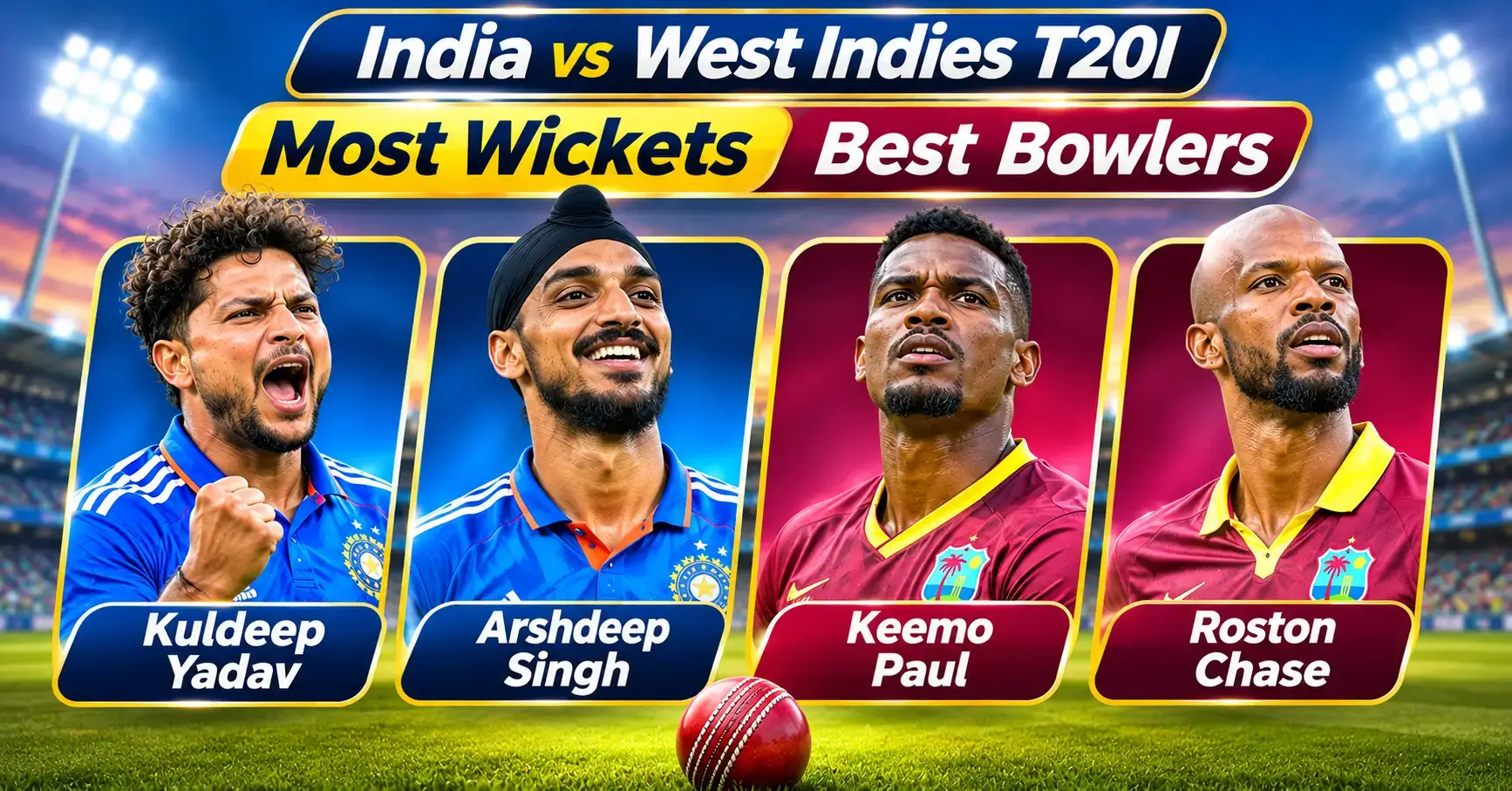
The India vs West Indies T20I most wickets list is led by Kuldeep Yadav, who has taken 20 wickets against the Caribbean side. Arshdeep Singh follows with 19, while Keemo Paul leads the West Indies bowlers with 14. These figures include the completed matches through 17 October 2026.
Quick answer: Kuldeep Yadav is the leading wicket-taker in India vs West Indies men’s T20Is with 20 wickets from 11 bowling innings. Arshdeep Singh has 19, and West Indies fast bowler Keemo Paul has 14. Obed McCoy owns the best innings figures in the rivalry: 6 for 17.
India vs West Indies T20I Most Wickets: Top 10 Bowlers
The table ranks bowlers by wickets in men’s T20Is between India and West Indies, through 17 October 2026. “Bowling innings” means innings in which a player delivered at least one ball; it is not total match appearances.
| Rank | Bowler | Team | Bowling innings | Wickets | Average | Economy | Best |
|---|---|---|---|---|---|---|---|
| 1 | Kuldeep Yadav | India | 11 | 20 | 15.70 | 7.14 | 3/12 |
| 2 | Arshdeep Singh | India | 15 | 19 | 25.63 | 8.99 | 3/12 |
| 3 | Keemo Paul | West Indies | 11 | 14 | 24.64 | 9.81 | 5/41 |
| 4 | Roston Chase | West Indies | 10 | 13 | 21.15 | 7.30 | 3/24 |
| 5 | Bhuvneshwar Kumar | India | 18 | 13 | 35.15 | 7.25 | 2/12 |
| 6 | Jason Holder | West Indies | 15 | 13 | 41.92 | 9.29 | 2/19 |
| 7 | Obed McCoy | West Indies | 9 | 12 | 24.25 | 9.39 | 6/17 |
| 8 | Romario Shepherd | West Indies | 13 | 12 | 36.00 | 11.08 | 4/31 |
| 9 | Ravi Bishnoi | India | 7 | 11 | 16.00 | 6.60 | 4/16 |
| 10 | Ravindra Jadeja | India | 12 | 11 | 29.73 | 8.96 | 3/48 |
Bar length is scaled to the leading total of 20 wickets.
Figures are specific to India–West Indies T20Is, not each player’s overall T20I career. Minor differences can appear across statistical sites if a page has not been refreshed after a series or uses a different cutoff date.
India occupy the top two places. Keemo Paul leads West Indies with 14 wickets, while Roston Chase, Bhuvneshwar Kumar and Jason Holder are tied on 13.
Kuldeep Yadav and Arshdeep Singh lead India’s bowling list
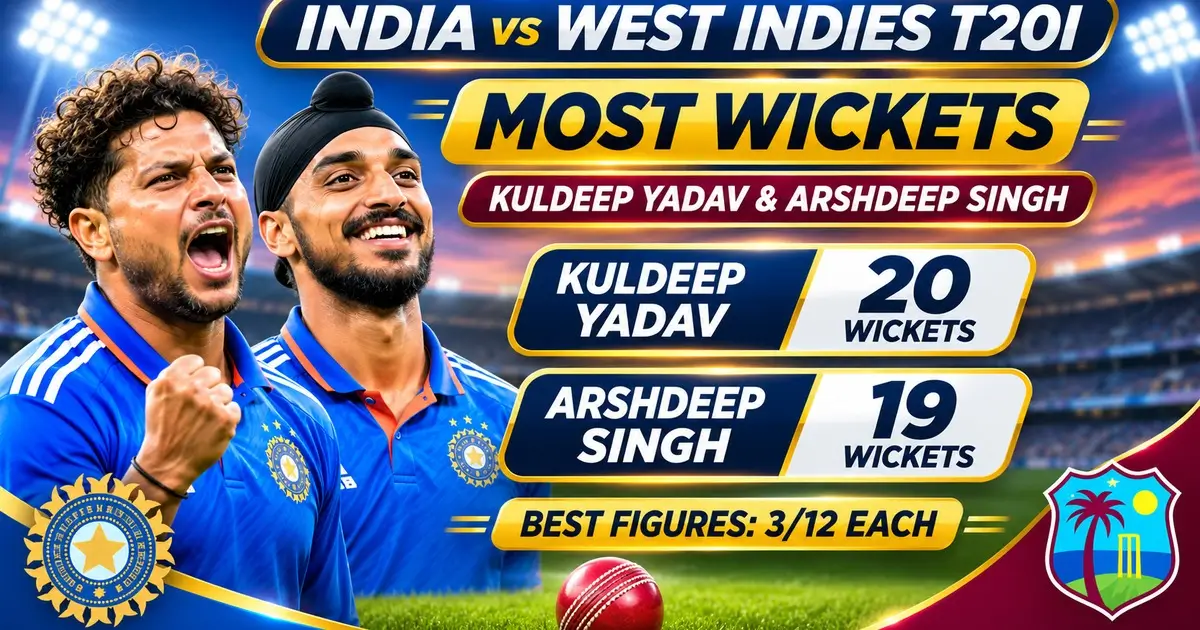
Kuldeep Yadav: the leading wicket-taker
Kuldeep’s 20 wickets make him the most successful bowler in this head-to-head T20I contest. He has taken those wickets in 11 bowling innings, at an average of 15.70 and an economy rate of 7.14. His best return against West Indies is 3 for 12.
Kuldeep’s average is the lowest among the ten bowlers, and his economy is also the best in the group. That combination shows both wicket-taking threat and control of scoring. His left-arm wrist spin changes pace and angle, making it difficult for batters to settle.
Kuldeep added three wickets in two appearances during 2026, extending his lead at the top of the rivalry list.
Arshdeep Singh: a close second
Arshdeep is only one wicket behind Kuldeep, with 19 in 15 bowling innings. His best figures against West Indies are 3 for 12. His left-arm pace gives India a different angle from Kuldeep’s wrist spin, and his role is especially important when the innings moves towards the final overs.
Arshdeep’s economy of 8.99 is higher than Kuldeep’s, but their roles differ. A fast bowler may be asked to defend runs at the death, when batters attack almost every delivery. Wickets in those overs remain valuable even when the economy rate rises.
Arshdeep’s 2026 return included 3 for 44 at Indore on 11 October. That spell helped India win the third T20I by 14 runs and kept him within one wicket of Kuldeep.
For readers following the team combinations behind these performances, the India vs West Indies playing XI 2026: all match lineups guide records the confirmed teams used across the October tour.
Other Indian bowlers with important records
Bhuvneshwar Kumar: control across many appearances
Bhuvneshwar Kumar has 13 wickets from 18 bowling innings against West Indies. His average of 35.15 is higher than the leading names, but his economy rate of 7.25 remains one of the most controlled in the top ten. His best figures in this fixture are 2 for 12.
Bhuvneshwar’s record reflects control through swing and changes of length, especially with the new ball.
Ravi Bishnoi: the strongest average after Kuldeep
Ravi Bishnoi has 11 wickets in seven bowling innings, with an average of 16.00 and an economy of 6.60. His best figures are 4 for 16. Among the ten listed bowlers, only Kuldeep has a lower bowling average. Bishnoi’s record is a reminder that a smaller sample can still show a very effective run of performances.
Ravindra Jadeja and the value of a containing role
Ravindra Jadeja has also taken 11 wickets in this rivalry. His best figures are 3 for 48, with an average of 29.73 and an economy rate of 8.96. His contribution is not measured by wickets alone. As a left-arm spinner, he can be used to build pressure, restrict easy singles and let a captain attack from the other end.
West Indies’ leading wicket-takers against India
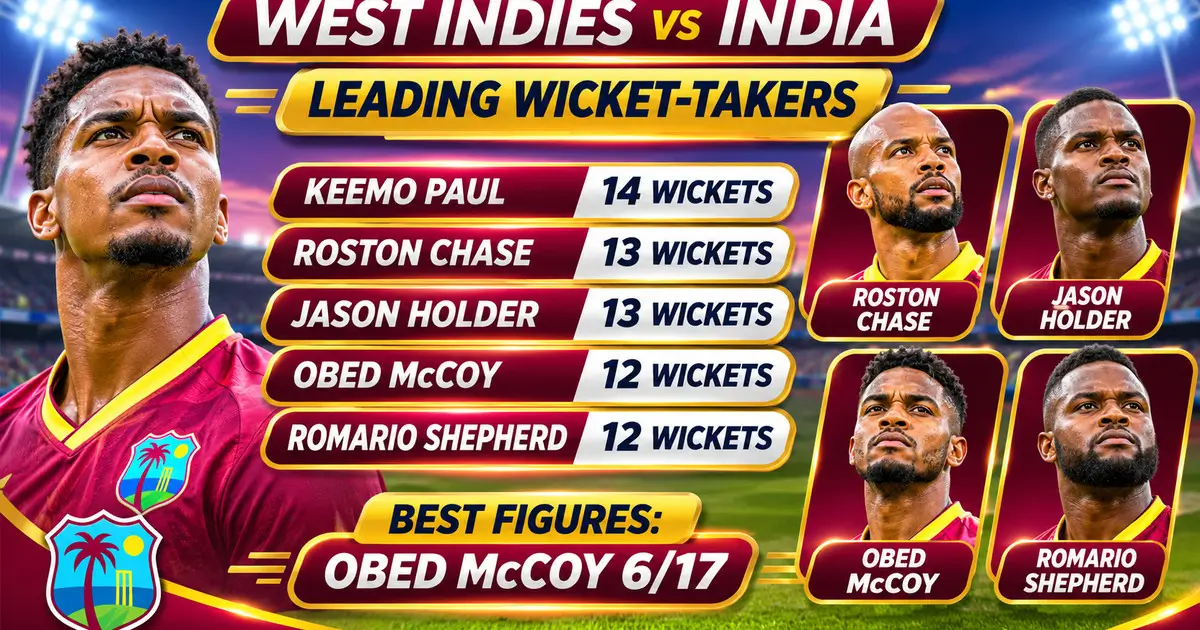
Keemo Paul: West Indies’ top bowler in the rivalry
Keemo Paul leads the West Indies column with 14 wickets in 11 bowling innings. He has an average of 24.64, an economy rate of 9.81 and best figures of 5 for 41. That five-wicket haul came in Hyderabad on 14 October 2026, when West Indies defeated India by 24 runs in the fourth T20I.
Paul’s 5 for 41 came in a high-scoring match. India chased 248 but were dismissed for 223 in 19.3 overs, allowing West Indies to win by 24 runs.
Roston Chase and Jason Holder: 13 wickets each
Roston Chase has 13 wickets, the same number as Bhuvneshwar Kumar and Jason Holder. Chase’s average of 21.15 is strong for this group, and his economy of 7.30 shows that he has often kept India from scoring freely. His best figures against India are 3 for 24.
Holder also has 13 wickets, with an average of 41.92 and economy of 9.29. His role combines seam bowling with lower-order batting.
Obed McCoy and Romario Shepherd
Obed McCoy has 12 wickets from nine bowling innings. His average is 24.25, and his best figures are 6 for 17. Romario Shepherd has 12 wickets from 13 bowling innings, with best figures of 4 for 31. Shepherd’s economy rate is 11.08, reflecting the attacking role he often fills in the later overs.
McCoy’s six-wicket haul remains the best innings return in this rivalry. It was also the first time a bowler had taken six wickets against India in a men’s T20I.
Best bowling figures in India vs West Indies T20Is
| Bowler | Team | Figures | Why it matters |
|---|---|---|---|
| Obed McCoy | West Indies | 6/17 | Best figures in the rivalry |
| Keemo Paul | West Indies | 5/41 | Five-wicket haul in Hyderabad in 2026 |
| Ravi Bishnoi | India | 4/16 | Best figures among India’s top-ten bowlers |
| Kuldeep Yadav | India | 3/12 | Best figures in 11 bowling innings |
| Arshdeep Singh | India | 3/12 | Best figures in the rivalry |
Obed McCoy’s 6 for 17: the standout spell
McCoy produced his record figures on 1 August 2022 at Warner Park in Basseterre. He took six wickets for 17 runs from four overs as India were bowled out for 138. West Indies then chased the target and won by five wickets, levelling the five-match series at 1–1.
McCoy struck with the first ball by dismissing Rohit Sharma, then removed Suryakumar Yadav, Ravindra Jadeja, Dinesh Karthik, Ravichandran Ashwin and Bhuvneshwar Kumar. This became a landmark spell in men’s T20Is.
India’s best spells in the fixture
Kuldeep’s 3 for 12 shows how wrist spin can attack the middle order without giving away many runs. Arshdeep has also reached 3 for 12, using left-arm pace to create different angles and target the stumps.
Bishnoi’s 4 for 16 is the only four-wicket haul among the Indian bowlers in this top ten. Such a spell can quickly change a chase or force a batting side to rebuild.
How to read the India vs West Indies bowling records
A wickets list is a useful starting point, but it does not tell the whole story. A bowler with more appearances has more chances to take wickets. A smaller sample can produce a better average or economy rate, so context matters.
- Wickets: the number of batters dismissed by the bowler. Run-outs are not credited to the bowler.
- Bowling average: the number of runs conceded for each wicket taken. A lower average is usually better.
- Economy rate: runs conceded per over. It helps show how well a bowler controls scoring.
- Best figures: the most wickets taken in one innings, followed by the runs conceded. For example, 6/17 means six wickets for 17 runs.
- Bowling innings: an innings in which the player bowled at least one delivery. It can be lower than the number of matches played.
Compare like with like. This article counts only men’s T20Is between India and West Indies, not ODI or Test wickets, domestic cricket, franchise tournaments or matches against other opponents. A player’s overall T20I career total will therefore be higher than the number shown here.
A clear cutoff date is essential. Figures published before the October 2026 tour showed Kuldeep on 17 wickets and Arshdeep on 14. The table here uses the updated snapshot through 17 October 2026.
What the 2026 T20I series added to the rivalry
The series finished 2–2 after rain stopped the fifth match in Bengaluru. India won in Lucknow and Indore; West Indies won in Ranchi and Hyderabad.
| Match | Date | Venue | Result |
|---|---|---|---|
| 1st T20I | 6 October 2026 | Lucknow | India won by 8 wickets |
| 2nd T20I | 9 October 2026 | Ranchi | West Indies won by 6 wickets |
| 3rd T20I | 11 October 2026 | Indore | India won by 14 runs |
| 4th T20I | 14 October 2026 | Hyderabad | West Indies won by 24 runs |
| 5th T20I | 17 October 2026 | Bengaluru | No result; rain |
The series changed the totals: Kuldeep extended his lead, Arshdeep closed the gap, and Paul moved to the top of the West Indies list. Paul’s five-wicket haul in Hyderabad and Arshdeep’s three wickets at Indore stood out.
McCoy’s six-wicket return from 2022 remains the landmark individual spell in this fixture. The ICC report on McCoy’s record-breaking 6 for 17 details the six dismissals and the significance of the performance in men’s T20I history.
By the end of the tour, the teams had met 36 times in T20Is. India had 22 wins, West Indies 12, and two matches ended without a result. The bowling table offers a different perspective: India hold the first two individual places, but McCoy owns the best single-innings haul.
Frequently asked questions
Who has taken the most wickets in India vs West Indies T20Is?
Kuldeep Yadav leads the men’s T20I head-to-head list with 20 wickets. He has taken them in 11 bowling innings, with best figures of 3 for 12.
Who is second on the India vs West Indies T20I wicket list?
Arshdeep Singh is second with 19 wickets from 15 bowling innings. His best figures against West Indies are also 3 for 12.
Which West Indies bowler has the most T20I wickets against India?
Keemo Paul leads West Indies bowlers with 14 wickets. His best figures are 5 for 41, taken in Hyderabad during the fourth T20I in October 2026.
Who has the best bowling figures in India vs West Indies T20Is?
Obed McCoy holds the record with 6 for 17 at Basseterre on 1 August 2022. It remains the only six-wicket haul by a bowler against India in men’s T20Is.
How many wickets has Bhuvneshwar Kumar taken against West Indies in T20Is?
Bhuvneshwar Kumar has taken 13 wickets in this fixture. His best bowling figures against West Indies are 2 for 12, and his economy rate is 7.25.
Are these figures for all international formats?
No. The table includes only men’s T20I matches between India and West Indies. ODI, Test, domestic and franchise cricket figures are not included.
Conclusion
The India vs West Indies T20I most wickets record is led by Kuldeep Yadav with 20, followed closely by Arshdeep Singh with 19. Keemo Paul is West Indies’ leading bowler in the fixture with 14, while Obed McCoy owns the best innings figures of 6 for 17.
The October 2026 series changed the leading totals and added another standout spell to the record books. Keep the cutoff date and format in mind when comparing these numbers, and use the wickets, average, economy and best figures together for a fair view of each bowler’s impact.