
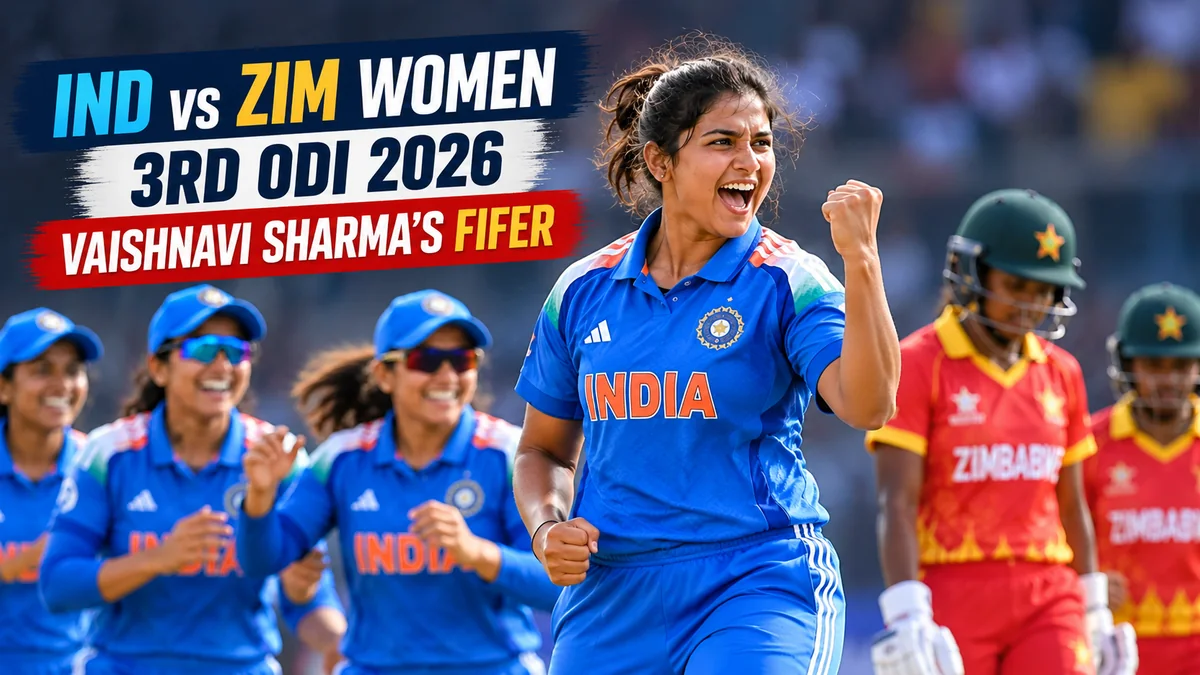
India Women completed a clean sweep of the three-match ODI series against Zimbabwe Women with an emphatic eight-wicket win in Vadodara on 28 October 2026. The defining moment was Vaishnavi Sharma’s maiden international five-wicket haul: the left-arm spinner returned 5 for 39 as Zimbabwe were dismissed for 131. India then chased the target in only 17 overs, with Pratika Rawal and Shafali Verma both scoring half-centuries.
IND-W vs ZIM-W 3rd ODI 2026: Match Summary
Zimbabwe won the toss and chose to bat at the BCA Stadium in Kotambi, Vadodara. India’s bowlers made that decision difficult almost immediately. Zimbabwe lost early wickets, struggled to score freely, and never built a partnership large enough to take control of the innings. Vaishnavi’s spell then broke the middle and lower order, leaving India a target of 132.
India lost Yastika Bhatia on the first ball of the chase, but that early wicket did not change the direction of the match. Pratika Rawal played a steady, attacking innings, while Shafali Verma scored quickly and put Zimbabwe’s bowlers under pressure. India reached 133 for 2 in 17 overs, winning by eight wickets with 198 balls remaining.
| Match detail | Information |
|---|---|
| Match | India Women vs Zimbabwe Women, 3rd ODI |
| Date | Wednesday, 28 October 2026 |
| Venue | BCA Stadium, Kotambi, Vadodara |
| Toss | Zimbabwe Women elected to bat |
| Zimbabwe Women | 131 all out in 39.5 overs |
| India Women | 133/2 in 17 overs |
| Result | India Women won by 8 wickets |
| Series outcome | India won the ODI series 3–0 |
| Standout performance | Vaishnavi Sharma: 5/39 in 10 overs |
Vaishnavi Sharma’s Maiden Five-Wicket Haul
Vaishnavi Sharma was the standout bowler of the third ODI. She finished with 5 wickets for 39 runs from her full quota of 10 overs, including one maiden. Her economy rate was 3.90 runs per over. The figures tell an important part of the story: she took half of Zimbabwe’s ten wickets while keeping the scoring rate under control.
Her impact was not limited to one phase. She removed Beloved Biza, who had struggled to get going, and later dismissed set batter Modester Mupachikwa. She also broke Zimbabwe’s resistance by removing Chiedza Dhururu and Michelle Mavunga before bowling Nyasha Gwanzura. Those wickets prevented Zimbabwe from turning a slow start into a competitive total.
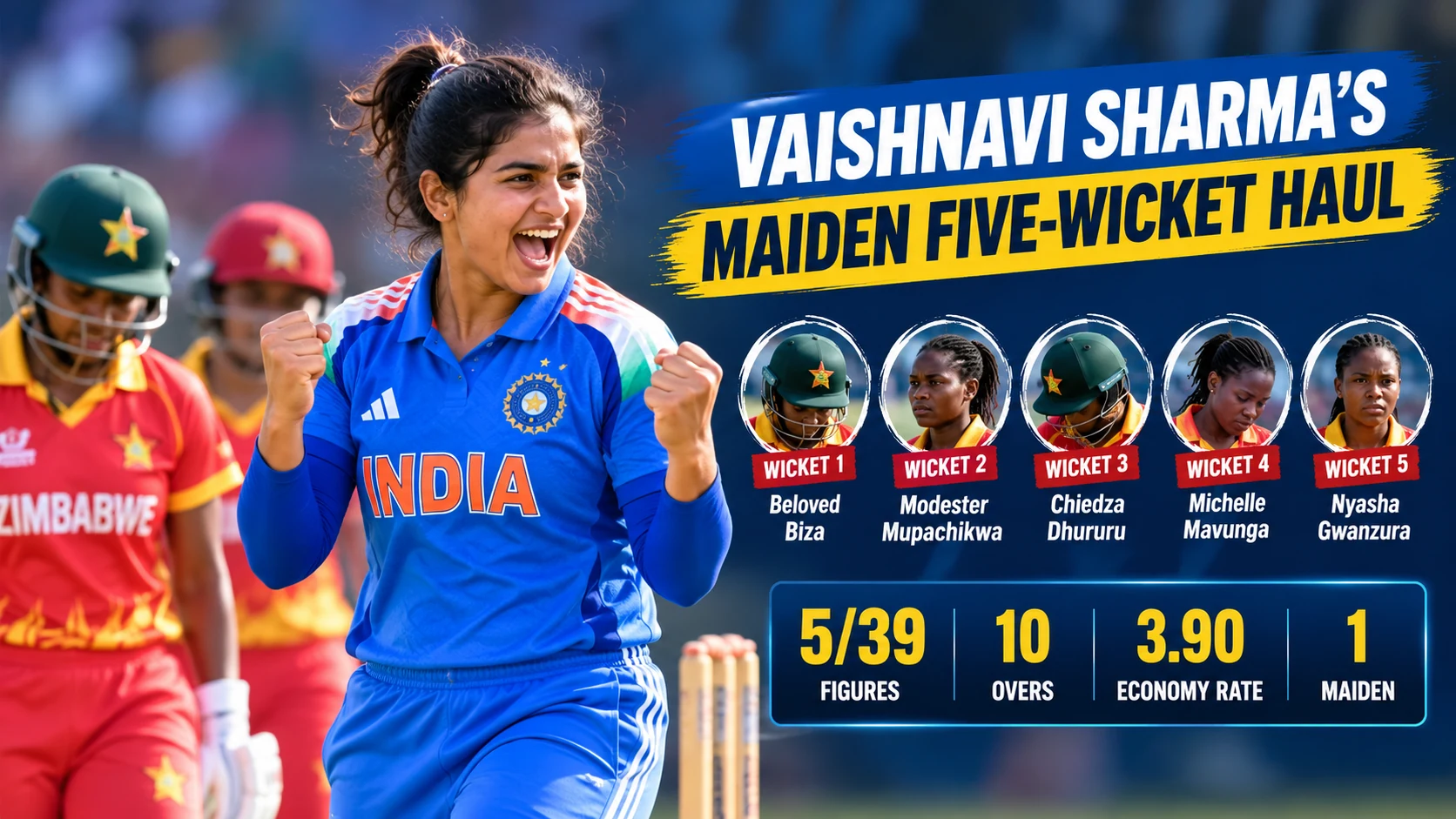
A five-wicket haul is a major milestone for any international bowler, especially in a format where batters have time to settle. This was reported as Vaishnavi’s maiden five-wicket haul in international cricket. Her performance also highlighted the value of having a spinner who can attack the stumps, vary flight and pace, and maintain discipline over a long spell.
Vaishnavi Sharma’s Bowling Figures
| Bowler | Overs | Maidens | Runs | Wickets | Economy |
|---|---|---|---|---|---|
| Vaishnavi Sharma | 10 | 1 | 39 | 5 | 3.90 |
| Sayali Satghare | 6 | 1 | 11 | 2 | 1.83 |
| Kranti Gaud | 7 | 1 | 23 | 2 | 3.28 |
| Jintimani Kalita | 6 | 0 | 27 | 0 | 4.50 |
Sayali Satghare and Kranti Gaud also played important roles, taking two wickets each. Satghare conceded only 11 runs in six overs, while Kranti returned 2 for 23. Their early breakthroughs ensured that Zimbabwe had to rebuild from a weak position rather than settle into a comfortable scoring rhythm.
For readers following the wider women’s cricket calendar, this match also underlined the importance of depth across formats. A team needs more than one standout bowler: early breakthroughs from the seamers, control from the spinner and sharp support in the field all helped India dictate the innings. Zimbabwe’s best response came through Mupachikwa and Nkomo, but their partnership was not enough to reset the game.
For readers exploring other online entertainment and gaming topics, CasinoIndia.vip is an external resource. It is unrelated to the match result, and all cricket figures in this report are presented separately from that link.
Zimbabwe Women’s Innings: Early Wickets Hurt the Visitors
Zimbabwe’s innings never found a smooth rhythm. They were 30 for 3 after the first 10 overs, a position that placed immediate pressure on the middle order. Loryn Phiri fell for a duck, Chipo Mugeri-Tiripano made four, and Beloved Biza scored only one. India’s bowlers attacked early and gave the visitors little room to build confidence.
Modester Mupachikwa top-scored with 37 from 48 balls, including seven fours. Captain Josephine Nkomo added 35 from 67 deliveries. Their contributions helped Zimbabwe recover from the early collapse, but the scoring rate remained modest. Chiedza Dhururu made 20, yet the innings lacked the late acceleration needed to reach a stronger total.
Zimbabwe reached 100 only late in the innings and slipped to 123 for 8 after 34 overs. The final two wickets added just eight runs before the innings ended at 131 in 39.5 overs. India’s disciplined bowling and fielding kept the pressure on throughout, and the lower order could not change the match’s direction.
Zimbabwe Women Batting Scorecard
| Batter | Runs | Balls | 4s | 6s |
|---|---|---|---|---|
| Modester Mupachikwa | 37 | 48 | 7 | 0 |
| Josephine Nkomo | 35 | 67 | 4 | 0 |
| Chiedza Dhururu | 20 | 39 | 4 | 0 |
| Nyasha Gwanzura | 10 | 13 | 2 | 0 |
| Michelle Mavunga | 6 | 9 | 1 | 0 |
| Chipo Mugeri-Tiripano | 4 | 8 | 1 | 0 |
| Francisca Chipare | 4* | 13 | 0 | 0 |
| Nomvelo Sibanda | 3 | 12 | 0 | 0 |
| Beloved Biza | 1 | 16 | 0 | 0 |
| Loryn Phiri | 0 | 6 | 0 | 0 |
| Olinder Chare | 0 | 10 | 0 | 0 |
| Extras | 11 | — | — | — |
| Total | 131 all out | 39.5 overs | ||
India’s Wicket-Takers
The bar chart below compares wickets taken by India’s main bowlers. It shows how the attack worked as a unit: Vaishnavi led the way, while Satghare and Kranti provided valuable support.
Chart note: The bars show wickets, not total bowling impact. Economy, pressure and the timing of wickets also matter when judging a spell.
India’s Chase: Pratika Rawal and Shafali Verma Finish the Job
India needed 132 runs to win, and the chase was completed in just 17 overs. Yastika Bhatia was dismissed on the first ball, but the early setback did not create a sustained opening for Zimbabwe. India reached 50 in 6.2 overs and maintained a scoring rate far above the visitors’ rate in the first innings.
Pratika Rawal anchored the chase with an unbeaten 59 from 56 balls. She struck four fours and three sixes, balancing control with attacking shots. Rawal reached her half-century from 47 deliveries and remained at the crease until the winning target was passed. Her innings gave India stability after the opening wicket.
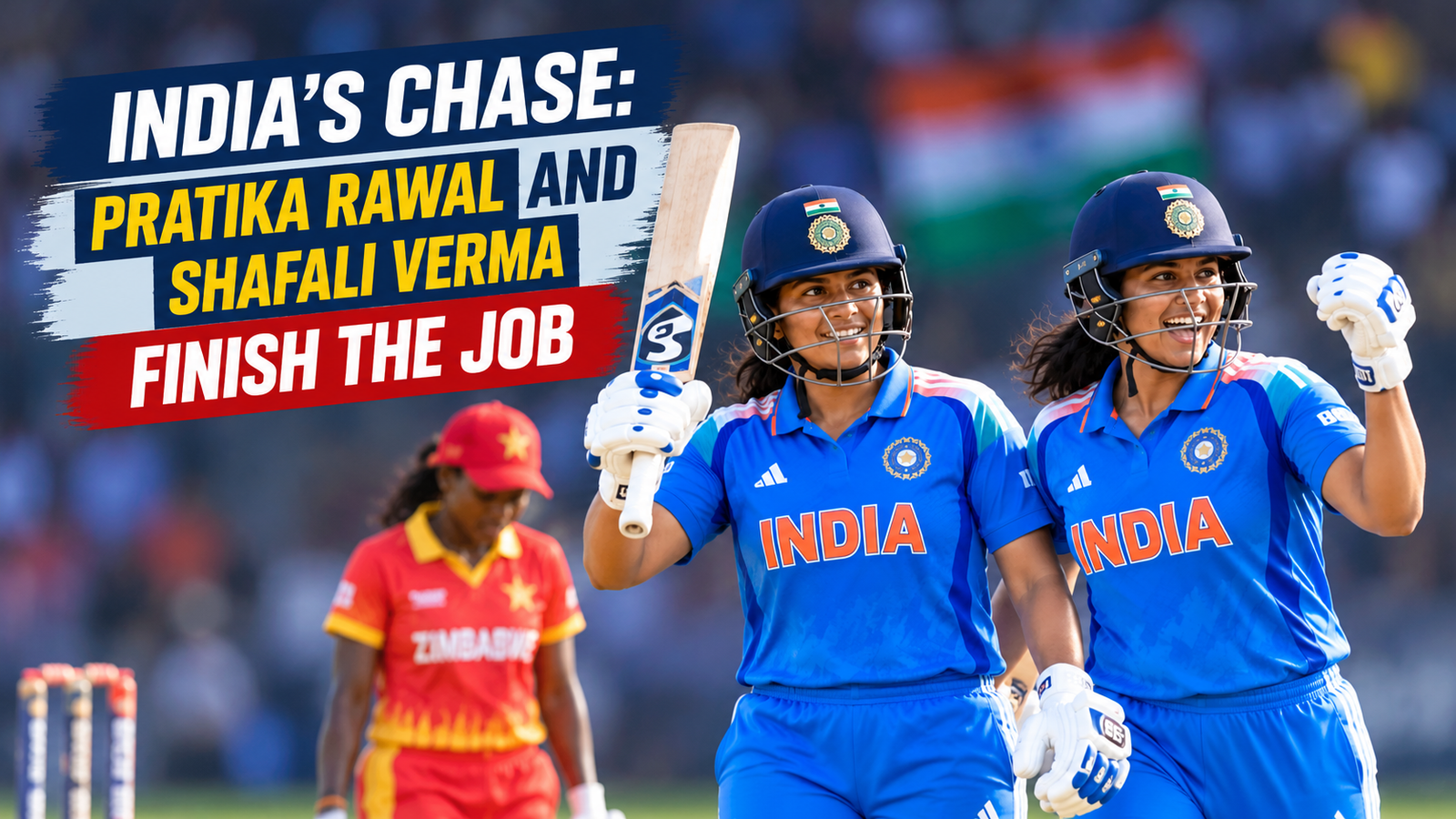
Shafali Verma supplied the acceleration. She scored 51 not out from 26 balls, with four fours and three sixes, reaching her half-century in only 26 deliveries. Her aggressive approach reduced the number of overs India needed and left Zimbabwe with little time to recover. Rawal and Verma’s contributions turned a modest chase into a decisive statement.
India Women Chase Scorecard
| Batter | Runs | Balls | 4s | 6s | Status |
|---|---|---|---|---|---|
| Yastika Bhatia | 0 | 1 | 0 | 0 | Out |
| Pratika Rawal | 59* | 56 | 4 | 3 | Not out |
| Shafali Verma | 51* | 26 | 4 | 3 | Not out |
| Harleen Deol | 14 | 13 | — | — | Out |
| Total | 133/2 | 17 overs | |||
The published scorecard records India at 133 for 2 in 17 overs. The match was won by eight wickets, with 198 deliveries left in the 50-over format. India’s run rate was approximately 7.82 per over, compared with Zimbabwe’s 3.29. That gap captures how decisively the home side controlled the match.
Graph: The Difference in Scoring Rates
This simple comparison shows the innings run rates calculated from the final totals and overs. India scored more than twice as quickly as Zimbabwe.
What the Match Stats Tell Us
| Statistic | Zimbabwe Women | India Women |
|---|---|---|
| Final score | 131 all out | 133/2 |
| Overs faced | 39.5 | 17.0 |
| Run rate | 3.29 | 7.82 |
| Wickets lost | 10 | 2 |
| Top individual score | Modester Mupachikwa, 37 | Pratika Rawal, 59* |
| Key bowling figure | — | Vaishnavi Sharma, 5/39 |
Three factors explain the result. First, India took wickets early and kept Zimbabwe’s scoring rate low. Second, Vaishnavi’s five-wicket haul stopped the middle order from building a match-changing partnership. Third, Rawal and Verma scored at pace in the chase, making the target too small to defend.
India Complete a 3–0 ODI Series Sweep
The third ODI completed India’s 3–0 sweep. India had already won the second ODI by 121 runs after posting 328 for 6, powered by Harmanpreet Kaur’s 126. The final match offered a different route to victory: the bowlers restricted Zimbabwe to 131, and the batters completed the chase with ease.
Winning by large margins in different ways is useful for a team. The second ODI showed India’s ability to post a big total and defend it. The third showed the value of early wickets, disciplined spin bowling and a fast chase. For Zimbabwe, the series provided a demanding test against a deep Indian lineup, and the team will need stronger starts and longer partnerships to challenge higher-ranked opponents.
Why Vaishnavi Sharma’s Fifer Matters
Vaishnavi’s five-for is the central story because it combined a personal milestone with a match-winning contribution. Her 10-over spell cost 39 runs, and she claimed five wickets without losing control of the scoring rate. For a young spinner, performances like this can build confidence and strengthen a case for further opportunities at international level.
One performance alone does not define a career, and it is too early to draw sweeping conclusions from a single match. However, the third ODI showed that Vaishnavi could sustain pressure over a full spell and take wickets at key moments. The challenge now is consistency: repeating the basics, adapting to different pitches and maintaining accuracy against batters who prepare specifically for her bowling.
It is also worth separating the headline figures from the tactical story. A five-wicket haul is memorable, but the pressure was created over many overs: Zimbabwe lost three wickets inside the first 10 overs, then struggled to accelerate against disciplined bowling. When the innings reached its closing stages, India still had enough control to attack for wickets rather than protect a large total.
The chase was equally instructive. Rawal’s unbeaten innings gave India a reliable base, while Verma’s strike rate meant the required rate never became a concern. This balance between a batter who can manage the innings and a partner who can attack is valuable in ODI cricket, even when the target is small.
For official tournament context and match listings, readers can also check the Use official scorecards when checking player figures, because summaries may omit extras or individual dismissal details.
Key Takeaways from IND vs ZIM Women 3rd ODI 2026
- Vaishnavi Sharma took 5/39: her maiden international five-wicket haul was the defining bowling performance.
- Zimbabwe were bowled out for 131: early wickets and a slow scoring rate kept the total modest.
- Pratika Rawal scored 59 not out: she anchored the chase and ensured India did not lose control after an early wicket.
- Shafali Verma made 51 not out from 26 balls: her quick half-century ended the contest rapidly.
- India won by eight wickets: the result sealed a 3–0 ODI series sweep.
Full Scorecard and Further Reading
For the complete ball-by-ball details, dismissals, bowling figures and fall-of-wicket information, read the Readers can also consult the ICC match centre for official series coverage and related match information.
Conclusion
India Women’s third ODI victory over Zimbabwe was built on a superb bowling effort and a confident chase. Vaishnavi Sharma’s 5 for 39 broke the visitors’ innings and gave her a landmark international performance. Zimbabwe’s 131 was never likely to be enough once Rawal and Verma began scoring freely. India finished on 133 for 2 in 17 overs, won by eight wickets and completed a 3–0 series sweep. The match will be remembered for Vaishnavi’s maiden five-for, but it was India’s collective performance that made the result so one-sided.